On 6 December I appeared on RTTV’s CrossTalk discussion programme alongside whistleblowing UK ex-diplomat Carne Ross, to talk about the implications of Wikileaks:
On 6 December I appeared on RTTV’s CrossTalk discussion programme alongside whistleblowing UK ex-diplomat Carne Ross, to talk about the implications of Wikileaks:
Finally the true intentions behind the draconian British law, the Official Secrets Act, and similar espionage-related laws in other countries such as the USA, have been laid bare. All is revealed — these laws apparently have nothing whatsoever to do with protecting national security and countering espionage — their primary purpose is to stifle dissent and legitimate criticism of the state.
How can I tell? Well, look at the reaction to the ongoing Wikileaks revelations, as opposed to today’s UK spy scandal involving the parliamentary assistant of a hitherto unremarkable MP.
 The now-notorious Wikileaks site has been going since 2007 and, in this brief time, has shone a bright light on such nasties as Trafigura, the BNP, Scientology, Climategate, Guantanamo, the Australian internet blacklist, Sarah Palin, and much more.
The site achieved world-wide notoriety this year with four big stories — starting with the harrowing film “Collateral Murder”, which demonstrated clearly that the Pentagon had been lying to the distraught families of the victims of this video-game nasty for years.
Since then Wikileaks has cleverly worked with selected media oulets such as The Guardian, The New York Times and Der Spiegel in Germany to give us the Afghan War logs and Iraq war files, which exposed endemic brutality, torture and war crimes (all in the name of spreading democracy, of course), and culminating over the last week with the ongoing Cablegate expose.
The response? Well the majority of the old media, particularly those that didn’t share in the juicy scoops, has been in attack mode: condemning whistleblowing; vilifying the character of Wikileaks spokesperson, Julian Assange; and gleefully reporting the widespread cyberspace crackdown (Amazon pulling the site, Paypal stopping contributions, the ongoing hack attacks).
But this is just so much hot air — what about the real substance of the disclosures? The violent horror, war crimes, and government lies? Why is our so-called Fourth Estate not demanding a response to all this terrible evidence?
 However, it is the reaction of the US political class that is most gob-smackingly shocking. The half-wits call for Assange’s prosecution under the US Espionage Act (even though he’s an Australian); to have him executed, assassinated by drone attack, or unlawfully disappeared as an “unlawful combatant”; and make hysterical calls for Wikileaks to be placed on the US list of proscribed foreign terrorist organisations. Daniel Ellsberg, the famous Pentagon Papers whistleblower, fears for Assange’s life.
Well, you can always tell how effective a whistleblower is by the response you engender when telling truth to power, and this is a pretty striking vindication.
Of course, Julian Assange is not strictly speaking a whistleblower per se. He is the next generation — a highly-capable, high-tech conduit, using his “hackivist” skills to out-pace and out-smart those who seek to conceal vital information.
As he said during a TED.com interview last summer, he strives to live by the ideal that to be a man is to be “capable and generous, not to create victims, but to nurture them…”. And this is indeed the protection Wikileaks offers, an avenue of secure disclosure for people of conscience on the inside, without their having to go public to establish the bona fides of what they are saying, with the resulting victimisation, loss of career, liberty, and possibly life.
Still, politicians seem unable to make the distinction — they are solely focused on loss of face, embarrassment, and shoring up the wall of secrecy that allows them to get away with lies, torture and war crimes. I hope that common sense will prevail and Assange will not become another sacrificial victim on the altar of “national security”.
 So why did I say at the start that the secrecy laws have come out of the closet? Well, in the wake of all this recent media and political hysteria about Wikileaks, this little espionage gem appeared in the UK media today. Essentially, the UK Home Secretary is booting out an alleged Russian spy, Ms Katia Zatuliveter who, despite getting through security vetting (MI5, anyone?), was really an SVR agent working as the Parliamentary assistant to Mike Hancock MP — a man who happens to have a special interest in Russia and who serves on the UK’s Parliamentary Defence Select Committee.
Now, in the old days such alleged activity would mean an automatic arrest and probable prosecution for espionage under the Official Secrets Acts (1911 and 1989). If we go with what the old media has reported, this would seem to be a clear-cut case. During the Cold War foreign spies working under diplomatic cover could be discreetly PNGed (the jargon for declaring a diplomat persona non grata). However, this young woman was working in Parliament, therefore can have no such diplomatic cover. But deportation and the avoidance of embarrassment seems to be the order of the day — as we saw also with the explusion of the Russian spy ring from the US last summer).
Which demonstrates with a startling clarity the real intentions behind the British OSA and the American Espionage Act. The full force of these laws will automatically be brought to bear against those exposing crime in high and secret places, pour enourager les autres, but will rarely be used against real spies.
Proof positive, I would suggest, that these laws were drafted to prevent criticism, dissent and whistleblowing, as I’ve written before, but not meaningfully to protect our national security. One can but hope that the Wikileaks débâcle acts as the long-overdue final nail in the OSA coffin.
Would it not be wonderful if our “esteemed” legislators could learn from recent events, draw a collective deep breath, and finally get to grips with those who pose a real threat to our nations — the people who lie to take us into illegal wars, and intelligence officers involved in torture, assassination and espionage?
For the first time in 100 years “C”, the head of the UK foreign intelligence service SIS (commonly known as MI6) has gone public.
Former career diplomat Sir John Sawers (he of Speedo fame) yesterday made a speech to the UK Society of Editors in what appeared to be a professionally diplomatic rear-guard action in response to a number of hot media topics at the moment.
Choosing both his audience wisely and his words carefully, he hit on three key areas:
Torture: Legal cases are currently going through UK courts on behalf of British victims of torture, in which MI5 and MI6 intelligence officers are alleged to have been complicit. The Metropolitan Police are currently investigating a number of cases. Over the last week, a British military training manual on “enhanced” interrogation techniques has also been made public. However, Sawers unblushingly states that MI6 abides by UK and international law and would never get involved, even tangentially, in torture cases. In fact, he goes on to assert that the UK intelligence agencies are training the rest of the world in human rights in this regard.
Whistleblowing: In the week following the latest Wikileaks coup — the Iraq War Diaries, comprising nearly 400,000 documents detailing the everyday horror of life in occupied Iraq, including war crimes such as murder, rape and torture committed by both US and UK forces — Sawers states that secrecy is not a dirty word: the intelligence agencies need to have the confidence that whistleblowers will not emerge to in order to guard agent and staff identities, as well as maintaining the confidence of their international intelligence partners that their (dirty?) secrets will remain, um, secret. One presumes he is advocating against the exposure of war crimes and justice for the victims.
This, one also presumes, is the justification for US politicians who propose cyber-attacks against Wikileaks and the declaration by some US political insiders that Julian Assange, spokesman of the organisation, should be treated as an unlawfully designated “unlawful combatant”, subject to the full rigour of extra-judicial US power, up to and including assassination.
Spurious media claims of unverified “damage” are the hoary old chestnuts always dragged out in whistleblower cases. After Wikileaks released its Afghan War Blog in July, government and intelligence commentators made apocalyptic predictions that the leak had put military and agent lives at risk. US Defense Secretary Robert Gates has since gone on the record to admit that this was simply not true.
During the Shayler whistleblowing case a decade ago, the government repeatedly tried to assert that agent lives had been put at risk, and yet the formal judgement at the end of his trial stated that this was absolutely not the case. And again, with the recent Wikileaks Iraq War Blog, government sources are using the same old mantra. When will they realise that they can only cry wolf so many times and get away with it? And when will the journalists regurgitating this spin wake up to the fact they are being played?
Accountability: Sawers goes on to describe the mechanisms of accountability, such as they are. He accurately states, as I have previously described ad nauseam, that under the 1994 Intelligence Services Act, he is notionally responsible to his political “master”, the Foreign Secretary, who has to clear in advance any legally dubious foreign operations (up to and including murder – the fabled “licence to kill” is not fiction, as you can see here).
The 1994 ISA also established the Prime Minister’s Intelligence and Security Committee (ISC) in Parliament, which many commentators seem to believe offers meaningful oversight of the spies. However, as I have detailed before, this is a mere fig leaf to real accountability: the ISC can only investigate issues of policy, finance and administration of the spy agencies. Disclosures relating to crime, operational incompetence or involvement in torture fall outside its remit.
But what happens if intelligence officers decide to operate beyond this framework? How would ministers or the ISC ever know? Other spy masters have successfully lied to their political masters in the past, after all.
Sir John has the gall to say that, if an operation is not cleared by the Foreign Secretary, it does not proceed. But what about the Gadaffi Plot way back in 1996, when MI6 was sponsoring a group of Islamic extremist terrorists in Libya to try to assassinate Colonel Gadaffi without, it has been asserted, the prior written approval of the then-Foreign secretary, Tory politician Malcom Rifkind? This was reported extensively, including in this article by Mark Thomas in the New Statesman. What happens if rogue MI6 officers blithely side-step this notional accountability — because they can, because they know they will get away with it — because they have in the past?
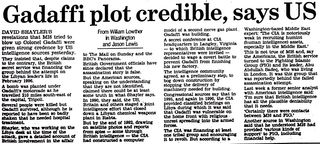 In the interests of justice, UK and international law, and accountability, perhaps a new Conservative/Coalition government should now reassess its approach to intelligence whistleblowers generally, and re-examine this specific disclosure about Libya, which has been backed up by international intelligence sources, both US and French, in order to achieve some sort of closure for the innocent victims in Libya of this MI6-funded terrorist attack? And it is finally time to hold the perpetrators to account — PT16, Richard Bartlett, and PT16B, David Watson, who were the senior officers in MI6 responsible for the murder plot.
As civilised countries, we need to rethink our approach to the issue of whistleblowing. Lies, spin, prosecutions and thuggish threats of assassination are beneath us as societies that notionally adhere to the principles of democracy. If we can only realistically hope that the actions of our governments, military forces, and intelligence agencies are transparent and accountable via whistleblowers, then we need to ensure that these people are legally protected and that their voices are heard clearly.
Here’s an interview I did for Russia Today TV on 8th July 2010 about the US/Russian spy swap:
Last year I had the honour to meet Julian Assange, the founder of the brilliant whistleblower website, WikiLeaks, that has been causing such a stir recently with the release of the decrypted US military film, “Collateral Murder”, and recently with the Afghan War Logs.
I have nothing but respect for WikiLeaks — it shines a torch into the dark corners of corrupt government and big business, and is the way forward in holding these organisations, which largely believe themselves to be above the law, at least somewhat to account.
Julian was kind enough to invite me to take part in a panel discussion with him at the Hacking at Random festival in the Netherlands last year. The discussion focused on whistleblowing and government accountability. Here’s the video:
And here’s an interview I did yesterday for Russia Today TV about the the spy story:
I’ve been following with interest the retro, Cold War spy saga currently unfolding in the USA. The headlines being that 10 alleged Russian sleepers (“illegals” in spy lingo) have been arrested by the FBI and are now charged with “working as agents of a foreign power”, which carries a sentence of five years in prison.
These Russian “illegals”, some of whom reportedly have been living openly as Russian immigrants, some as other foreign nationals, have allegedly been infiltrating the US since the mid-1990s, and were tasked to get friendly with American power-brokers, to glean what information they could about the thoughts of the US great and the good about Russia, Iran, defence plans etc.
Whatever the truth of this case, and the charges are detailed, I find the timing and media attention given to this story interesting for three key reasons:
From what has been reported of the court papers, the FBI investigation has been going on for years. Apparently they have known about the spy ring since 2000, and have included communications intercept material in the indictment dating from 2004 and 2008, as well as sting operations from the beginning of this year. So it’s curious that the FBI decided to swoop now, in the immediate aftermath of a successful and, by all accounts friendly, meeting between the Russian and American presidents in Washington DC.
Many people are commenting on this aspect of the timing. And, indeed, one might speculate about wheels within wheels — it appears that there are still hardline factions within the US administration that want to ensure that a warmer working relationship cannot develop between Russia and the USA. A strategy of tension is good for business – especially companies like Halliburton and Xe (formerly Blackwater) which profit from building vast US military bases in Central Asia.
But what also intrigues me is the possible behind-the-scenes action.
 This story is getting blanket media coverage. It’s a good, old-fashioned, Cold War-style coup, hitting all the jingoistic spy buttons, just at a time when the US spooks are under pressure about their performance in the nebulous and ever-shifting “war on terror”, the shredding of constitutional rights, the illegal surveillance of domestic political activists, and complicity in extraordinary rendition and torture. It’s a useful “reminder” that the bloated US security infrastructure is worth all the money it costs, despite the dire state of US national finances. Pure propaganda.
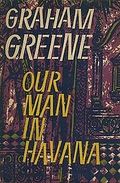
I’m also willing to bet that there is a more covert aspect to this story too — some behind-the-scenes power play. There are, at the last count, 17 acknowledged intelligence agencies in the US, all competing for prestige, power and resources. By making these arrests, the FBI will see this as a step up in the spy pecking order. It reminds me inevitably (and perhaps flippantly) of the classic spy novel by former intelligence officer Graham Greene, “Our Man in Havana”. In this no doubt entirely fictional work, a British MI6 asset invents a spy ring to increase his standing and funding from London HQ.
Also curious is the role played by one Christopher Metsos, allegedly the 11th man, not initially arrested, who is reported to have passed money to the spy ring. He was caught yesterday in Cyprus trying to board a plane to Hungary, and inexplicably granted bail — inexplicable at least to the Greek police, who always worry that their suspect will flee over the border into the Turkish segment of the island, never to be seen again. And this has indeed happened, according to The Guardian newspaper this evening. Perhaps he has some urgent appointments to sell vacuum cleaners north of the border.….
An interesting example of press manipulation appeared today in the UK media. Britain is in the throes of a general election and many pundits are saying that the result is too close to call — the feeling being that the UK’s third party, the Liberal Democrats, may hold the balance of power in a hung parliament. The Daily Mail, one of the most rabidly right-wing of the national newspapers, chose today to print a story about the arrest and subsequent rescue of two UK soldiers in Iraq in 2005.
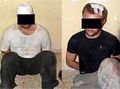 The general thrust of the piece was that the Labour government was willing to sacrifice our soldiers by refusing to authorise their rescue, in order to avoid political embarrassment. This story appears to be a fairly obvious attempt by The Daily Wail to encourage military personnel and their families to vote against the incumbent government, which was willing to sacrifice our boys’ lives for political expediency.
However,I would suggest that there is another level to this story. Many remember when the news first broke: how two SAS soldiers, working under cover and disguised as Arabs, failed to stop their car at a checkpoint and engaged in a shoot-out that killed one Iraqi and injured three more. The SAS operatives were arrested and taken to a police station where the authorities discovered that their car contained weapons and explosives. The SAS launched a rescue, ploughing into the police station with tanks, and then tracking their targets to a local militia house nearby, fighting their way in and saving their comrades. All heroic stuff. However, the obvious follow-up questions are:
1) What the hell were these two soldiers doing in disguise, and with a car-load of weaponry?
2) Precisely why was the government so embarrassed about the potential political fall-out?
I think these two questions are inter-dependent. Dirty tricks and collusion are a standard methodology for the SAS and the intelligence community — a well-documented tactic they used in the war in Northern Ireland over three decades. So just what was the intended destination of the weaponry? Would they have been used for an attack subsequently blamed on “insurgents” or “Al Qaeda”?
As for the potential political embarrassment, the Daily Mail’s excuse — that the British government didn’t want to undermine the perceived sovereignty of the Iraqis at that time — is just too feeble to stand up. The issue of political embarrassment makes far more sense if seen in terms of UK government awareness of the use by the British military of dirty tricks, collusion or false flag terrorism in Iraq.
Of course, this is a perfectly standard tactic used by many countries’ military and intelligence infrastructures. It would be naïve to think it does not happen, but it is a retrograde, risky and counter-productive tactic.
In the 21st century it is more naïve to think that such activity is either effective or acceptable in a world where the spread of democracy and the application of international law and human rights are the way forward.
 The US government has apparently been getting its knickers in a twist about the excellent Wikileaks website. A report written in 2008 by US army counter-intelligence analysing the threat posed by this haven for whistleblowers has been leaked to, you’ve guessed it, the very subject of the report.
Wikileaks was set up three years ago to provide a secure space for principled whistleblowers around the world to expose corruption and crimes committed by our governments, intelligence agencies and mega-corporations. The site takes great care to verify the information it publishes, adheres to the principle of exposing information very much in the public interest, and vigorously protects the identify of its sources.
By doing so, Wikileaks plays a vital part in informing citizens of what is being done (often illegally) in their name. This free flow of information is vital in a democracy.
Well, no government likes a clued-up and critical citizenry, nor does it like to have transparency and accountability imposed on it. Which led to the report in question.
As I have written before ad nauseam, whistleblowers provide an essential function to the healthy working of a democracy. The simplistic approach would be to say that if governments, spies and big corporations obeyed the law, there would be no need for whistleblowers. However, back in the real, post‑9/11 world, with its endless, nebulous “war on terror”, illegal wars, torture, extraordinary rendition and Big Brother surveillance, we have never had greater need of them.
Rather than ensuring the highest standards of legality and probity in public life, it is far simpler for the powers that be to demonise the whistleblower — a figure who is now (according to the Executive Summary of the report) apparently seen as the “insider threat”. We are looking at a nascent McCarthyism here. It echoes the increasing use by our governments of the term “domestic extremists” when they are talking about activists and protesters.
There are laws to protect whistleblowers in most areas of work now. In the UK we have the Public Interest Disclosure Act (1998). However, government, military, and especially intelligence professionals are denied this protection, despite the fact that they are most often the very people to witness the most heinous state abuses, crimes and corruption. If they try to do something about this, they are also the people most likely to be prosecuted and persecuted for following their consciences, as I described in a talk at the CCC in Berlin a couple of years ago.
Ideally, such whistleblowers need a protected legal channel through which to report crimes, with the confidence that these will be properly investigated and the perpetrators held to account. Failing that, sites like Wikileaks offer an invaluable resource. As I said last summer at the Hacking at Random festival in NL, when I had the pleasure of sharing a stage with Wikileaks founder Julian Assange, I just wish that the organisation had existed a decade earlier to help with my own whistleblowing exploits.
The Official Secrets Act (1989) in the UK, is drafted to stifle whistleblowers rather than protect real secrets. Such laws are routinely used to cover up the mistakes, embarrassment and crimes of spies and governments, rather than to protect national security. After all, even the spooks acknowledge that there are only three categories of intelligence that absolutely require protection: sensitive operational techniques, agent identities and ongoing operations.
This US counter-intelligence report is already 2 years old, and its strategy for discrediting Wikileaks (by exposing one of their sources pour encourager les autres) has, to date, manifestly failed. Credit is due to the Wikileaks team in out-thinking and technologically outpacing the intelligence community, and is a ringing endorsement for the whole open source philosophy.
I’ve said this before, and I shall say it again: as our countries evolve ever more into surveillance societies, with big brother databases, CCTV, biometric data, police drones, voting computers et al, geeks may be our best (and last?) defence against emerging Big Brother states.
The Xmas Day “Al Qaeda” terror attack on a transatlantic flight bound for Detroit is an interesting one. Awful for those on the flight, of course, and my heart goes out to them for the fear they must have experienced.
But which are the governments most staunch in their prosecution of the war on terror? Let’s call them the “Axis of Good”.….
The USA, the UK, and the Netherlands.
So it must be just nuts to them that the immediately identifiable Al Qaeda terrorist is reported to be a Nigerian-born UK engineering student who is flying via Schiphol airport in NL to the USA. Even better, he acquired his “bomb” in Yemen — interestingly, a country that is under increasing assault by the US military at the moment.
This ticks a number of useful national security boxes, reminding us what a threat our nations face.
The alleged terrorist is reported to have been on the watch list of the US security apparatus, but not on the “no fly” list — which is unverifiable anyway, but reportedly contains the names of over a million people. So yet another break-down in this unwieldy security system.
 We already have a situation where all citizens of the US, UK and NL are effectively treated like criminals every time they take a plane, as well as everyone else attempting to fly into these countries. However, this incident has demonstrated that the security around flying is not just a slow irritant — a “Big Brother Lite” with its stupid restrictions around liquids, maquillage, shoes, belts and laptops — it has been dramatically shown not to work.
Identifying potential terrorists is like looking for a needle in a haystack. This has become an establishment cliché these days: the terrorists have to be lucky only once, and the security services have to be constantly lucky to stop an attack. The odds are acknowledged to be impossible.
What used to be agreed within British and other European spook circles is the view that the best intelligence comes from tricky-to-run human sources. They may have their flaws, but they can occasionally provide precise and lifesaving intelligence. The US approach has long been diametrically opposed to this approach — instead they sit back and hoover up every scrap of information via data mining and hope to sieve something out of it. They then tend to respond with whizz-bang, hands-off gadgetry, much like a deadly video game.
So, that said, let’s make two guesses how this new attack will be interpreted and used by our governments and security forces:
1) They admit that they need to reassess their approach to the “war on terror”.
2) Focus on ever more draconian data mining measures at the point of travel — whether they work or not, whether they slide us ever nearer a police-state or not — until we are effectively prisoners in our own countries.
A difficult prediction for 2010.
The final annoyance will, at least from a personal perspective, be that they now ban the carrying of powders as well as liquids on board a flight. If they stop me travelling with my Max Factor, that’s it. Trains only in the future.
Happy New Year!
I strongly recommend you take the time to watch this film about FBI whistleblower, Sibel Edmonds.
“Kill the Messenger” joins some interesting dots, not just about what might have been going on round Sibel’s case, but also adds a different perspective to the notorious outing of CIA officer, Valerie Plame.
Of course, a film that investigates how the might of the state can be used to stifle the legitimate dissent of a whistleblower will always resonate with me.
Same message, different country.
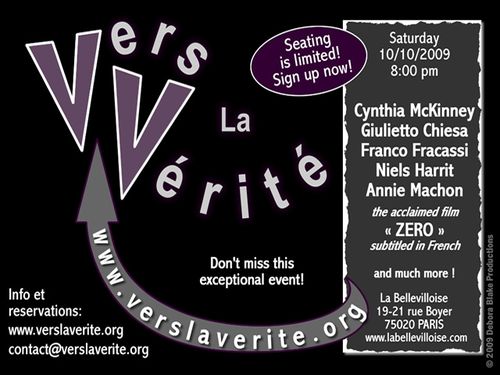
Here’s my latest effort. It should be an amazing weekend in Paris, with Congresswoman Cynthia McKinney, the 2008 US Green Party presidential candidate, headlining our “Vers la Verite” event on the Saturday night. Have a look at the website for the full line-up.
 I’ve been following the extraordinary case of Gary McKinnon for years now in a long range kind of way, but we are now in the final throes of his prolonged fight against extradition to the USA, and he needs all the support we can give him. The Daily Mail recently started a campaign against his extradition: it’s not often I agree with the Wail, but I’m wholeheartedly in favour of this initiative.
For those of you who have been living in a bunker for the last 7 years, Gary McKinnon is the self-confessed geek who went looking for evidence of UFOs and ETs on some of America’s most secret computer systems at the Pentagon and NASA.
And, when I say secret, obviously I don’t mean in the sense of encrypted or protected. The Yanks obviously didn’t feel that their national defence warrants even cursory protection, as Gary didn’t have to hack his way in past multiple layers of protection. Apparently the systems didn’t even have passwords.
Gary, who suffers from Asperger’s Syndrome, is no super hacker. Using a basic PC and a dial-up connection in his bedroom, he managed to sneak a peek at the Pentagon computers, before kindly leaving a message that the US military might like to have a think about a little bit of basic internet security. Hardly the work of a malignant, international cyber-terrorist.
UK police investigated Gary soon after this episode, way back in 2002. All he faced, under the UK’s 1990 Computer Misuse Act, would have been a bit of community service if he’d been convicted. Even that was moot, as the Crown Prosecution Service decided not to prosecute.
And that, as they say, should have been that.
However, in 2003 the UK government passed yet another draconian piece of law in response to the “war on terror” — the Extradition Act. Under this invidious, one-sided law, the US authorities can demand the extradition to America of any British citizen, without presenting any evidence of the crime for which they are wanted. Needless to say, this arrangement only works one way: if the Brits want to extradite a suspect from the US they still have to present prima facie evidence of a crime to an American court. The Act also enshrines the questionable European arrest warrant system in British law.
So how on earth did the half-wits in Parliament come to pass such an awful law? Were they too busy totting up their expense fiddles to notice that they were signing away British sovereignty? This law means that it is easier for a US court to get a Brit in the dock than it is for them to get a US citizen from another state. In the latter case, evidence is still also required.
Let’s get this straight. The UK authorities decided not to prosecute in this country. Even if they had, Gary would probably have been sentenced to community service. However, if he is extradited, he will get up to 70 years in a maximum security prison in the US.
So a year after Gary’s bedroom hack, and after the CPS had decided there was no case to answer, the US authorities demanded Gary’s extradition retroactively. The UK government, rather than protecting a British citizen, basically said “Yes, have him!”. Gary has been fighting the case ever since.
 He has not been alone. Many people from across the political spectrum see this unilateral law as invidious. And the government reckoned without his mum. Janis Sharp has fought valiantly and indefatigably to protect her son from this unjust extradition. She has lobbied MPs, talked to newspapers, gained the support of many public and celebrity figures. She even recently met the PM’s wife, Sarah Brown, who was reportedly in tears for Gary. Yet still the majority of the parliamentary half-wits refuse to do anything.
In fact, it gets worse. Over the last few years many MPs have signed Early Day Motions supporting Gary’s fight against extradition. But in a recent debate in the House of Commons about the need to revise the provisions of the Extradition Act, 74 of these MPs betrayed him and voted for the government to keep the Act in place. Only 10 Labour MPs stuck to their guns and defied the party Whip. One Labour MP, Andrew MacKinley, will stand down at the next election in protest at this hypocrisy.
This week is crunch time: on Friday a final judicial ruling will be made about the case. It was the last throw of the legal dice for Gary. If this fails, he will have to rely on political intervention, which is possible, to prevent his harmful, unjust and unnecessary extradition to the USA. Please visit the Free Gary website and do all you can in support.
 So Colonel Gaddafi of Libya has been dishing out the diplomatic gifts generously to the former US administration. Listed in the public declaration are even such items as a diamond ring presented to former Secretary of State, Condaleeza Rice, and other gifts to the value of $212,000.
This seems a slightly uneven distribution of largesse from the Middle East to the West. Before 9/11 and the ensuing war on terror, Gaddafi was still seen by the west as the head of a “rogue state”. Bombs, rather than gifts, were more likely to rain down on him.
However, since 2001 he has come back into the fold and is as keen as the coalition of the “willing” to counter the threat from Islamic extremist terrorists. So now he’s the new bestest friend of the US and UK governments in this unending fight.
But that was kind of inevitable, wasn’t it? As a secular Middle Eastern dictator, Gaddafi has traditionally had more to fear from Islamists than has the West. Particularly when these same Islamist groups have received ongoing support from those very governments that are now cosying up to Gaddafi.
Just to remind you, the reason I helped David Shayler in his whistleblowing on the crimes of MI5 and MI6 was because of just such a plot- the attempted assassination of Gaddafi in 1996 that was funded by the UK external intelligence gathering agency, MI6. In 1995 Shayler, then the head of the Libyan section in MI5, was officially briefed by his counterpart in MI6, David Watson (otherwise known as PT16/B), about an unfolding plot to kill Gaddafi. A Libyan military intelligence officer, subsequently code-named Tunworth, walked in to the British embassy in Tunis and asked to speak to the resident spook.
Tunworth said he was the head of a “ragtag group of Islamic extremists” (who subsequently turned out to have links to Al Qaeda — at a time when MI5 had begun to investigate the group), who wanted to effect a coup against Colonel Gaddafi. They needed funding to do this, and that was where MI6 came in. As a quid pro quo, Tunworth promised to hand over the two Lockerbie supsects for trial in Europe , which had for years been one of MI6’s priority targets — not to mention all those juicy oil contracts for BP et al.
Over the course of about 5 months, MI6 paid Tunworth’s group over $100,000, thereby becoming conspirators in a murder plot. Crucially, MI6 did not get the prior written permission of their political master, the Foreign Secretary, making this action illegal under the terms of the 1994 Intelligence Services Act.
Manifestly, this coup attempt did not work — Gaddafi is now a strong ally of our western governments. In fact, an explosion occurred beneath the wrong car in a cavalcade containing Gaddafi as he returned from the Libyan People’s Congress in Sirte. But innocent people died in the explosion and the ensuing security shoot-out.
So, MI6 funded an illegal, highly reckless plot in a volatile part of world that resulted in the deaths of innocent people. How more heinous a crime could there be? But to this day, despite a leaked MI6 document that proved they knew the existence of the proposed plot, and despite other intelligence sources backing up Shayler’s disclosures, the UK government has still refused to hold an enquiry. Quite the opposite — they threw the whistleblower in prison twice and tried to prosecute the investigating journalists.
Some people may call me naïve for thinking that the intelligence agencies should not get involved in operations like this. Putting aside the retort that the spies often conflate the idea of the national interest with their own, short-sighted careerism, I would like to remind such cynics that we are supposed to be living in modern democracies, where even the secret state is supposed to operate within the rule of law and democratic oversight. Illegal assassination plots, the use of torture, and false flag, state-sponsored terrorism should remain firmly within the retro, pulp-fiction world of James Bond.