Fascism 2012 — the ongoing merger of the corporate and the state

I’m gradu­ally com­ing to after a knock-out blow last Octo­ber — the unex­pec­ted death of my beloved and only broth­er, Rich.  Words can­not describe.

But look­ing for­ward to the delights that 2012 will no doubt offer: Juli­an Assange remains trapped in a leg­al spider­’s web, but all cred­it to Wikileaks — it keeps on provid­ing the goods. 

The recent pub­lic­a­tion of the Spy­Files should have been a massive wake-up call, as it it high­lighted the increas­ing use and abuse of mer­cen­ary spy tech — all without any effect­ive over­sight, as I recently wrote in my art­icle for the Bur­eau of Invest­ig­at­ive Journ­al­ism

Need­less to say, the issue of massive com­mer­cial sur­veil­lance cap­ab­il­it­ies usu­ally remains con­fined to a niche media mar­ket, although the Daily Mail did rouse itself to report that shop­pers were being tracked via mobile phones as they con­sumed their way around malls.  Well, I sup­pose it’s a start.

With the growth of mer­cen­ary spy com­pan­ies in our minds, we should be even more con­cerned about the accel­er­ated shred­ding of our civil liber­ties, par­tic­u­larly in the US and UK.  Des­pite earli­er prom­ises that he would veto any such legis­la­tion, Pres­id­ent Obama signed into law the invi­di­ous NDAA on 31st Decem­ber.  This means that the US mil­it­ary is now empowered to seize and indef­in­itely detain, with no recourse to tra­di­tion­al due pro­cess, not only poten­tially all non-Amer­ic­ans across the plan­et à la the Guantanamo/extraordinary rendi­tion mod­el, but can now also do this to US cit­izens with­in their own country.

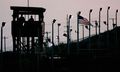
Guantanamo_BayDes­pite the pas­sion­ate inter­net debate, the issue has unsur­pris­ingly been largely ignored by most of the main­stream cor­por­ate media.  But the pre­dom­in­antly US-based inter­net com­ment­ary dis­plays a breath­tak­ing hypo­crisy: yes, the NDAA is a ter­rible law with awful implic­a­tions for Amer­ic­an cit­izens.  How­ever, people around the world have been liv­ing with just this fear for a dec­ade, with whole com­munit­ies afraid of being snatched and dis­ap­peared into black CIA tor­ture facil­it­ies.   Where was the US out­rage then?  The Pas­tor Mar­tin Niemoeller poem remains as rel­ev­ant today as when it was writ­ten 70 years ago.

That said a couple of brave voices have spoken out: Naomi Wolf recently described how the US legis­lat­ors could iron­ic­ally find them­selves on the receiv­ing end of this law, if we go by all his­tor­ic pre­ced­ents.  Paul Craig Roberts was on froth­ing good form too, inveigh­ing against the war crimes of the US mil­it­ary, the per­se­cu­tion of Wikileaks for expos­ing those very crimes, and the evolving total­it­ari­an­ism of our countries.

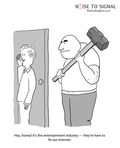
SOPAIn a digit­al mir­ror of the NDAA, the enter­tain­ment industry and their pet lob­by­ists are suc­cess­fully ram­ming through the invi­di­ous SOPA law.   As acclaimed digit­al rights act­iv­ist and author, Cory Doc­torow, described in his key­note at the recent CCC geek­fest in Ber­lin, these ostens­ibly com­mer­cial laws are in effect a stalk­ing horse for gov­ern­ments to seize con­trol of the inter­net.  As he wrote in the Guard­i­an “you can­’t make a sys­tem that pre­vents spy­ing by secret police and allows spy­ing by media giants”. 

With this in the back of our minds, the Wikileaks Spy­Files rev­el­a­tions about the increas­ing glob­al­isa­tion and com­mer­cial­isa­tion of cor­por­ate spy tech­no­logy are even more alarm­ing.  The gov­ern­ment spy agen­cies work with little effect­ive over­sight, but the mer­cen­ar­ies have a com­pletely free leg­al rein.  Intriguingly, it appears that unlike our own gov­ern­ments Afgh­anistan is alive to this prob­lem and is reportedly boot­ing out for­eign contractors. 

Yet the bal­ance of power in cer­tain west­ern coun­tries is slid­ing over­whelm­ingly towards police states —  or, indeed, fas­cism, if you take into con­sid­er­a­tion Benito Mus­solin­i’s defin­i­tion: “the mer­ger of state and cor­por­ate power”.

Our line of defence is slender — organ­isa­tions like Wikileaks, one or two politi­cians of con­science, a few remain­ing real invest­ig­at­ive journ­al­ists and per­haps the odd whis­tleblower.  Bey­ond that, we must indi­vidu­ally get to grips with the threat, get informed, teched up, and pro­tect ourselves, as we can no longer rely on our gov­ern­ments to uphold our basic rights — you know, pri­vacy, free­dom of expres­sion, habeas cor­pus, and all those oth­er delight­fully old-fash­ioned ideas.

If we do not act soon, we may no longer be able to act at all in the near future.…  So I wish every­one an informed, pro­duct­ive and act­ive 2012!


Global Investigative Journalism Conference, Kiev

Off to do a key­note at the Glob­al Invest­ig­at­ive Journ­al­ism Con­fer­ence in Kiev.   Should be inter­est­ing — watch this space.

GIJC_logo

Libyans caught between a rock and a hard place

This art­icle in today’s New York Times, par­tic­u­larly these fol­low­ing two para­graphs, sent a shiver down my spine for the fate of the Liby­an people:

Abdelhakim-Belhaj“The most power­ful mil­it­ary lead­er is now Abdel Hakim Bel­haj, the former lead­er of a hard-line group once believed to be aligned with Al Qaeda.The grow­ing influ­ence of Islam­ists in Libya raises hard ques­tions about the ulti­mate char­ac­ter of the gov­ern­ment and soci­ety that will rise in place of Col. Muam­mar el-Qaddafi’s autocracy.….

.…Mr. Bel­haj has become so much an insider lately that he is seek­ing to unseat Mah­moud Jib­ril, the Amer­ic­an-trained eco­nom­ist who is the nom­in­al prime min­is­ter of the inter­im gov­ern­ment, after Mr. Jib­ril obliquely cri­ti­cized the Islamists.”

The Liby­ans, finally free of Gad­dafi’s 42-year dic­tat­or­ship, now seem faced with a choice between an Islam­ist fac­tion that has stated pub­licly that it wants to base the new con­sti­tu­tion on Sharia — a state­ment that must have caused a few ripples amongst Liby­a’s edu­cated and rel­at­ively  eman­cip­ated women — or a new gov­ern­ment headed up by an Amer­ic­an-trained economist. 

Shock_DoctrineAnd we all know what hap­pens to coun­tries when such eco­nom­ists move in: asset strip­ping, the syphon­ing off of the nation­al wealth to transna­tion­al mega-corps, and a plunge in the people’s liv­ing stand­ards.  If you think this sounds extreme, then do get your hands on a copy of Naomi Klein’s excel­lent “Shock Doc­trine” — required read­ing for any­one who wants to truly under­stand the grow­ing glob­al fin­an­cial crisis.

Of course, this would be an ideal out­come for the US, UK and oth­er west­ern forces who inter­vened in Libya. 

Mr Bel­haj is, of course, anoth­er mat­ter.  Not only would an Islam­ist Libya be a poten­tially dan­ger­ous res­ult for the West, but should Bel­haj come to power he is likely to be some­what hos­tile to US and par­tic­u­larly Brit­ish interests. 

Why?  Well, Abdul Hakim Bel­haj has form.  He was a lead­ing light in the Liby­an Islam­ic Fight­ing Group, a ter­ror­ist organ­isa­tion which bought into the ideo­logy of “Al Qaeda” and which had made many attempts to depose or assas­sin­ate Gad­dafi, some­times with the fin­an­cial back­ing of the Brit­ish spies, most not­ably in the failed assas­sin­a­tion plot of 1996.

Of course, after 9/11 and Gad­dafi’s rap­proche­ment with the West, this col­lab­or­a­tion was all air-brushed out of his­tory — to such an extent that in 2004 MI6 was instru­ment­al in  kid­nap­ping Bel­haj, with the say-so of the CIA, and “extraordin­ar­ily ren­der­ing” him to Tripoli in 2004, where he suffered 6 years’ tor­ture at the hands of Liby­a’s bru­tal intel­li­gences ser­vices.  After this, I doubt if he would be minded to work too closely with UK companies.

So I’m will­ing to bet that there is more behind-the-scenes med­dling from our spooks, to ensure the ascend­ency of Jib­ril in the new gov­ern­ment.  Which will be great for West­ern busi­ness, but not so great for the poor Libyans.….

Spy documents found in Libya reveal more British double dealing

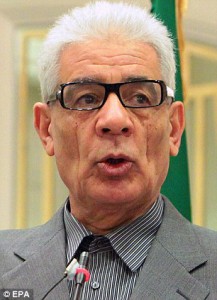
Musa_KousaA cache of highly clas­si­fied intel­li­gence doc­u­ments was recently dis­covered in the aban­doned offices of former Liby­an spy mas­ter, For­eign Min­is­ter and high-pro­file defect­or, Musa Kusa.

These doc­u­ments have over the last couple of weeks provided a fas­cin­at­ing insight into the grow­ing links in the last dec­ade between the former UK Labour gov­ern­ment, par­tic­u­larly Tony Blair, and the Gad­dafi régime.  They have dis­played in oily detail the degree of toady­ing that the Blair gov­ern­ment was pre­pared to coun­ten­ance, not only to secure luc­rat­ive busi­ness con­tracts but also to gloss over embar­rass­ing epis­odes such as Lock­er­bie and the false flag MI6-backed 1996 assas­sin­a­tion plot against Gaddafi.

These doc­u­ments have also appar­ently revealed dir­ect involve­ment by MI6 in the “extraordin­ary rendi­tion” to Tripoli and tor­ture of two Liby­ans.  Iron­ic­ally it has been repor­ted that they were wanted for being mem­bers of the Liby­an Islam­ic Fight­ing Group, the very organ­isa­tion that MI6 had backed in its failed 1996 coup.

The sec­u­lar dic­tat­or­ship of Col Gad­dafi always had much to fear from Islam­ist extrem­ism, so it is per­haps unsur­pris­ing that, after Blair’s notori­ous “deal in the desert” in 2004, the Gad­dafi régime used its con­nec­tions with MI6 and the CIA to hunt down its enemies.  And, as we have all been end­lessly told, the rules changed after 9/11…

The tor­ture  vic­tims, one of whom is now a mil­it­ary com­mand­er of the rebel Liby­an forces, are now con­sid­er­ing suing the Brit­ish gov­ern­ment.  Jack Straw, the For­eign Sec­ret­ary at the time, has tried to shuffle off any blame, stat­ing that he could not be expec­ted to know everything that MI6 does.

Well, er, no — part of the job descrip­tion of For­eign Sec­ret­ary is indeed to over­see the work of MI6 and hold it to demo­crat­ic account­ab­il­ity, espe­cially about such ser­i­ous policy issues as “extraordin­ary rendi­tion” and tor­ture.  Such oper­a­tions would indeed need the min­is­teri­al sign-off to be leg­al under the 1994 Intel­li­gence Ser­vices Act.

There has been just so much hot air from the cur­rent gov­ern­ment about how the Gib­son Tor­ture Inquiry will get to the bot­tom of these cases, but we all know how tooth­less such inquir­ies will be, cir­cum­scribed as they are by the terms of the Inquir­ies Act 2005.  We also know that Sir Peter Gib­son him­self has for years been “embed­ded” with­in the Brit­ish intel­li­gence com­munity and is hardly likely to hold the spies mean­ing­fully to account.

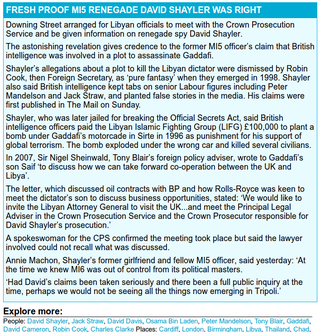
MoS_Shayler_11_09_2011So I was par­tic­u­larly intrigued to hear that the the cache of doc­u­ments showed the case of Dav­id Shayler, the intel­li­gence whis­tleblower who revealed the 1996 Gad­dafi assas­sin­a­tion plot and went to pris­on twice for doing so, first in France in 1998 and then in the UK in 2002, was still a sub­ject of dis­cus­sion between the Liby­an and UK gov­ern­ments in 2007. And, as I have writ­ten before, as late as 2009 it was obvi­ous that this case was still used by the Liby­ans for lever­age, cer­tainly when it came to the tit-for-tat nego­ti­ations around case of the murder in Lon­don out­side the Liby­an Embassy of WPC Yvonne Fletch­er in 1984.

Of course, way back in 1998, the Brit­ish gov­ern­ment was all too ready to crush the whis­tleblower rather than invest­ig­ate the dis­clos­ures and hold the spies to account for their illeg­al and reck­less acts.  I have always felt that this was a fail­ure of demo­cracy, that it ser­i­ously under­mined the future work and repu­ta­tion of the spies them­selves, and par­tic­u­larly that it was such a shame for the fate of the PBW (poor bloody whis­tleblower).

But it now appears that the Brit­ish intel­li­gence com­munity’s sense of omni­po­tence and of being above the law has come back to bite them.  How else explain their slide into a group-think men­tal­ity that par­ti­cip­ates in “extraordin­ary rendi­tion” and tor­ture?

One has to won­der if wily old Musa Kusa left this cache of doc­u­ments behind in his aban­doned offices as an “insur­ance policy”, just in case his defec­tion to the UK were not to be as com­fort­able as he had hoped — and we now know that he soon fled to Qatar after he had been ques­tioned about the Lock­er­bie case.

But wheth­er an hon­est mis­take or cun­ning power play, his actions have helped to shine a light into more dark corners of Brit­ish gov­ern­ment lies and double deal­ing vis a vis Libya.…

Spies and the Media — my recent talk at the Centre for Investigative Journalism

Here’s the film of my talk at the recent sum­mer school at the Centre for Invest­ig­at­ive Journ­al­ism in Lon­don a month ago:


Many thanks to Gav­in and the rest of the CIJ team for such a stim­u­lat­ing and thought-pro­vok­ing weekend!

UK spies get a B+ for intrusive surveillance in 2010

Black_sheep?The quan­go­crats charged with over­see­ing the leg­al­ity of the work of the UK spies have each pro­duced their undoubt­ably author­it­at­ive reports for 2010. 

Sir Paul Kennedy, the com­mis­sion­er respons­ible for over­see­ing the inter­cep­tion of com­mu­nic­a­tions, and Sir Peter Gib­son, the intel­li­gence ser­vices com­mis­sion­er, both pub­lished their reports last week. 

Gib­son has, of course, hon­our­ably now stood down from his 5‑year over­sight of MI5, MI6, and GCHQ in order to head up the inde­pend­ent enquiry into spy com­pli­city in torture. 

And both the reports say, nat­ur­ally, that it’s all hunky-dorey.  Yes, there were a few mis­takes (well, admis­trat­ive errors — 1061 over the last year), but the com­mis­sion­ers are con­fid­ent that these were neither malign in intent nor an indic­a­tion of insti­tu­tion­al failings. 

So it appears that the UK spies gained a B+ for their sur­veil­lance work last year.

Both com­mis­sion­ers pad out their reports with long-win­ded descrip­tions of what pre­cisely their role is, what powers they have, and the full, frank and open access they had to the intel­li­gence officers in the key agencies. 

They seem sub­limely unaware that when they vis­it the spy agen­cies, they are only giv­en access to the staff that the agen­cies are happy for them to meet — intel­li­gence officers pushed into the room, primped out in their party best and scrubbed behind the ears — to tell them what they want to hear. 

Any intel­li­gence officers who might have con­cerns have, in the past, been rig­or­ously banned from meet­ing those charged with hold­ing the spies to demo­crat­ic account.….

.…which is not much dif­fer­ent from the over­sight mod­el employed when gov­ern­ment min­is­ters, the notion­al polit­ic­al mas­ters of MI6, MI6 and GCHQ, sign off on bug­ging war­rants that allow the aggress­ive invest­ig­a­tion of tar­gets (ie their phones, their homes or cars, or fol­low them around).  Then the min­is­ters are only giv­en a sum­mary of a sum­mary of a sum­mary, an applic­a­tion that has been titrated through many mana­geri­al, leg­al and civil ser­vice fil­ters before land­ing on their desks. 

So, how on earth are these min­is­ters able to make a true eval­u­ation of the worth of such an applic­a­tion to bug someone? 

They just have to trust what the spies tell them — as do the commissioners. 

UK Intelligence and Security Committee to be reformed?

The Guard­i­an’s spook com­ment­at­or extraordin­aire, Richard Norton-Taylor, has repor­ted that the cur­rent chair of the Intel­li­gence and Secur­ity Com­mit­tee (ISC) in the UK Par­lia­ment, Sir Mal­colm Rif­kind, wants the com­mit­tee to finally grow a pair.  Well, those wer­en’t quite the words used in the Grauny, but they cer­tainly cap­ture the gist.

If Rif­kind’s stated inten­tions are real­ised, the new-look ISC might well provide real, mean­ing­ful and demo­crat­ic over­sight for the first time in the 100-year his­tory of  the three key UK spy agen­cies — MI5, MI6, and GCHQ, not to men­tion the defence intel­li­gence staff, the joint intel­li­gence com­mit­tee and the new Nation­al Secur­ity Council .

FigleafFor many long years I have been dis­cuss­ing the woe­ful lack of real demo­crat­ic over­sight for the UK spies.  The privately-con­vened ISC, the demo­crat­ic fig-leaf estab­lished under the aegis of the 1994 Intel­li­gence Ser­vices Act (ISA), is appoin­ted by and answer­able only to the Prime Min­is­ter, with a remit only to look at fin­ance, policy and admin­is­tra­tion, and without the power to demand doc­u­ments or to cross-exam­ine wit­nesses under oath.  Its annu­al reports are always heav­ily redac­ted and have become a joke amongst journalists.

When the remit of the ISC was being drawn up in the early 1990s, the spooks were apo­plect­ic that Par­lia­ment should have any form of over­sight what­so­ever.  From their per­spect­ive, it was bad enough at that point that the agen­cies were put on a leg­al foot­ing for the first time.  Spy think­ing then ran pretty much along the lines of “why on earth should they be answer­able to a bunch of here-today, gone-tomor­row politi­cians, who were leaky as hell and gos­siped to journ­al­ists all the time”?

So it says a great deal that the spooks breathed a huge, col­lect­ive sigh of relief when the ISC remit was finally enshrined in law in 1994.  They really had noth­ing to worry about.  I remem­ber, I was there at the time.

This has been borne out over the last 17 years.  Time and again the spies have got away with telling bare­faced lies to the ISC.  Or at the very least being “eco­nom­ic­al with the truth”, to use one of their favour­ite phrases.  Former DG of MI5, Sir Steph­en Lander, has pub­licly said that “I blanche at some of the things I declined to tell the com­mit­tee [ISC] early on…”.  Not to men­tion the out­right lies told to the ISC over the years about issues like whis­tleblower testi­mony, tor­ture, and counter-ter­ror­ism meas­ures.

But these new devel­op­ments became yet more fas­cin­at­ing to me when I read that the cur­rent Chair of the ISC pro­pos­ing these reforms is no less than Sir Mal­colm Rif­kind, crusty Tory grandee and former Con­ser­vat­ive For­eign Min­is­ter in the mid-1990s.

For Sir Mal­colm was the For­eign Sec­ret­ary notion­ally in charge of MI6 when the intel­li­gence officers, PT16 and PT16/B, hatched the ill-judged Gad­dafi Plot when MI6 fun­ded a rag-tag group of Islam­ic extrem­ist ter­ror­ists in Libya to assas­sin­ate the Col­on­el, the key dis­clos­ure made by Dav­id Shayler when he blew the whistle way back in the late 1990s.

Obvi­ously this assas­sin­a­tion attempt was highly reck­less in a very volat­ile part of the world; obvi­ously it was uneth­ic­al, and many inno­cent people were murdered in the attack; and obvi­ously it failed, lead­ing to the shaky rap­proche­ment with Gad­dafi over the last dec­ade.  Yet now we are see­ing the use of sim­il­ar tac­tics in the cur­rent Liby­an war (this time more openly) with MI6 officers being sent to help the rebels in Benghazi and our gov­ern­ment openly and shame­lessly call­ing for régime change.

Malcolm_RifkindBut most import­antly from a leg­al per­spect­ive, in 1996 the “Gad­dafi Plot” MI6 appar­ently did not apply for pri­or writ­ten per­mis­sion from Rif­kind — which they were leg­ally obliged to do under the terms of the 1994 Intel­li­gence Ser­vices Act (the very act that also estab­lished the ISC).  This is the fabled, but real, “licence to kill” — Sec­tion 7 of the ISA — which provides immunity to MI6 officers for illeg­al acts com­mit­ted abroad, if they have the requis­ite min­is­teri­al permission.

At the time, Rif­kind pub­licly stated that he had not been approached by MI6 to sanc­tion the plot when the BBC Pan­or­ama pro­gramme con­duc­ted a spe­cial invest­ig­a­tion, screened on 7 August 1997.  Rif­kind’s state­ment was also repor­ted widely in the press over the years, includ­ing this New States­man art­icle by Mark Thomas in 2002.

That said, Rif­kind him­self wrote earli­er this year in The Tele­graph that help should now be giv­en to the Benghazi “rebels” — many of whom appear to be mem­bers of the very same group that tried to assas­sin­ate Gad­dafi with MI6’s help in 1996 — up to and includ­ing the pro­vi­sion of arms.  Rif­kind’s view of the leg­al­it­ies now appear to be some­what more flex­ible, whatever his stated pos­i­tion was back in the 90s. 

Of course, then he was notion­ally in charge of MI6 and would have to take the rap for any polit­ic­al fall-out.  Now he can relax into the role of “quis cus­todiet ipsos cus­todes?”.  Such a relief.

I shall be watch­ing devel­op­ments around Rif­kind’s pro­posed reforms with interest.

Guardian article: the role of the spies in the UK

Here’s the text of an art­icle I wrote for The Guard­i­an a while ago, where I sug­gest we need a fresh per­spect­ive and some clear think­ing on the role of the spies in the UK

Worth reit­er­at­ing, fol­low­ing the pre-empt­ive arrest of protesters: 

Mark_KennedyThe cas­cade of rev­el­a­tions about secret police­men, start­ing with PC Mark Kennedy/environmental act­iv­ist “Mark Stone”, has high­lighted the iden­tity crisis afflict­ing the Brit­ish secur­ity estab­lish­ment. Private under­cov­er police units are hav­ing their James Bond moment – cider shaken, not stirred – while MI5 has become ever more plod-like, yet without the accom­pa­ny­ing over­sight. How has this happened to our demo­cracy without any pub­lic debate?

From the late 19th cen­tury the Met­ro­pol­it­an Police Spe­cial Branch invest­ig­ated ter­ror­ism while MI5, estab­lished in 1909, was a counter-intel­li­gence unit focus­ing on espi­on­age and polit­ic­al “sub­ver­sion”. The switch began in 1992 when Dame Stella Rim­ing­ton, then head of MI5, effected a White­hall coup and stole primacy for invest­ig­at­ing Irish ter­ror­ism from the Met. As a res­ult MI5 magic­ally dis­covered that sub­ver­sion was not such a threat after all – this rev­el­a­tion only three years after the Ber­lin Wall came down – and trans­ferred all its staff over to the new, sexy counter-ter­ror­ism sec­tions. Since then, MI5 has been eagerly build­ing its counter-ter­ror­ism empire, des­pite this being more obvi­ously evid­en­tial police work.

Spe­cial Branch was releg­ated to a sup­port­ing role, dab­bling in organ­ised crime and anim­al rights act­iv­ists, but not ter­ribly excited about either. Its prestige had been ser­i­ously tar­nished. It also had a group of exper­i­enced under­cov­er cops – known then as the Spe­cial Duties Sec­tion – with time on their hands.

Acpo_logoIt should there­fore come as little sur­prise that Acpo, the private lim­ited com­pany com­pris­ing seni­or police officers across the coun­try, came up with the bril­liant idea of using this skill-set against UK “domest­ic extrem­ists”. Acpo set up the Nation­al Pub­lic Order Intel­li­gence Unit (NPOIU). This first focused primar­ily on anim­al rights act­iv­ists, but mis­sion creep rap­idly set in and the unit’s role expan­ded into peace­ful protest groups. When this unac­count­able, Stasi-like unit was revealed it rightly caused an out­cry, espe­cially as the term “domest­ic extrem­ist” is not recog­nised under UK law, and can­not leg­ally be used as jus­ti­fic­a­tion to aggress­ively invade an indi­vidu­al’s pri­vacy because of their legit­im­ate polit­ic­al beliefs and act­iv­ism. So, plod has become increas­ingly spooky. What of the spooks?

As I men­tioned, they have been aggress­ively hoover­ing up the pres­ti­gi­ous counter-ter­ror­ism work. But, des­pite what the Amer­ic­ans have hys­ter­ic­ally asser­ted since 9/11, ter­ror­ism is not some unique form of “evil­tude”. It is a crime – a hideous, shock­ing one, but still a crime that should be invest­ig­ated, with evid­ence gathered, due pro­cess applied and the sus­pects on tri­al in front of a jury.

A mature demo­cracy that respects human rights and the rule of law should not intern sus­pects or render them to secret pris­ons and tor­ture them for years. And yet this is pre­cisely what our spooks are now allegedly doing – par­tic­u­larly when col­lud­ing with their US counterparts.

Also, MI5 and MI6 oper­ate out­side any real­ist­ic demo­crat­ic over­sight and con­trol. The remit of the intel­li­gence and secur­ity com­mit­tee in par­lia­ment only cov­ers the policy, admin­is­tra­tion and fin­ance of the spies. Since the com­mit­tee’s incep­tion in 1994 it has repeatedly failed to mean­ing­fully address more ser­i­ous ques­tions about the spies’ role. The spooks are effect­ively above the law, while at the same time pro­tec­ted by the dra­coni­an Offi­cial Secrets Act. This makes the abuses of the NPOIU seem almost quaint. So what to do? A good first step might be to have an informed dis­cus­sion about the real­ist­ic threats to the UK. The police and spies huddle behind the pro­tect­ive phrase “nation­al secur­ity”. But what does this mean?

Climate_camp_and_policeThe core idea should be safe­guard­ing the nation’s integ­rity. A group of well-mean­ing envir­on­ment­al pro­test­ers should not even be on the radar. And, no mat­ter how awful, the occa­sion­al ter­ror­ist attack is not an exist­en­tial threat to the fab­ric of the nation in the way of, say, the planned Nazi inva­sion in 1940. Nor is it even close to the sus­tained bomb­ing of gov­ern­ment, infra­struc­ture and mil­it­ary tar­gets by the Pro­vi­sion­al IRA in the 70s-90s.

Once we under­stand the real threats, we as a nation can dis­cuss the steps to take to pro­tect ourselves; what meas­ures should be taken and what liber­ties occa­sion­ally and leg­ally com­prom­ised, and what demo­crat­ic account­ab­il­ity exists to ensure that the secur­ity forces do not exceed their remit and work with­in the law.

The Age of Transparency?

Black_sheep_text?Well, this is an inter­est­ing case in the US.  Thomas Drake, a former seni­or exec­ut­ive at the Amer­ic­an Nation­al Secur­ity Agency (NSA), the US elec­tron­ic eaves­drop­ping organ­isa­tion, is being charged under the 1917 US Espi­on­age Act for allegedly dis­clos­ing clas­si­fied inform­a­tion to a journ­al­ist about, gasp, the mis­man­age­ment, fin­an­cial waste and dubi­ous leg­al prac­tices of the spy­ing organ­isa­tion.  These days it might actu­ally be more news­worthy if the oppos­ite were to be disclosed.…

How­ever, under the terms of the Espi­on­age Act, this des­ig­nates him an enemy of the Amer­ic­an people on a par with bona fide trait­ors of the past who sold secrets to hos­tile powers dur­ing the Cold War.

It strikes me that someone who reports mal­prac­tice, mis­takes and under-per­form­ance on the part of his (secret­ive) employ­ers might pos­sibly be someone who still has the motiv­a­tion to try to make a dif­fer­ence, to do their best to pro­tect people and serve the genu­ine interests of the whole coun­try.  Should such people be pro­sec­uted or should they be pro­tec­ted with a leg­al chan­nel to disclosure? 

Thomas Drake does not sound like a spy who should be pro­sec­uted for espi­on­age under the USA’s anti­quated act, he sounds on the avail­able inform­a­tion like a whis­tleblower, pure and simple.  But that won’t neces­sar­ily save him leg­ally, and he is appar­ently facing dec­ades in pris­on.  Pres­id­ent Obama, who made such a song and dance about trans­par­ency and account­ab­il­ity dur­ing his elec­tion cam­paign, has an even more egre­gious track record than pre­vi­ous pres­id­ents for hunt­ing down whis­tleblowers — the new “insider threat”.

This, of course, chimes with the Brit­ish exper­i­ence.  So-called left-of-centre polit­ic­al can­did­ates get elec­ted on a plat­form of trans­par­ency, free­dom of inform­a­tion, and an eth­ic­al for­eign policy (think Blair as well as Obama), and promptly renege on all their cam­paign prom­ises once they grab the top job. 

In fact, I would sug­gest that the more pro­fessedly “lib­er­al” the  gov­ern­ment, the more it feels empowered to shred civil liber­ties.  If a right-wing gov­ern­ment were to attack basic demo­crat­ic freedoms in such a way, the offi­cial oppos­i­tion (Democrats/Labour Party/whatever) would be obliged to make a show of oppos­ing the meas­ures to keep their core voters sweet.  Once they’re in power, of course, they can do what they want.

One stark example of this occured dur­ing the passing of the Brit­ish Offi­cial Secrets Act (1989) which, as I’ve writ­ten before, was spe­cific­ally designed to gag whis­tleblowers and pen­al­ise journ­al­ists.  The old OSA (1911) was already in place to deal with real traitors.

And who voted against the passing of this act in 1989?  Yes, you’ve guessed it, all those who then went on to become Labour gov­ern­ment min­is­ters after the 1997 Labour elec­tion land­slide — Tony Blair, Jack Straw, the late Robin Cook and a scrum of oth­er rather for­get­table min­is­ters and Attor­ney Gen­er­als.….  And yet it was this very New Labour gov­ern­ment in the UK that most often used the OSA to halt the free-flow of inform­a­tion and the dis­clos­ures of informed whis­tleblowers.  Obama has indeed learnt well.

It’s an oldie but still a good­ie: as one of my law­yers once wryly told me, it does­n’t mat­ter whom you vote for, the gov­ern­ment still gets in.….

Can the product of bugs be used as court evidence in the UK?

Black_sheep?_textAn inter­est­ing story on Chan­nel 4 TV news today: four Lon­don police officers are being pro­sec­uted for beat­ing up Babar Ahmad in 2003 while arrest­ing him on sus­pi­cion of ter­ror­ism charges.  And it turns out that the key evid­ence for the pro­sec­u­tion comes not from Ahmad’s com­plaint, nor from pho­to­graphs of his injur­ies, but from the product of an eaves­drop­ping device, more com­monly known as a bug, planted in his home by the UK Secur­ity Ser­vice, MI5.

It’s inter­est­ing in itself that MI5 has released this inform­a­tion for court pro­ceed­ings against Met counter-ter­ror­ism officers.  I shall res­ist spec­u­lat­ing now, but shall be watch­ing devel­op­ments with interest.

But the point I want to make quickly today is about the use of inter­cept mater­i­al as leg­al evid­ence in UK courts.  This can poten­tially be cru­cial for law­yers when speak­ing to their cli­ents, journ­al­ists who wish to pro­tect their sources, polticial act­iv­ists, and those who simply wish to pro­tect their inher­ent right to pri­vacy as the encroach­ing elec­tron­ic sur­veil­lance state con­tin­ues to swell.

It can also be poten­tially use­ful inform­a­tion for MPs talk­ing to their con­stitu­ents.  Indeed, return­ing to the years-long case of Babar Ahmad, there was a media furore in 2008 when it was revealed that the Met had author­ised the bug­ging of his con­ver­sa­tions with his MP Sad­iq Khan dur­ing pris­on visits. 

And who was the com­mand­ing officer who author­ised this?  Step for­ward former Met Counter Ter­ror­ism supremo, Andy Hay­man, that much esteemed defend­er of Brit­ish civil liber­ties who recently sug­ges­ted “dawn raids” and “snatch squads ” be used against polit­ic­al activists.

Unlike most oth­er west­ern coun­tries, the UK does not allow the use of tele­phone inter­cept as evid­ence in a court of law.  As I’ve writ­ten before, it’s a hangover from the cold war spy­ing game.  MI5 has tra­di­tion­ally seen phone taps as a source of intel­li­gence, not evid­ence, des­pite the fact that much of their work is notion­ally more evid­en­tially based in the 21st cen­tury.  It also still remains a sub­ject of debate and a fiercely fought rear­gard action by the spies them­selves, who claim telecheck is a “sens­it­ive technique”. 

As if we don’t all know that our phones can be bugged.….

How­ever, eaves­drop­ping devices that are planted in your prop­erty — your home, your office, even your car — can indeed pro­duce evid­ence that can be used against you in a court of law.   All this requires a Home Office War­rant (HOW) to make it leg­al, but Home Sec­ret­ar­ies are tra­di­tion­ally reluct­ant to refuse a request in the interests of “nation­al secur­ity”.  Moreover, if the own­er of the prop­erty agrees to a bug, even without a HOW, they can be leg­ally used.  So if you live in ren­ted accom­mod­a­tion, befriend your landlord!

Not a lot of people know all that — but we should. 

How the Light Gets In — speaking in Hay-on-Wye, May 30 2011

How_the_light_gets_in_Banner I did two ses­sions at Hay-on-Wye philo­sophy and music fest­iv­al — How the Light gets In in May 2011.

The first was a debate called “An Age of Trans­par­ency” with neo-con­ser­vat­ive com­ment­at­or Douglas Mur­ray, and philo­soph­er Nigel Warburton.

The second was my talk about “Spies, Lies, and Life on the Run”.

Here’s a link to a video of my talk.

How_the_light_gets_in_banner

So wasn’t the royal wedding lovely?

Well, yes, for some per­haps, and no doubt for the happy couple.

How­ever, oth­ers spent the glor­i­ous day in a bare, con­crete police cell, pre-empt­ively arres­ted for what they might do and untrace­able to their loved ones and law­yers.  Effect­ively they were “dis­ap­peared”, taken off the streets in case they uttered some­thing that might mar the great day or, heav­en for­bid, caused some embarrassment.

A few days ago I wrote a piece high­light­ing my con­cerns about the threatened secur­ity response to pos­sible pro­test­ers — draw­ing com­par­is­ons with the mind­set, if not the viol­ent tac­tics, of the thugs in Syr­i­a’s secur­ity appar­at­us.  But still, in some deep recess of my mind and against all the accu­mu­lated evid­ence from my last 15 years, I found I still had an emo­tion­al, resid­ual echo of the notion of Brit­ish fair play that, really, we don’t do those kinds of things in the UK.  Well, then I was a child, and spoke as a child.… 

In the run up to the happy nup­tials, the Met­ro­pol­it­an Police stated that it had no spe­cif­ic intel­li­gence of any ter­ror­ist threat from either dis­sid­ent Irish repub­lic­ans, nor from any pos­sible group­ing emer­ging from the Middle East.  Des­pite this, the secur­ity forces had launched a massive intel­li­gence-gath­er­ing oper­a­tion to hunt down known “anarch­ists” who might want to voice their protest against the concept of the mon­archy.  Act­iv­ist pages on Face­book were sud­denly deleted with no warn­ing, but the com­pany said it was because of regis­tra­tion issues, and not because of the police.

Yes, there may well have been some who wanted to cause viol­ence — after which they could have been arres­ted legit­im­ately under the terms of the law .  How­ever, what the police did in this case was in an alto­geth­er dif­fer­ent league.  Using the meth­od­o­logy if not the bru­tal­ity of the Syr­i­an mukhabar­at, they organ­ised house raids and snatch squads.  They banned cer­tain act­iv­ists from Lon­don, and arres­ted oth­ers both in the days before the wed­ding and on the day itself. 

Those caught in the secur­ity sweep included a Pro­fess­or of Anthro­po­logy, Chris Knight, and his friends who were plan­ning a bit of mildly amus­ing street theatre involving a fake guil­lot­ine and a Prince Andrew dummy (is that tautologous?).

Oth­ers swept up by the secur­ity forces included a bunch of envir­on­ment­al­ist squat­ters who were busily tend­ing their mar­ket garden, accord­ing to rightly con­cerned MP John McDon­nell, and some ran­dom “zom­bies” who wanted to go to an altern­at­ive “not the roy­al wed­ding” garden party.  Hardly the stuff of revolu­tion­ary nightmares.

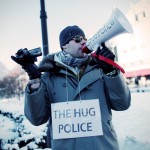
Hug_the_Police2And then there’s the case of Charlie Veitch, now denounced across the UK media as the known anarch­ist. Yes, Charlie is anti-roy­al­ist and wanted to voice his views, but he runs an inter­na­tion­ally-known act­iv­ist organ­isa­tion called the Love Police, for chris­sakes.  The peace­ful inten­tions of the organ­isa­tion might pos­sibly be giv­en away by the name.…

So what happened? On Thursday even­ing two police officers, tooled up with proto-Borg tech, muscled their way into the Cam­bridge home he shares with his girl­friend, Silkie Carlo, declar­ing that they were there to arrest him and search the place. They had the pres­ence of mind to film the whole pro­cess and ask some per­tin­ent questions.

Charlie’s alleged pre-crime?  That he had pos­ted a fright­en­ingly pres­ci­ent video on You­tube say­ing that he thought he was being spied on, but still cri­tiquing the roy­al wed­ding and sug­gest­ing that fel­low act­iv­ists get togeth­er in Soho Square, Lon­don (quite a dis­tance away from the fest­iv­it­ies) on the day.  OK, so he had a bit of a rant — but that’s what people do on You­tube.  Agree with him or strongly dis­agree, it’s called his free­dom of expres­sion — a much-vaunted, tra­di­tion­al Brit­ish liberty. 

But in the eyes of the police, appar­ently he was “con­spir­ing to cause a pos­sible breach of the peace”, and needed to be locked up.   It’s like we’ve time-trav­elled back to pre-revolu­tion­ary 18th cen­tury France, where the king could issue a lettre de cachet to send people to the Bastille.

So at the very time that Prince Wil­li­am and his blush­ing bride were cre­ated Duke and Duch­ess of Cam­bridge, a Brit­ish cit­izen was raided, locked up and hid­den away in a police cell in that very city for exer­cising free speech. 

On Thursday night he was hauled off to the Cam­bridge nick, which then refused to con­firm to his under­stand­ably upset girl­friend where he was being held, before being transfered to the Met Police on Fri­day morn­ing and held incom­mu­nic­ado for the rest of the day.  Fam­ily and law­yers then appar­ently spent fruit­less hours ringing around all the Lon­don police sta­tions try­ing to track him down.  So Charlie had effect­ively been “dis­ap­peared”, like a dis­sid­ent in a total­it­ari­an régime.

So let’s get this straight — we’re talk­ing about the Met­ro­pol­it­an Police spy­ing on known act­iv­ists (as we all now know they do, after the under­cov­er cop scan­dal earli­er this year) to pre­vent them from express­ing their legit­im­ate polit­ic­al views about the wed­ding of Kate and Wills.  The secur­ity forces had already stated that there was no spe­cif­ic ter­ror­ist threat, so this was all about pre­vent­ing an embar­rass­ing incid­ent on the big day.  And I’m sorry, but I don’t think that Pre­ven­tion of Embar­rass­ment is covered by the leg­al code.

Plus, these arrests were pre-empt­ive to stop a pos­sible crime which might be com­mit­ted — and let’s face it, only breach of the peace at that.  Not a biggy.

So we are basic­ally look­ing at the police spy­ing on and then pre-empt­ively arrest­ing cam­paign­ers for being poten­tial dis­sid­ents, for ThoughtCrime.  How much more Orwellian can it get?

I men­tioned the tac­tics of the Syr­i­an secur­ity forces and their bru­tal crack-down.  I’ve also pre­vi­ously writ­ten about how the slide towards fas­cism began in Ger­many in the 1930s with the bru­tal­isa­tion of intern­al oppos­i­tion­ists and dissidents . 

So let’s really stop and think about this — do we really want to let these early indic­a­tions slide by, uncon­tested? After all, we have the Olympics and the Dia­mond Jubilee next year, and no doubt the same, or exten­ded, powers will come into force.  How far will we let it go before we wake up to the threat?

As I’ve writ­ten before, with thanks to Pas­tor Mar­tin Niemoeller:

First they came for the Irish in the 1980s,

But I was not Irish so I did not speak up.

Then they came for the Muslims after 9/11,

But I was not a Muslim, so I did not speak up.

Then they came for the “domest­ic extremists”,

But I was not an act­iv­ist, so I did not speak up.

Then they came for me;

and there was nobody left to speak up for me.


RTTV interview on the royal wedding and arrest of UK activists

My inter­view on 29 April 2011 for RTTV about the pre-empt­ive arrests of UK polit­ic­al act­iv­ists in the run-up to the roy­al wedding. 

Thoughtcrime appears to have arrived in the UK — and I acci­dent­ally became a roy­al wed­ding com­ment­at­or (sort of). 

Well, nev­er say nev­er in life.…


A tale of two countries — pre-emptive policing in Britain and Syria

What a dif­fer­ence a mere month makes in the UK media.  At the end of March The Inde­pend­ent news­pa­per pro­duced this art­icle in the wake of the huge TUC anti-cuts protest in Lon­don, where the Brit­ish Home Sec­ret­ary was cas­tig­ated for con­sid­er­ing great­er police powers to pre­vent such “trouble” again, with par­tic­u­lar ref­er­ence to the forth­com­ing roy­al wedding.

At the time former assist­ant com­mis­sion­er at Scot­land Yard, Andy Hay­man, who had served as the head of the Met­ro­pol­it­an Police Counter-Ter­ror­ism squad and was, umm,  reportedlymuch-esteemed officer before his early resig­na­tion, adop­ted a mus­cu­lar tone by call­ing for “snatch squads” and “dawn raids” to be car­ried out by police against sus­pec­ted trouble­makers.  How ter­ribly un-British.

Per­haps I’m start­ing at shad­ows, but with the above in mind two inter­est­ing aricles appeared in that very same news­pa­per today.

The first art­icle that caught my eye con­firmed there was indeed just such a secur­ity crack­down against sus­pec­ted dis­sid­ents in the UK on the eve of the roy­al wed­ding.  Lynne Owens, the Met­ro­pol­it­an Police assist­ant com­mis­sion­er in charge of the roy­al poli­cing oper­a­tion, is quoted as saying:

“We have to be abso­lutely clear. If any­one comes to Lon­don intend­ing to com­mit crim­in­al acts, we will act quickly, robustly and decis­ively.” She said the Met was work­ing with forces across the coun­try and would use “spot­ters” to identi­fy those caus­ing trouble.”

The art­icle goes on to say:

As police teams step up their pro­cess of “pre-event invest­ig­a­tion” and “intel­li­gence gath­er­ing”, reports have come in from pro­test­ers that plain-clothed police are turn­ing up at their homes to warn them against attend­ing Fri­day’s event.” 

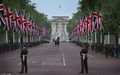
Military&pageantryIt seems that the poor old Met is hav­ing con­nip­tions about poten­tially embar­rass­ing pro­test­ers sul­ly­ing the pageantry of the roy­al wed­ding and is put­ting our money where its mouth is.  Last week The Tele­graph also repor­ted that counter-intel­li­gence oper­a­tions were being con­duc­ted against “anarch­ists” to pre­vent trouble on 29th April.

Inter­est­ing use of lan­guage, but I sup­pose that one news­pa­per­’s “pro­test­er” will always be another­’s “anarch­ist”.…

So what of the second art­icle that con­cerned me?  This described the bru­tal secur­ity crack­down in Syr­ia, where the secret police were pre-empt­ively hunt­ing down and arrest­ing sus­pec­ted dissidents:

Syr­i­a’s feared secret police raided hun­dreds of homes yes­ter­day as author­it­ies stepped up attempts to crush the pro-reform movement.….”

UK For­eign Sec­ret­ary, Wil­li­am Hag­ue is quoted as say­ing that:

Syr­ia is now at a fork in the road… it can choose ever-more viol­ent repres­sion which can only ever bring short-term secur­ity for the author­it­ies there.”

How much more need I say?  Put­ting aside the fact that Hag­ue seems to have acquired his very own fork(ed tongue), the only dis­cern­able dif­fer­ence at this stage is in the sheer scale of the bru­tal­ity and repres­sion, not the mind-set or intent.

It’s a slip­pery slope.….