Former US Congresswoman and current Presidential Green Party candidate, Cynthia McKinney, visited London in September 2007. I had the privilege of introducing her at the London event.
The Guardian today reported that the United Nations Committee on Human Rights had issued a damning indictment of the British government’s use of legislation to suppress a right that is fundamental to all functioning democracies: freedom of expression.
This is not news to me. But it’s interesting that freedom of expression is now being curtailed in so many varied, interesting and imaginative ways: libel laws, terrorism laws and official secrecy. That’s quite an arsenal.
Britain is now infamous for being the “libel capital” of the world. Wealthy individuals can use our courts to suppress publication of critical books and articles anywhere in the world, if they can prove that the book has been sold in the UK – even if it’s just one, second-hand copy on Amazon. The magazine, Private Eye, has been commenting on this extensively over the last year.
Then, under the slew of new counter-terrorism legislation that the Labour government has introduced since 2001, it is now an offence to say anything that might “encourage” terrorism. That definition is so broad that, say, you or I made an innocent comment about the Palestinian or Iraqi situation, and this could be misconstrued by another person as encouraging them to violence, this could be assessed subjectively as a criminal offence by the prosecuting authorities. This is third party thought-crime.
These sort of laws have a negative impact on free speech, as publishers, editors and journalists begin to self-censor rather than run informed risks for the public good.
But it’s the third area of law that resonates most with me, for obvious reasons: the 1989 Official Secrets Act, which criminalises any unauthorised disclosure by serving or former intelligence officers, notified persons, and other crown servants and officials. These people are the most likely to witness high crimes and misdemeanors on the part of government, police and the intelligence services, and yet they are the most criminalised in this country for speaking out. Whistleblowers in other areas of work are specifically protected by the law under the Public Interest Disclosure Act (1998).
How did this happen? Ever since the 1911 Official Secrets Act came into force, there has been legislation to protect this nation’s genuine secrets against the actions of traitors. Under this law, crown servants face 14 years in prison if they betray information to hostile powers. Of course we need to protect genuine secrets, and this is certainly safeguard enough.
 The change in this law was specifically designed to gag genuine whistleblowers in sensitive areas, not protect national security. This came about in the 1980s after the notorious failed prosecution of Ministry of Defense civil servant, Clive Ponting. In 1984 he blew the whistle on the fact the British government knew that the Argentinian warship, the General Belgrano, was sailing away from the exclusion zone during the Falklands War in 1982. Despite this, the order was still given to attack it, and many were killed. Ponting was rightly outraged by this, and went public. His actions were manifestly in the public interest, and this was precisely the successful defense he ran in court. Furious, the Conservative government of the time re-wrote the secrecy laws, removing the public interest defense to deter such principled whistleblowers in the future. And this is the current Official Secrets Act criticised so strongly by the UN.
Interestingly, at the time the Labour party strongly opposed this change, rightly thinking that this would curtail crucial information reaching the public domain. At this point, of course, many of them correctly suspected that they were on the receiving end of illegal investigations by MI5.
The roll call of Labour MPs who voted against the proposed Act as it passed through Parliament in 1988 includes such luminaries as Tony Blair, Jack Straw and the former Attorney General John Morris. All these people went on to use the 1989 OSA to threaten and prosecute the intelligence whistleblowers of the last decade.
The blanket ban on freedom of expression for intelligence personnel appears to be illegal under the terms of the European Convention of Human Rights. Sure, Article 10(2) does give nations the limited right to curtail freedom of expression in a proportionate way to protect national security. However, the term “national security” has never been defined for legal purposes in this country and is used as a catch-all phrase to prevent disclosure of anything embarrassing to the government and the intelligence agencies. Plus, during these cases, lawyers and judges have consistently confused the notion of the national interest with national security – two very different beasts. And freedom of expression cannot be legally curtailed under the Convention merely for reasons of “the national interest”.
So I was heartened to read the UN’s verdict on this legal mess: “Powers under the Official Secrets Act have been “exercised to frustrate former employees of the crown from bringing into the public domain issues of genuine public interest, and can be exercised to prevent the media from publishing such matters”.”
Let’s hope this leads to the reinstatement of the public interest defence at the very least. During this time of the unending “war on terror”, governments lying to take us into illegal wars, and the use of torture and internment, whistleblowers play an important role in upholding and defending our democratic values. We need to protect them, not prosecute them.
Stephen Armstrong published an interesting article in today’s New Statesman magazine. Based on his new book War plc: the Rise of the New Corporate Mercenary, it examines the rise of the corporate security consultant. Or in basic English – mercenaries.
I met Stephen when I was invited by James Whale to review the book on Press TV. I was impressed with his research and depth of knowledge on this subject. It was an unusually harmonious talk show — rather than arguing, we all took a broadly similar approach to the issue of mercenaries, oversight and accountability.
The increasing privatisation of intelligence is an insidious development in the world of espionage and war. For many decades there have existed on the fringes of the official intelligence world a few private security companies; think Kroll, Blackwater, Aegis. These companies are often the last refuge of .….. former intelligence officers of the western spook organisations.
These people, often frustrated at the overly bureaucratic nature of the governmental spy organisations, resign and are gently steered towards these corporations. That, or the relocation officers get them nice juicy jobs at merchant banks, arms companies or international quangos. It’s always useful to have reliable chaps in useful places, after all.
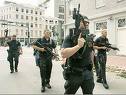 In the last decade, however, we have seen an explosion in the number of these companies. One of my former colleagues is a founder of Diligence, which is going from strength to strength. These kinds of companies specialise in corporate spying, the neutralisation of opposition and protest groups, and security. The latter usually boils down to providing military muscle in hot spots like Iraq. While I can see the attraction for soldiers leaving crack regiments and wondering what on earth they can do with their specialised expertise, and who then decide that earning £10,000 a week risking their lives in Baghdad is a good bet, this has worrying implications for the rule of law.
Leaving aside the small matter that, under international and domestic UK law, all wars of aggression are illegal, our official British military presence in Afghanistan and Iraq is at least to a certain degree accountable. The most egregious war crimes have resulted in court martials. But the new mercenaries live in a legal no-man’s land, and in this territory anything goes. Or can at least be covered up.
This is the same principle that has guided these unofficial spook companies over the years – plausible deniability. What little democratic oversight there is in the UK of the intelligence community still does give them limited pause for thought: what if the media hears about it? What if an MP asks an awkward question? By using former colleagues in the corporate intelligence world, MI5, MI6 et al can out source the risk.
The oversight and accountability for the official spooks and the army are bad enough. The privatisation of intelligence and military might makes a further mockery of the feeble oversight provisions in place in this country. This is a worrying development in legal and democratic terms; more importantly, it has a direct, daily impact on the rights of innocent men, women and children around the world. We need to ensure that the official and unofficial spooks and military are accountable under the law.
When
the Cold War ended, it didn’t spell curtains for the secret agent.
Private espionage is a booming industry and environmental protest
groups are its prime target

As you hunker down for the last few days of the Camp for Climate
Action, discussing how to force your way into Kingsnorth power station
in an attempt to prevent the construction of a new coal facility, cast
your eyes around your fellow protesters. Do they look entirely bona
fide to you? And don’t look for the old-school special branch officers
— Kent Police are a tiny force. It’s the corporate spies hired by
private companies you need to watch out for.
According to the private espionage industry itself, roughly one in four of your comrades is on a multinational’s payroll.
Russell Corn, managing director of Diligence, one of a growing
number of “corporate intelligence agencies”, with offices high in the
Canary Wharf glass tower, says private spies make up 25 per cent of
every activist camp. “If you stuck an intercept up near one of those
camps, you wouldn’t believe the amount of outgoing calls after every
meeting saying, ‘Tomorrow we’re going to cut the fence’,” he smiles.
“Easily one in four of the people there are taking the corporate
shilling.”
In April this year, for instance, the anti-aviation campaign network
Plane Stupid, one of the main organisers of the eco-camp built to
protest against the expansion of Heathrow Airport, announced that one
of its activists, Ken Tobias, was actually called Toby Kendall, was
working for a corporate espionage firm called C2i, and had been leaking
information about the group to paying clients and the media. He had
been hired by an as yet unknown private company to provide information
and disrupt the group’s campaigning.
When Tobias first turned up at Plane Stupid’s meetings in July 2007,
he seemed a committed former Oxford student dedicated to reducing
aircraft emissions. The group gradually became suspicious because he
showed up early at meetings, constantly pushed for increasingly drama
tic direct action and — the ultimate giveaway — dressed a little too
well for an ecowarrior. When they showed his picture around Oxford they
found an old college pal who identified him as Toby Kendall. A quick
Google search revealed his Bebo page with a link to a corporate
networking site, where his job as an “analyst” at C2i International,
working in “security and investigations”, was pasted in full public
view.
Just a month earlier, a woman called Cara Schaffer had contacted the
Student/Farmworker Alliance, an idealistic bunch of American college
students who lobby fast-food companies to help migrant workers in
Florida who harvest tomatoes. Like the cockle-pickers of Morecambe Bay,
many of these workers are smuggled into the US by gangs which then take
their passports and force them to work without pay to clear often
fictitious debts to regain their papers.
Again, Schaffer’s excessive eagerness aroused suspicion, and again,
the internet revealed her true identity. She owned Diplomatic Tactical
Services, a private espionage firm which had pre viously hired as a
subcontractor one Guillermo Zara bozo, today facing murder charges in
Miami for his role in allegedly executing four crew members of a
chartered fishing boat, an allegation he denies. Schaffer turned out to
be working for Burger King — the home, perhaps appropriately, of the
Whopper.
The cute thing about these two bozos is that they got caught pretty
early on, but that was because they were young and had no background in
espionage.
The real market is in proper, old-school spies who are suddenly
entering the private sector. For professional spooks, the 1990s were no
fun at all. The Cold War was over, defence spending was down and a
detailed knowledge of cold-drop techniques in central Berlin was
useless to governments looking for Arabic speakers who knew the Quran.
From New York and London to Moscow and Beijing, any decent-sized
corporation can now hire former agents from the CIA, FBI, MI5, MI6 and
the KGB. The ex-spooks are selling their old skills and contacts to
multinationals, hedge funds and oligarchs, digging up dirt on
competitors, uncovering the secrets of boardroom rivals and exposing
investment targets. They are also keeping tabs on journalists,
protesters and even potential employees.
“MI5 and MI6 in particular have always guided ex-employees into
security companies,” explains Annie Machon, the former MI5 agent who
helped David Shayler blow the whistle on the security services back in
1997. “It’s always useful to them to have friends they can tap for info
or recruit for a job that requires plausible deniability. The big
change in recent years has been the huge growth in these companies.
Where before it was a handful of private detective agencies, now there
are hundreds of multinational security organisations, which operate
with less regulation than the spooks themselves,” she says.
Corn’s company Diligence, for instance, was set up in 2000 by Nick
Day, a former MI5 spy, and an ex-CIA agent, Mike Baker. Before long,
the duo had built up a roster of high-paying clients including Enron,
oil and pharmaceutical companies, as well as law firms and hedge funds.
In 2001, a small investment by the Washington lobbying company Barbour
Griffith & Rogers propelled their growth. However, BGR and Baker
sold their stakes in 2005, shortly before a scandal shook Diligence.
KPMG, the global professional services firm, accused Diligence staff of
impersonating British spies to gain information on a corporate takeover
for a Russian telecoms client called Alfa Group. Diligence settled the
lawsuit without admitting liability.
Since then, it has recruited the former Conservative Party leader
Michael Howard as chairman of its European operations. And it is that
sort of respectability and lobbying power that big players are after.
In 2007, the parent company of the US private military firm Blackwater,
which hit the headlines for gunning down Iraqi civilians in Baghdad
last September, entered this market through Total Intelligence
Solutions (TIS), a new CIA-type private operation, to provide
intelligence services to commercial clients.
Blackwater’s vice-chairman, J Cofer Black, who runs TIS, spent three
decades in the CIA and the state department, becoming director of the
Counterterrorist Centre and co-ordinator for counter terrorism, a job
with ambassadorial rank. He describes the new company as bringing “the
intelligence-gathering methodology and analytical skills traditionally
honed by CIA operatives directly to the boardroom. With a service like
this, CEOs and their security personnel will be able to respond to
threats quickly and confidently — whether it’s determining which city
is safest to open a new plant in or working to keep employees out of
harm’s way after a terrorist attack.”
Black also says TIS will operate a “24/7 intelligence fusion and
warning centre” that will monitor civil unrest, terrorism, economic
stability, environmental and health concerns, and information
technology security around the world.
The established firms already operating in this area include Kroll,
Aegis, Garda, Control Risks, GPW and Hakluyt & Co. More firms are
opening every day and there is little regulation of the sector.
Hakluyt & Co was founded in 1995 by former British MI6 officers,
with a reputation for discreet and effective investigations. The
company butler, a former gurkha, greets visitors to its London HQ, a
town house off Park Lane. In winter, meetings can be conducted beside
the fire. Computers are rarely in sight. Hakluyt’s advisory board has
become an exit chamber for captains of industry and former government
officials. Members have included Sir Rod Eddington, a former BA CEO,
and Sir Christopher Gent, former chief executive of Vodafone.
“It is hard to work well for an oil company without knowing who all
the key decision-makers in a government are and having the right
contacts to reach them,” explains Stéphane Gérardin, who runs the
French private security company Géos. “We have an intelligence section
where we employ some investigative journalists, people from the finance
sector, from equity banks and some from security backgrounds.
“It is an important part of image protection for our clients as
well. We have our own tracking and monitoring centre, with analysts
doing risk mapping and preparing our clients for every potential
problem. It could be about alerting them to local sensitivities. Or, in
this globalised internet age, it can be a group of students in
Cambridge who have launched a protest website, who may be sending out a
petition.
“So we need to be able to understand and prepare our own propaganda
to counter such attacks. This is work we do to protect our clients.”
Like the state security services, which ended up running Class War
in the 1990s after a hugely successful penetration, these spies work to
become reliable members of any protest movement. In April 2007, the
Campaign Against Arms Trade called in the police after court documents
showed that the weapons manufacturer BAE Systems had paid a private
agency to spy on the peace group.
BAE admitted that it had paid £2,500 a month to LigneDeux
Associates, whose agent Paul Mercer — accepted as a trusted member of
the campaign — passed information, including a legally privileged
document, to BAE’s director of security, Mike McGinty.
Unlike the security services, however, these services don’t bother
with penetrating the far left or anti-fascist groups. Their clients are
only interested in the protest movements that threaten corporations.
And as that is the nature of much protest in these times, it is a wide
field, but with a particular impact on environmental groups.
At any of this summer’s green protests the corporate spies will be
there, out-of-work MI5 agents tapping green activists’ mobile phones to
sell the information on to interested companies.
Russell Corn knows of incidents where a spook at a meeting has
suggested a high-street bank as a target, then left the meeting to
phone the officers of said bank, telling them that he has penetrated an
activist camp planning an attack and offering to sell the details. Corn
has no time for such behaviour, however.
“The thing about a really good private spy,” he tells me, “is that you’ll never know he’s around and he’ll never get caught.
“The fact you can’t see them … it means nothing at all.”
The lack of any meaningful oversight of the UK’s intelligence community was highlighted again last week, when The Daily Mail reported that a crucial fax was lost in the run-up to the 7/7 bombings in London in 2005.
There has yet to be an official enquiry into the worst terrorist atrocity on the UK mainland, despite the call for one from traumatised families and survivors and the legitimate concerns of the British public. To date, we have had to make do with an “official narrative” written by a faceless bureaucrat and published in May 2006. As soon as it was published, the then Home Secretary, John Reid, had to correct egregious factual errors when presenting it to Parliament.
The Intelligence and Security Committee (ISC) also did a shoddy first job, when it cleared the security forces of all wrong-doing in its initial report published at the same time. It claimed a lack of resources had hampered MI5’s counter-terrorism efforts.
However, following a useful leak, it emerged that MI5 had not only been aware of at least two of the alleged bombers before the attack, it had been concerned enough to send a fax up to West Yorkshire Police Special Branch asking them to investigate Mohammed Sidique Khan and Shehzad Tanweer. This fax was never acted upon.
So the ISC has been forced to produce another report, this time apparently admitting that, yes, there had been intelligence failures, most notably the lost fax. West Yorkshire SB should have acted on it. But the intelligence officer in MI5 responsible for this investigation should have chased it up when no response was forthcoming.
This second ISC report, which has been sitting on the Prime Minister’s desk for weeks already, is said to be “devastating”. However, I’m willing to bet that if/when it sees the light of day, it will be anything but.
 The ISC is at best an oversight fig leaf. It was formed in 1994, when MI6 and GCHQ were put on a statutory footing for the first time with the Intelligence Services Act. At the time the press welcomed this as a great step forward towards democratic accountability for the intelligence community. Well, it could not have been worse than the previous set-up, when MI5, MI6 and GCHQ did not officially exist. They were not required to obey the laws of the land, and no MP was allowed to ask a question in Parliament about their activities. As 1980s whistleblower Peter Wright so succinctly put it, the spies could bug and burgle their way around with impunity.
So the establishment of the ISC was a (very) limited step in the right direction. However, it is not a Parliamentary Committee. Its members are selected by the Prime Minister, and it is answerable only to the PM, who can vet its findings. The remit of the ISC only covers matters of spy policy, administration and finance. It is not empowered to investigate allegations of operational incompetence nor crimes committed by the spies. And its annual report has become a joke within the media, as there are usually more redactions than coherent sentences.
The ISC’s first big test came in the 1990s following the Shayler and Tomlinson disclosures. These involved detailed allegations of illegal investigations, bungled operations and assassination attempts against foreign heads of state. It is difficult to conceive of more heinous crimes committed by our shadowy spies.
But how did the ISC react? If one reads the reports from the relevant years, the only aspect that exercised the ISC was Shayler’s information that MI5 had on many MPs and government ministers. The ISC was reassured by MI5 that would no longer be able to use these files. That’s it.
Forget about files being illegally held on hundreds of thousands of innocent UK citizens; forget about the illegal phone taps, the preventable deaths on UK streets from IRA bombs, innocent people being thrown in prison, and the assassination attempt against Colonel Gaddafi of Libya. The fearless and eternally vigilant ISC MPs were primarily concerned about receiving reassurance that their files would no longer be vetted by MI5 officers on the basis of membership to “subversive” organisations. What were they afraid of – that shameful evidence of early left-wing activity from their fiery youth might emerge? Heaven forbid under New Labour.
Barely a day goes by when newspaper headlines do not remind us of terrible threats to our national security. Only in the last week, the UK media has reported that the threat of espionage from Russia and China is at its highest since the days of the Cold War; that resurgent Republican terror groups in Northern Ireland pose a graver danger to us even than Al Qaeda; that radicalised British Muslim youth are returning from fighting with the Taliban to wage war on the streets of the UK. We have to take all this on trust, despite the intelligence community’s appalling track record of bending the truth to gain more powers and resources. This is why meaningful oversight is so vitally important for the health of our democracy. The ISC is a long way from providing that.
Last Sunday George Bush graciously flew into the UK for a final official visit before he steps down as president in January next year. PM Gordon Brown looked distinctly uncomfortable at their joint press conference, particularly when he had to announce that the UK would continue to support US military adventurism in the Middle East by sending yet more troops out there.
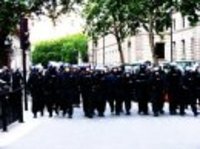
Of course, over the years many millions of us opposed these illegal wars, but to no avail. This was the last opportunity for peace protesters in the UK to vent their feelings towards Bush. The police responded in an increasingly heavy-handed way, penning the peaceniks up, beating innocent people around the head for no reason, and calling in the armoured riot police.
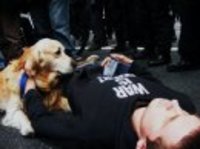 One friend of mine said that they were standing there playing protest songs when suddenly a wall of Robocop lookalikes appeared and began to advance on them. My friend, a seasoned activist, had never seen anything quite like it; even he was unnerved. Another decided to make a stand. Well, to be exact, he lay down at their feet, protected only by Solomon his trusty Peace Dog.
Despite all this, the police persisted in blaming the protesters. Deputy Assistant Commissioner Chris Allison announced that the Met would hold an enquiry and said: “We are seriously disappointed by the irresponsible and criminal action of those who have challenged police….”
Allison then went on to make a statement that chilled my heart: he said that the protest could have been used as a “cover” for terrorists targeting George Bush.
 So this is what it has come to. Many intelligent commentators over recent years have said that politicians and police use the threat of terrorism to gain more and more draconian powers. Time and again we have seen innocent people stopped for no good reason under Section 44 of the Terrorism Act. Infamously, this Act was also used to throw 87 year old Walter Wolfgang out of a Labour Party conference for heckling Jack Straw. Police can even arrest you now purely to ascertain your identity.
But for a senior policeman to claim that violence is acceptable against peace campaigners as they might be harbouring terrorists is one step beyond. The tactics the US army has used so disastrously on the streets of Baghdad have now been imported to the streets of Westminster.
 I have been saying for a long time that the laws are already in place for the UK to be defined as effectively a police state. The only reason that this is not yet obvious to all is because these laws are not applied more widely. But perhaps we are seeing the first signs of this now.
Where will this end? The German people did not just wake up one day in 1939 and find that they lived under a fascist régime. The process was slow, and the erosion of democracy incremental. The vast majority was not even aware of what was happening to their country until it was too late.
They say that if you put a frog in cold water, and then gradually heat up the pot, the frog cannot detect the change in temperature fast enough and will sit there boiling to death. This, I fear, is what is happening to our democracy.
The UK mainstream media has made much this week of Home Secretary Jacqui Smith’s assertion that MI5 had not requested the government’s proposed extension of the imprisonment without charge of terrorist suspects from 28 to 42 days.
This statement has caused a furore in the UK, and there is a chance that the PM may lose the key vote in Parliament on this amendment tomorrow.
 In fact, such has been the uproar that the Director General of MI5, Jonathan Evans, is reported by Reuters to have made a rare public statement:
“Since the security service is neither a prosecuting authority nor responsible for criminal investigations, we are not, and never have been, the appropriate body to advise the government on pre-charge detention time limits,” he said in a statement on the MI5 website.
“We have not, therefore, sought to comment publicly or privately on the current proposals, except to say that we recognise the challenge posed for the police service by the increasingly complex and international character of some recent terrorist cases.”
What particularly strikes me about this is an apparently insignificant phrase, “raised publicly or privately”.
In contrast to the Metropolitan Police Commissioner Sir Ian Blair, who admitted to “unintentionally misleading” the parliamentary Joint Committee charged with assessing the need to increase the detention limit, Evans had refused to give evidence about the 42 day issue. So he has certainly not raised this in a publicly accountable way.
It’s the word “private” that intrigues me. It reeks of sotto voce discussions between old school chums at the grander gentlemen’s clubs in London: of unattributable briefings between anonymous MI5 officers and chosen journalists; and of cosy lunches with Fleet Street editors in the DG’s dining room at Thames House, MI5’s London HQ.
While Evans denies using this methodology around the 42 day issue, his statement confirms that such private discussions do indeed play a part in influencing policy decisions and media perception.
 I saw this approach first-hand in the 1990s during the whistleblowing years. In fact, it was then that MI5 stepped up its charm offensive with politicians and journalists. It was during one of the first of these cosy media lunches in Thames House, hosted by the then DG Stephen Lander, that the respected BBC Diplomatic Editor Mark Urban asked a fateful question about the Gaddafi Plot and was reportedly told by Lander that “he was not here to answer half-baked questions from smart-arse journalists”. So there were certain shortfalls in the charm, even if the lack of accountability held up well.
But there are other, more sinister ways for the spies to manipulate public opinion. MI6 has a sensitive section called Information Operations (I/Ops), which exists purely to set the news agenda for the spies. I/Ops manages this either by massaging the facts, spinning the tone of the story or, more worryingly, planting false stories in a quiescent press.
In the 1990s there was a famous case. Colonel Gaddafi’s son, Saif Al Islam, applied for a visa to come to Britain. I/Ops planted a completely false story in The Sunday Telegraph that he was involved in money laundering with Iran and, lo and behold, MI5 had the perfect excuse to deny him a visa. Al Islam subsequently sued the newspaper which, faced with Shayler’s evidence, settled out of court.
 A few months ago the ex-head of MI6, Sir Richard Dearlove, gave a talk at the LSE about the intelligence agencies and the media. I went along to have a laugh, and was graciously allowed to ask a question. Naturally I raised the issue of I/Ops, its relationship with the media, and whether such a role was acceptable in a modern democracy.
In the context of the talk, what could have been more pertinent? However, Dearlove declined to answer. In fact, he went so far as to say that such a matter was “within the ring of secrecy”. At which point a journalist from a prestigious national newspaper who was sitting next to me, turned and said gleefully that this at last proved that I/Ops existed. Gratifying as this was, I shall reiterate my question: is the role of I/Ops acceptable in a modern democracy, where we are supposed to enjoy freedom of information, transparency and accountability from the powers-that-be?
In January 2008 I spoke at the IT Defense Conference in Hamburg in January 2008. This is a summary of my talk.
The Spying Game? – Annie Machon
I gave a presentation about the role of intelligence
agencies in the current era of the unending “war on terror”, how they
monitor us, and the implications for our democracies.
 In the name of protecting national security, spy agencies are being
given sweeping new powers and resources. Their intelligence has been
politicised to build a case for the disastrous war in Iraq, they are
failing to stop terrorist attacks, and they continue to collude in
illegal acts of internment and torture, euphemistically called
“extraordinary rendition”. Most western democracies have already given
so many new powers to the spies that we are effectively living in
police states. As an informed community, what can we do about this?
t‑style: normal; font-variant: normal; font-weight: normal; font-size: 7pt; line-height: normal; font-size-adjust: none; font-stretch: normal;”> The illegal MI6
assassination attempt against Colonel Gaddafi of Libya
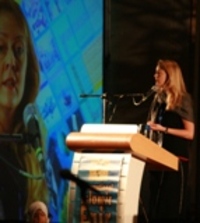 In July 2007 I was invited to speak at the International Islamic Fair in Malaysia along with 9/11 hero William Rodriguez.
The Fair is designed to increase understanding and co-operation between Islamic and non-Islamic communities. Politicians, diplomats and campaigners from around the world are invited to speak. Thousands of people attended the four day event, and the Fair made headlines across the Far East.
Here is the photo gallery of the 2007 IIF Conference.
I was honoured to receive a standing ovation, and comments included:
“Former British MI5 agent & American depleted uranium expert among best received paper presenters”
and
“The IIF2007 Conference fulfilled most of its pre-event promises – as far as content goes. In addition to the presence of William Rodriguez (last survivor of 9/11) as a session moderator, the conference participants were also ‘thrilled’ by the lectures of other overseas speakers including Sheikh Imran Hosein (former N.York mosque imam), H.E. Mahdi Ibrahim Muhammad (Ambassador / member of National Assembly, Sudan), Annie Machon (former British Intelligence MI5 agent) and Khaled Taha of Aljazeera, Qatar.”
So the spooks are yet again trying to recruit IT professionals. MI6 is currently advertising for a, quote, “world class enterprise architect”, but is offering a salary significantly below the market rate. MI5 is constantly on the lookout for IT staff –as recent adverts in the press will attest.
 My sense is that the agencies are still desperately playing IT catch-up. In the 1990s, when I worked as an intelligence officer, we were still writing out everything longhand and getting our secretaries to type it up – with all the attendant typos, revisions and delays. Information databases, such the system codenamed Durbar, which held the terrorist records, could only be accessed via 1970s, beige, monitor-and-keyboard, all-in-one computers.
In the early 1990s MI5 did try to develop its own information management system from scratch, rightly thinking that buying off-the-shelf from an American megacorp was probably not good security. However, MI5 management still thought IT was a low priority – despite the fact the efficient processing of information should have been the core work. So, the agency paid significantly below the market rates for IT professionals, and posted mainstream intelligence officers, with no project management experience, to run the department for 2 year periods. Needless to say, moral was rock-bottom. The IT bods were unmotivated, the IOs demoralised at being posted to a career graveyard slot and the unwieldy system, codenamed Grant, never got off the ground.
In the middle of the decade MI5 in desperation bought an off-the-shelf package which was based on Windows 95. Even then officers had to fight to have access to a terminal to do their work. And, of course, Windows is not known as the most stable or secure system available. I also heard recently that MI5 is still using this proprietary software, and thinks that it can protect its information systems by patching up security problems. It gives one such faith that MI5 can really protect this country from terrorist attack.
But this leads us onto a more serious issue regarding our national sovereignty. What the hell is our government doing, shovelling billions of pounds every year over to US IT companies to pay for licences that then permit our government departments to use their software packages? And with the current concerns about terrorism and the subsequent datamining activities of a paranoid US administration, how can we be sure that the NSA is not sneaking a peek at the work of our security forces via back doors in this software?
So, to protect our sovereignty, as well as develop our knowledge base and grow our economy, why does the UK government not encourage all government agencies and departments to switch from proprietary to open source software? After all, many other countries around the world are already doing this for precisely these reasons.
No doubt it’s that pesky “special relationship” kicking in again.….
A worrying article in today’s Guardian by the indefatigable Duncan Campbell, in which he reports that police are using the Terrorism Act (2000) to try to force a journalist to hand over information from a source.
This issue is the scared cow of journalism – that they never reveal their sources. To do so would immediately deter whistleblowers from speaking in confidence to the media, and government crimes and lies would remain secret. The protection of journalistic sources contributes to safeguarding our democracy, as legislation such as the Freedom of Information Act (2000) is effectively toothless when up against the inner workings of the state.
Because of this, journalists with integrity in this country and abroad are willing to risk prison rather than hand over their notes. As Campbell remarks, this happened to Martin Bright in 2000 when he was Home Affairs Editor at The Observer. The Metropolitan Police Special Branch went crashing into the offices on Farringdon Road, demanding that he hand over all his notes on the Shayler case. More bizarrely, they also demanded a letter Shayler had sent to The Guardian, even though it had already been published in the newspaper. Thankfully for Martin, the National Union of Journalists supported him, and the police eventually backed off.
The fact that the police are using the Terrorism Act as is a worrying new development. But it’s not just production orders from the police that journalists and newspapers have to be worried about. The authorities have a range of weapons in their arsenal if they choose to suppress information emanating from inner government circles or the intelligence world. And yet it is within these very circles that the most heinous crimes and violations are committed, and whence the most significant whistleblowers tend to emerge. Think Dr David Kelly, David Shayler, Katherine Gun.
So, what else can the authorities use to suppress valid criticism? Well, firstly and most notoriously, we have the Official Secrets Act in the UK. This does not just prevent intelligence officers and notified government officials from ever speaking to anyone outside the agency about anything, ever (Section 1(1)). Slightly less well known is Section 5, which makes it a crime for any journalist to receive or elicit information from these whistleblowers that damages “national security” (the term to this day remains undefined). Of course, as we saw in the Shayler case, the government is always extremely reluctant to cross the media and enforce this, so it is usually just the unfortunate whistleblower who is hung out to dry.
If the threat of the OSA fails, the government can always find a tame judge to issue an emergency injunction. Again, this happened in the Shayler case, when an injunction was taken out both against him and the UK’s national media. Needless to say, the injunction against the media was dropped (even this government quailed at the prospect of taking on News International and the Mail group), but remains in place to this day against the hapless whistleblower.
This injunction is no small thing. The government’s lawyers have used it to frighten off publishers from even looking at a novel (that’s right – a work of fiction) that Shayler wrote in 1998. Letters winged their way from government lawyers to UK publishers in London in 1999. And when Shayler built a website, hosted by Tabnet in California, the government wrote to them pointing out that there was an injunction in place and asking for the site to be taken down. Tabnet gently pointed out that perhaps the British government had forgotten about 1776, and continued to host the site.
If the OSA and injunctions are not enough, we also have the notorious D Notice Committee (now rebranded as the Defence Press and Broadcasting Advisory Committee), a body that can block publication of a story by issuing a notice at the say-so of the government. Very appropriate in a so-called democracy. What makes it worse is that the Committee is made up of volunteers from amongst the great and the good from the media world, as well as representatives from government departments. These guys, senior editors and TV executives, enter the charmed inner circle and start to police their own industry. It’s amazing how quickly new appointees go native and fight the government’s corner.
So there you have it – a whole battery of laws to protect the British Establishment from the scrutiny and constructive criticism of the media. When a journalist of integrity stands up to the authorities, we should all support them. They are providing a crucial service of ventilation and accountability for our retreating democracy. I wish Shiv Malik, the freelancer at the eye of the current storm, the very best.
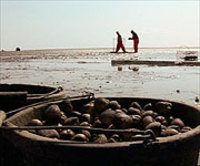 Four times in the past three years, powers designed to catch terrorists have been deployed against potential cockle rustlers on the sands outside Poole Harbour in Dorset. I kid you not. The Independent newspaper yesterday reported that Poole Borough Council had used the sweeping surveillance of the Regulation of Investigatory Powers Act (2000), otherwise known as RIPA, to police the cockle fishermen of Dorset.
RIPA was intended (the government told us in 2000) merely to update for the internet age the old Interception of Communications Act (1985) that for the first time had regulated the intrusive surveillance carried out by spooks and police. In fact, the Grim RIPA massively expanded state intrusion into our personal lives, so that nine government organizations, including the security services and police, and 792 public authorities (of which 474 are local councils) now have the powers to snoop on our private communications, and then some.
In fact, documents disclosed under the Freedom of Information Act suggest that Poole Borough Council may have the dubious distinction of being the nosiest in the UK, using RIPA not only to police its waters, but also to check on the residential status of locals, damage caused to traffic barriers or other minor infractions. Hardly the stuff of James Bond.
Inadvertently, Poole Council has provided a classic case of reductio ad absurdum, but this can be useful in highlighting more serious flaws.
In the last decade we have seen a slew of laws passed by our elected representatives in parliament that are potentially dangerous to our democracy and way of life. All these laws have been whipped through parliament, and the media has tended not to give them much consideration.
One such law that springs to mind is the Civil Contingencies Act (2004). This was passed with barely a murmur and, in the wake of the foot and mouth crisis, was deemed to be A Good Thing. However, the devil is always in the detail. This law allows any senior government minister, at the stroke of a pen, to declare a 30 day state of emergency. Under these terms, the authorities can prevent our free association at political meetings or demonstrations, they can quarantine us, or prevent us moving freely around our country. They can even seize our homes, demolish them, and not have to pay a penny in compensation, as this will have been done to protect “national security”.
 But the real stinker was the draft of the Legislative and Regulatory Reform Act (2006). If Blair had succeeded in passing this law, it would have spelled the end of 700 years of parliamentary democracy in Britain. Had the original draft been approved, any senior government minister could have abolished any law previously passed by our Houses of Parliament.
Not for nothing was this nicknamed the “Abolition of Parliament Bill” (well, that and the fact that its formal title is a tongue-twister – try saying it out loud!). Following a citizens’ campaign, the Bill was watered down as it passed through the Houses of Parliament. However, even though limited safeguards have been introduced, ministers are still in a position to tinker with any British laws except the Human Rights Act. So, the tendency for authoritarian government may have been reined in this time, but we need to remain vigilant.
Many people are aware and are also apprehensive of how these laws could be misused against the citizens of the UK if a more ruthless and draconian government were in power. Many commentators say we are sleep-walking towards a police state. The tragedy is that we are pretty much there – most of the necessary laws are in place. It is time for us all to re-engage in the democratic process and halt this rush towards a completely unaccountable government.
The government is pushing through yet another piece of legislation designed to provide “public service honesty, integrity and independence” to the British people. As part of this strategy, the draft Constitutional Renewal Bill even contains a section to provide protection for government whistleblowers. Needless to say, spies are automatically excluded (see section 25 (2) of the draft Bill).
The draft Bill states that any whistleblowers from within the ranks of MI5, MI6 and GCHQ will be dealt with internally. This has always been the case for MI5 and 6 (despite the government’s breathtaking lies during the Shayler case that he could have gone to any crown servant with his concerns). However, in the case of GCHQ, this Bill will take away employees’ rights to go to an independent Commissioner, to bring it into draconian line with its sister agencies.
So, to put this bluntly, those in our intelligence agencies who experience ethical qualms about their work or, even worse, witness crimes, will have to take their concerns to the head of the very agency committing these crimes. Let’s guess how far these complaints will go.
Now, some might say that it’s naïve to think that the intelligence agencies don’t commit illegal or unethical acts. All I can say to that is — grow up. James Bond is a myth. Even the bad old days of the Cold War when, as former MI5 officer Peter Wright put it, MI5 could “bug and burgle its way around London” with impunity are long gone. The 1985 Interception of Communications Act (and subsequent legislation), the 1989 Security Service Act, and the 1994 Intelligence Services Act, have put paid to that. In line with basic human rights, the spies now have to apply for ministerial permission based on, ahem, a solid intelligence case, to aggressively investigate a target.
During the 10 month period of my recruitment to MI5 in 1990, I was repeatedly told that the organisation had to obey the law; that it was evolving into a modern counter-terrorism agency. If that is indeed the case, then why is MI5 still to this day not accountable in the same way as the Metropolitan Police Special Branch, which does the same work?
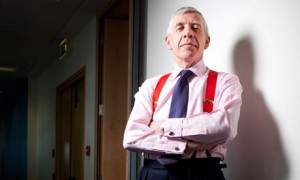 And who is the brave politician ensuring that our intelligence community can remain shrouded in secrecy and protected from criticism by the full force of the law? Stand up Justice Minister Jack Straw.
It just remains for me to say that Straw has a certain history in this area. In 1997, when Shayler blew the whistle, Straw was the Home Secretary, the government minister charged with overseeing MI5. One of Shayler’s early disclosures was that MI5 held files on a number of politicians, including Straw himself. Did Straw demand to see his file in angry disbelief? No, he meekly did the spies’ bidding and issued a blanket injunction against Shayler and the UK’s national media.
But think about it — this is a classic Catch 22 situation. Either MI5 was right to open a file on Straw because he was a political subversive and a danger to national security – in which case, should he not have immediately resigned as Home Secretary? Or MI5 got it wrong about Straw. In which case he should have been investigating this mistake and demanding to know how many other innocent UK citizens had files wrongly and illegally opened on them.
But Straw did neither. Perhaps he was worried about what the spies could reveal about him? It’s interesting that he is yet again rushing to protect their interests….
So, the argument about CCTV and our big brother society rumbles on. A senior policeman, Detective Chief Inspector Mick Neville of the Visual Images, Identifications and Detections Office (Viido) at New Scotland Yard, has been quoted as saying that only 3 per cent of crimes have been solved by CCTV evidence. Despite the UK having the highest per capita number of CCTVs in the world, this brave new world has failed to make us safer.
A few other police forces, and naturally the security companies flogging the kit, say that CCTV has at least dramatically reduced opportunistic crimes. Who should we believe?
What cannot be disputed is the fact that there are well over 4,000,000 CCTVs in this country, and the organisation, Privacy International, assesses that we are the most watched citizenry in Europe.
While some law-abiding citizens say they feel intimidated by CCTV and how the information could potentially be misused, most people seem not to care. In fact, the majority apparently feel safer if they can see CCTV on the streets, even if this pervasive surveillance has in no way discouraged crimes of violence. So why this gap between perception and reality?
One of my pet theories has always been to blame Big Brother. No, not the book. I have always been flummoxed by the popularity of the TV show and the plethora of reality TV spin-offs. My instinctive reaction was that it was similar to being “groomed” to accept round-the-clock intrusion into our personal lives. More than accept – desire it. The clear message is that such surveillance can lead to instant fame, wealth and access to the Z‑list parties of London. And for that we are sleep-walking into a real Orwellian nightmare.
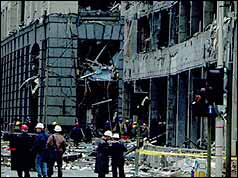 Slightly flippant theories aside, it is interesting that one of the most cited examples of the need for CCTV was the Bishopsgate bombing in London in 1993. In this case a lorry bomb, filled with a tonne of home made explosive (HME) was detonated in the heart of the city of London by the IRA. One person was killed, many were injured, and hundreds of millions of pounds worth of damage was caused, not to mention the fact threat the IRA scored a huge publicity coup.
But this had nothing to do with the lack or otherwise of CCTV in the streets of the City. It was an intelligence failure, pure and simple.
This attack could and should have been prevented. It occurred while I was working in MI5, and it was widely known in the service at the time that the bomber should have been arrested six months before during a surveillance operation. Despite the fact that he was seen checking out another lorry bomb in storage, he was allowed to walk free and escape to the Republic of Ireland due to procedural cock-ups. Months later, he returned to the City and bombed Bishopsgate.
By relying increasingly on technologies to protect us, we are following in the footsteps of the Americans. They have always had an over-reliance on gadgets and gizmos when seeking to investigate criminals and terrorists: satellite tracking, phone taps, bugs. But this hoovering up of information is never an adequate replacement for precise investigative work. Plus, any criminal or terrorist worth their salt these days knows not to discuss sensitive plans electronically.
Scatter-gun approaches to gathering intelligence, such as blanket surveillance, still at this stage require human beings to process and assess it for evidential use. That, according to DCI Neville, is part of the problem. There is just too much coming in, not enough staff, insufficient co-operation between forces, and the job lacks perceived status within the police.
The other problem of an over-reliance on technology is that it can always be hacked. The most recent hacking has broken the RFID chips that we all carry in our passports, Oyster cards and the planned ID cards. New technologies cannot guarantee that our personal data is secure, so rather than protecting us, they make us more liable to crimes such as identity theft.
So once again national and local government bodies have rushed to buy up technology, without fully thinking through either its application or its usefulness. And without fully assessing the implications for a free society. Just because the technology exists, it does not mean that it is fit for purpose, nor that it will make us safer.