Judicial rendition — the UK-US extradition treaty is a farce

Some­times I sit here read­ing the news —  on sub­jects in which I take a deep interest such as the recent police invest­ig­a­tion into UK spy com­pli­city in tor­ture, where the police decided not to pro­sec­ute — and feel that I should com­ment.  But really, what would be the point?  Of course the police would not find enough con­crete evid­ence, of course no indi­vidu­al spies would be held to account, des­pite the fact that the Brit­ish gov­ern­ment has already paid massive set­tle­ments to the victims.

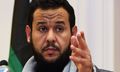
BelhadjNow there are reports that the police will be invest­ig­at­ing MI6 involve­ment in the extraordin­ary rendi­tion and tor­ture of two Liby­ans.  The case appears bang to rights, with doc­u­ment­ary evid­ence that high-rank­ing MI6 officers and gov­ern­ment min­is­ters were involved in and approved the oper­a­tion.  Yet I’m will­ing to bet that the plods at Scot­land Yard will still not be able to find the requis­ite evid­ence to pro­sec­ute anybody. 

The inev­it­able (and prob­ably wished-for out­come on the part of the author­it­ies) is that people become so weary and cyn­ic­al about the lack of justice that they stop fight­ing for it.  And they can tem­por­ar­ily suc­ceed, when we suc­cumb to cyn­ic­al burnout.

But the case repor­ted in today’s Daily Mail, that of a young Brit­ish stu­dent facing extra­di­tion to the US des­pite hav­ing broken no laws in the UK, suc­ceeded in rous­ing my wrath. 

Richard_ODwyerThe hap­less 23-year old Richard O’D­wyer faces 10 years in a max­im­um secur­ity Amer­ic­an pris­on.  His crime, accord­ing to the US, is that he set up a UK-based web­site that provided links to oth­er inter­na­tion­al web­sites that allegedly hos­ted copy­right material.

This case is so troub­ling on so many levels it is dif­fi­cult to know where to begin.  There are issues around the crack­down of US cor­por­ate copy­right law, issues around the inequal­ity of the uni­lat­er­al Extra­di­tion Act 2003, and his­tor­ic ques­tions of US hypo­crisy about extradition.

So let’s start with the unsup­por­ted alleg­a­tions against poor Richard O’D­wyer.  He is a stu­dent who built a web­site that col­lated a list of sites in oth­er coun­tries that host films, books and music for free down­load.  O’D­wyer did not him­self down­load any copy­righted mater­i­al, and the web­sites he linked to were appar­ently with­in jur­is­dic­tions where such down­loads are not illeg­al.  Provid­ing a sign­post to oth­er leg­al inter­na­tion­al sites is mani­festly not a crime in the UK and he has nev­er been charged.

How­ever, over the last couple of dec­ades the US enter­tain­ment lobby has been fight­ing a vicious rear­guard action against copy­right infringe­ment, start­ing with the music, then the film, and now the pub­lish­ing industry.  The lob­by­ists have proved vic­tori­ous and the invi­di­ous SOPA and PIPA laws are soon to be passed by the US Con­gress.  All well and good you might think — it’s one of those mad US issues.  But oh no, these laws have glob­al reach.  What might be leg­al with­in the UK might still mean that you fall foul of US legislation.

Gary_McKinnon2Which is where the Extra­di­tion Act 2003 becomes par­tic­u­larly threat­en­ing.  This law means that any UK cit­izen can be deman­ded by and handed over to the US with no prima facie evid­ence.  As we have seen in the appalling case of alleged hack­er Gary McKin­non, it mat­ters not if the “crime” were com­mit­ted on UK soil (as you can see here, McKin­non’s case was not pro­sec­uted by the UK author­it­ies in 2002.  If it had been, he would have received a max­im­um sen­tence of 6 months’ com­munity ser­vice: if extra­dited he is facing up to 70 years in a US max­im­um secur­ity prison).

The UK gov­ern­ment has tried to spin the egre­gious Liby­an cases as “judi­cial rendi­tion” rather than “extraordin­ary kid­nap­ping” or whatever it’s sup­posed to be.  So I think it would be accur­ate to call Gary McKin­non’s case “judi­cial rendi­tion” too, rather than bor­ing old extradition.

Richard O’D­wyer appar­ently did­n’t com­mit any­thing that could be deemed to be a crime in the UK, and yet he is still facing extra­di­tion to the US and a 10 year stretch.  The new US laws like SOPA threaten all of us, and not just with judi­cial rendition. 

As I have men­tioned before, digit­al rights act­iv­ist Cory Doc­torow summed it up best: “you can­’t make a sys­tem that pre­vents spy­ing by secret police and allows spy­ing by media giants”.  These cor­por­ate inter­net laws are a Tro­jan horse that will threaten our basic civil liber­ties across the board.

So now to my third point.  The hypo­crisy around the Amer­ic­an stance on extra­di­tion with the UK is breath­tak­ing.   The UK has been dis­patch­ing its own cit­izens off at an alarm­ing rate to the “tender” mer­cies of the US judi­cial sys­tem since 2004, with no prima facie evid­ence required.  In fact, the leg­al proof required to get a UK cit­izen extra­dited to the US is less than that required for someone to be extra­dited from one US state to another. 

The US, on the oth­er hand, delayed rat­i­fy­ing the law until 2006, and the bur­den of proof required to extra­dite someone to the UK remains high, so it is unbal­anced not only in concept but also in prac­tice.  And this des­pite the fact that the law was seen as cru­cial to facil­it­ate the trans­fer of highly dan­ger­ous ter­ror­ist sus­pects in the end­less “war on terror”.

Why has this happened?  One can but spec­u­late about the power of the Irish lobby in the US gov­ern­ment, as Sir Men­zies Camp­bell did dur­ing a par­lia­ment­ary debate about the Act in 2006.   How­ever, it is well known that the US was remark­ably coy about extra­dit­ing IRA sus­pects back to the UK to stand tri­al dur­ing the 30-year “Troubles” in North­ern Ire­land.  We even have well-known apo­lo­gists such as Con­gress­man Peter King, the Chair­man of the Home­land Secur­ity Com­mit­tee attempt­ing to demon­ise organ­isa­tions like Wikileaks as ter­ror­ist organ­isa­tions, while at the same being a life-long sup­port­er of Sinn Féin, the polit­ic­al wing of the Pro­vi­sion­al IRA.

UK_poodleThe double stand­ards are breath-tak­ing.  The US dic­tates an extra­di­tion treaty with the UK to stop ter­ror­ism, but then uses this law to tar­get those who might poten­tially, tan­gen­tially, minutely threaten the profits of the US enter­tain­ment mega-corps; and then it delays rat­i­fy­ing and imple­ment­ing its own law for poten­tially dubi­ous polit­ic­al reasons.

And the UK gov­ern­ment yet again rolls over and takes it, while inno­cent stu­dents such as Richard O’D­wyer must pay the price.  As his moth­er is quoted as say­ing: “if they can come for Richard, they can come for anyone”.

The Bureau of Investigative Journalism article

Here is a recent art­icle I wrote for The Bur­eau of Invest­ig­at­ive Journ­al­ism, about our slide into a sur­veil­lance state. 

TBIJ sup­por­ted Wikileaks dur­ing the release of the Spy­Files. The issue is of such cru­cial import­ance for our demo­cracy, I was dis­ap­poin­ted that more of the main­stream media did not fol­low up on the stor­ies provided.

Here’s the text:

Ana­lys­is: the slide into a sur­veil­lance state

Fifty years ago, Pres­id­ent Eis­en­hower warned of the ‘dis­astrous rise’ of the mil­it­ary-indus­tri­al com­plex. His fears proved all too accurate.

Now in the post‑9/11 world, the threat goes even fur­ther: the mil­it­ary-indus­tri­al com­plex is evolving into the mil­it­ary-intel­li­gence com­plex. It is a world, I fear, that is pro­pelling us into a dysto­pi­an sur­veil­lance nightmare.

I have seen this night­mare unfold from close quar­ters. In the mid-90s I was an intel­li­gence officer for MI5, the UK domest­ic secur­ity ser­vice. That is, until I resigned to help my former part­ner and col­league Dav­id Shayler blow the whistle on a cata­logue of incom­pet­ence, cov­er-ups and crimes com­mit­ted by spies. We naively hoped that this would lead to an inquiry, and a review of intel­li­gence work and account­ab­il­ity with­in the notori­ously secret­ive Brit­ish system.

The blun­ders and illeg­al oper­a­tions that we wit­nessed in our six years at MI5 took place at what is prob­ably the most eth­ic­al and account­able dec­ade in the Brit­ish spy­ing service’s 100-year history.

Even then, they were get­ting away with pretty much whatever they wanted.

Since the attacks of 9/11, I have watched with increas­ing dis­may as more powers, money and resources have been pumped into the inter­na­tion­al intel­li­gence com­munity to com­bat the neb­u­lous ‘war on ter­ror’. As a res­ult, civil liber­ties have been eroded in our own coun­tries, and count­less inno­cent people have been killed, maimed and dis­placed across the Middle East.

The Reg­u­la­tion of Invest­ig­at­ory Powers Act (RIPA), which was designed to allow our spy agen­cies to law­fully inter­cept our com­mu­nic­a­tions to counter ter­ror­ism and organ­ised crime, has been routinely used and abused by almost 800 pub­lic bod­ies. MI5 admit­ted to mak­ing 1,061 mis­takes or ‘admin­is­trat­ive errors’ this year alone in its applic­a­tion of RIPA, accord­ing to the Inter­cep­tion of Com­mu­nic­a­tions Com­mis­sion­er, Sir Paul Kennedy.

Intel­li­gence creep extends to the police, as we saw with the under­cov­er police scan­dal earli­er this year, where the unac­count­able Nation­al Pub­lic Order Intel­li­gence Unit was dis­covered to be infilt­rat­ing harm­less and legit­im­ate protest groups for years on end.

It is a world, I fear, that is pro­pelling us into a dysto­pi­an sur­veil­lance nightmare.

Even bey­ond the under­cov­er cops, we have seen an explo­sion in cor­por­ate spy­ing. This involves mer­cen­ary spy com­pan­ies such as Xe (formerly Black­wa­ter), Kroll, Aegis and Dili­gence offer­ing not just secur­ity muscle in hot­spots around the world, but also bespoke oper­a­tions enabling big cor­por­a­tions to check out staff or to infilt­rate and invest­ig­ate protest groups that may embar­rass the companies.

The mer­cen­ary spy oper­ates without any over­sight what­so­ever, and can even be gran­ted immunity from pro­sec­u­tion, as Xe enjoyed when oper­at­ing in Iraq.

The last dec­ade has also been a boom time for com­pan­ies provid­ing high-tech sur­veil­lance cap­ab­il­it­ies. One aspect of this in the UK – the endem­ic CCTV cov­er­age – is notori­ous. Loc­al coun­cils have inves­ted in mobile CCTV smart spy cars, while cam­er­as that bark orders to you on the street have been tri­alled in Middlesbrough.

Drones are increas­ingly used for aer­i­al sur­veil­lance – and the poten­tial for mil­it­ar­isa­tion of these tools is clear.

All this des­pite the fact that the head of the Met­ro­pol­it­an Police depart­ment that is respons­ible for pro­cessing all this sur­veil­lance inform­a­tion stated pub­licly that CCTV evid­ence is use­less in help­ing to solve all but 3% of street rob­ber­ies in Lon­don. In fact, since CCTV has been rolled out nation­ally, viol­ent crime on the streets of Bri­tain has increased.

But, hey, who cares about facts when secur­ity is Big Busi­ness? Someone, some­where, is get­ting very rich by rolling out ever more Orwellian sur­veil­lance tech­no­logy. And while the tech­no­logy might not be used against the wider UK cit­izenry in a par­tic­u­larly malig­nant man­ner – yet – the same com­pan­ies are cer­tainly allow­ing their tech­no­lo­gies to find their way to the more viol­ent and repress­ive Middle East­ern states.

That would nev­er hap­pen in Bri­tain – would it? We retain an optim­ist­ic faith in the long-term benign inten­tions of our gov­ern­ment, while tut-tut­ting over Syr­i­an police snatch squads pre-empt­ively arrest­ing sus­pec­ted dis­sid­ents. Yet this has already happened in the UK: before the roy­al wed­ding in April, pro­test­ers were pre-empt­ively arres­ted to ensure that they would not cause embar­rass­ment. The intent is the same in Syr­ia and Bri­tain. Only the scale and bru­tal­ity dif­fers – at the moment.

When I worked for MI5 in the 1990s I was appalled how eas­ily tele­phone inter­cep­tion could be used illeg­ally, and how eas­ily the spies could hide their incom­pet­ence and crimes from the gov­ern­ment. In the last dec­ade it has become much worse, with seni­or spies and police officers repeatedly being caught out lying to the tooth­less Intel­li­gence and Secur­ity Com­mit­tee in Par­lia­ment. And this is only the offi­cial intel­li­gence sector.

How much worse is the endem­ic sur­veil­lance car­ried out by the cor­por­ate spy industry?

The bal­ance of power, bolstered by new tech­no­lo­gies, is shift­ing over­whelm­ingly in favour of the Big Broth­er state – well, almost. The WikiLeaks mod­el is help­ing level the play­ing field, and whatever hap­pens to this trail­blaz­ing organ­isa­tion, the prin­ciples and tech­no­logy are out there and will be rep­lic­ated. This genie can­not be put back in the bottle. This – com­bined with the work of informed MPs, invest­ig­at­ive journ­al­ists and poten­tially the occa­sion­al whis­tleblower – gives me hope that we can halt this slide into a Stasi state.

Annie Machon is a former spy with MI5, the Brit­ish intel­li­gence agency work­ing to pro­tect the UK’s nation­al secur­ity against threats such as ter­ror­ism and espi­on­age.
You can read Annie Machon’s blog ‘Using Our Intel­li­gence’ here.

The Big Dig Journalism Conference, Copenhagen

I recently did the open­ing key­note at the Big Dig invest­ig­at­ive journ­al­ism con­fer­ence in Copen­ha­gen.  Thanks to the organ­isers for a won­der­ful weekend!

Mediafabric talk, Prague, October 2011

Last Octo­ber I had the pleas­ure of speak­ing at the excel­lent Medi­afab­ric con­fer­ence in Prague.  The focus of my talk was the future of intel­li­gence, whis­tleblow­ing and journalism.

The event was organ­ised by Source­fab­ric, an inter­na­tion­al organ­isa­tion that provides open source tools and solu­tions for journ­al­ists, so it was an eclect­ic and stim­u­lat­ing crowd of journ­al­ists, geeks, hack­tav­ists and design­ers.   So well done and thank you to the organisers.

Here’s the video:

Speaking at Mediafabric Conference, Prague, 21 October

SF_brandmark_small

Off tomor­row to speak at the Medi­afab­ric con­fer­ence in Prague. 

Should be a good one — all about the media, journ­al­ists, tech­no­lo­gists, design­ers, hack­ers,  and all points in between!

The con­fer­ence has been organ­ised by Source­fab­ric, and there will be live stream­ing here.

Journalists need to wise up to secrecy laws

GIJC_logo

I had a fant­ast­ic time at the Glob­al Invest­ig­at­ive Journ­al­ism Con­fer­ence in Kiev last week­end.  A huge  well done to the organ­isers for a great four days, and I loved hav­ing the chance to meet so many inter­est­ing and inter­ested people from across the world!

I was invited to give the open­ing key­note speech (video to fol­low), where I dis­cussed some of my exper­i­ences from the MI5 whis­tleblow­ing years, but then went on to apply the harsh les­sons learned to the cur­rent situ­ation vis a vis the issue of spy influ­ence on the media today and the thorny issue of whis­tleblow­ing and the pro­tec­tion of sources.

Part of my talk focused on the con­trol of the media by the spies in Bri­tain.  As I have writ­ten before, this is very much a “car­rot and stick” scen­ario: the soft aspect, of course, being cosy chats with selec­ted journ­al­ists, well-timed career-enhan­cing scoops, as well as an increas­ingly unhealthy journ­al­ist­ic depend­ence on brief­ings com­ing out of the intel­li­gence world and government.

The stick aspect includes the bat­tery of harsh laws that can be called upon to sup­press free report­ing in the UK, which some­times leads to self-cen­sor­ship by the media.  These laws include:

Beginning_of_trialHow do I know all this?  Well, as you can see from many of the links in the above list, I’ve lived through much of this and have fol­lowed with great interest sim­il­ar and related cases over the years.  More inform­a­tion about these issues can be found in this excel­lent report pro­duced by Art­icle 19 and Liberty over a dec­ade ago.  The situ­ation has not improved.

While in Kiev I atten­ded an excel­lent ses­sion where two Rus­si­an journ­al­ists dis­cussed the rami­fic­a­tions of report­ing on the mod­ern incarn­a­tion of the Rus­si­an intel­li­gence agency, the FSB.

I was some­what startled to hear that even in Rus­sia journ­al­ists have more leg­al pro­tec­tion than those in the UK — ie they face no crim­in­al leg­al sanc­tion if they report whis­tleblower mater­i­al from the Rus­si­an spy agen­cies.  In the UK journ­al­ists poten­tially face 2 years in pris­on for doing so, under the invi­di­ous Sec­tion 5 of the 1989 OSA.

Way to go, Brit­ish democracy.

Global Investigative Journalism Conference, Kiev

Off to do a key­note at the Glob­al Invest­ig­at­ive Journ­al­ism Con­fer­ence in Kiev.   Should be inter­est­ing — watch this space.

GIJC_logo

Libya, MI6, and torture — interview on Press TV

Libya, MI6, tor­ture, and more happy sub­jects dis­cussed recently on “Africa Today” on Press TV

The pro­gramme was inter­est­ing, informed and bal­anced.  Do have a watch:

The Official Secrets Act — when will the British media learn?

I have been watch­ing with a cer­tain cyn­ic­al interest the unfold­ing of Oper­a­tion Weet­ing, one of the pleth­ora of Met­ro­pol­it­an Police invest­ig­a­tions into the UK phone hack­ing scan­dal, involving many of our favour­ite play­ers: shady private invest­ig­at­ors, pred­at­ory journ­al­ists, bent cop­pers, and politi­cians con­tort­ing them­selves in an effort to pro­tect both their own repu­ta­tions and their Friends in High Places.  And the ripples are spread­ing inter­na­tion­ally.  Noth­ing like a little bit of globilisation.…

Rupert_and_Rebekah The Guard­i­an news­pa­per has made most of the early run­ning in expos­ing the cor­rupt prac­tices of the now defunct News of the Screws, high­light­ing all the dubi­ous tabloid prac­tices of hack­ing, blagging, pinging, and god knows what else.  All this done with the help of bot­tom-feed­ing private invest­ig­at­ors, but also mani­festly with the help of cor­rupt police officers who were not averse to the idea of tak­ing a bribe to help their friends in Wap­ping.  And how far might this “trickle down cor­rup­tion” might have gone, um, up?

Des­pite the self-right­eous­ness of oth­er UK news­pa­pers, it has also now become appar­ent that these dubi­ous and poten­tially illeg­al prac­tices were com­mon through­out Fleet Street, and oth­er nation­al news­pa­pers are also under investigation.

And yet it appears that all this could have been nipped in the bud over a dec­ade ago, when Steven Nott, a con­cerned Brit­ish cit­izen, tried to expose the vul­ner­ab­il­ity of mobile phones after he stumbled across the prac­tice by acci­dent.  He took his find­ings to a vari­ety of nation­al news­pa­pers, all of whom seem to have ini­tially thought there was a good story, but every time the news was bur­ied.  Well, I sup­pose it would be, would­n’t it — after all, why would hacks expose a prac­tice that could be so useful?

But back to the dear old OSA and the media.

Police_news_international In yes­ter­day’s Observ­er news­pa­per, it was repor­ted that the police have threatened the journ­al­ists at The Guard­i­an with the Offi­cial Secrets Act (1989) to force them to dis­close the iden­tity of their source amongst the police officer(s) in Oper­a­tion Weet­ing who leaked use­ful inform­a­tion to the news­pa­per to help its expos­ure of illeg­al prac­tices.  And, rightly, the great and the good are up in arms about this dra­coni­an use of a par­tic­u­larly invi­di­ous law:

John Cooper, a lead­ing human rights law­yer and vis­it­ing pro­fess­or at Cardiff Uni­ver­sity, echoed Evans’s con­cerns. “In my view this is a mis­use of the 1989 act,” Cooper said. “Fun­da­ment­ally the act was designed to pre­vent espi­on­age. In extreme cases it can be used to pre­vent police officers tip­ping off crim­in­als about police invest­ig­a­tions or from selling their stor­ies. In this instance none of this is sug­ges­ted, and many believe what was done was in the pub­lic interest.

Cooper added: “The police action is very likely to con­flict with art­icle 10 of the European Con­ven­tion on Human Rights, which pro­tects free­dom of speech.”

But I think he’s miss­ing a bit of recent leg­al his­tory here.  The UK had the 1911 OSA which was sup­posed to pro­tect the coun­try from espi­on­age and trait­ors, who faced 14 years in pris­on upon con­vic­tion.  Need­less to say this pro­vi­sion was rarely used — most of the cold war Soviet moles in the estab­lish­ment were allowed to slink off to the USSR, or at the very most be stripped of their “K”.

How­ever, as I’ve writ­ten before, the revised 1989 OSA was much more use­ful for the estab­lish­ment.  It was spe­cific­ally put in place to stop whis­tleblow­ing after the embar­rass­ment of the 1980s Clive Ponting/Belgrano case. 

Ponting The new act was spe­cific­ally designed to strip away the “pub­lic interest” defence used by Pont­ing in his tri­al, and also to pen­al­ise journ­al­ists who had the temer­ity to report leaks and whis­tleblow­ing from the heart of the estab­lish­ment.  The OSA (1989) has been used extens­ively since the late 1990s, des­pite the fact that many seni­or fig­ures in the former Labour gov­ern­ment opposed its pro­vi­sions when it went through Par­lia­ment.   Journ­al­ists are just as liable as whis­tleblowers or “leak­ers” under the pro­vi­sions of this act (the infam­ous Sec­tion 5).

So, back to The Guard­i­an and its leg­al cham­pi­ons.  I agree with what they are say­ing: yes, the 1989 OSA  has a chilling effect on free­dom of speech that unduly vic­tim­ises both the whis­tleblower and the journ­al­ist; yes, it is a uniquely dra­coni­an law for a notion­al West­ern demo­cracy to have on its books; yes, there should be a defence of “act­ing in the pub­lic interest”; and yes, the OSA should be deemed to be incom­pat­ible with Sec­tion 10(2) of the European Con­ven­tion of Human Rights, guar­an­tee­ing free speech, which can only be cir­cum­scribed in the interests of “nation­al secur­ity”, itself a leg­ally undefined, neb­u­lous, and con­tro­ver­sial phrase under Brit­ish law.

David_Shayler_High_Court But if all the out­raged law­yers read up on their case law, par­tic­u­larly the hear­ings and leg­al dog­fights in the run up to Regina v Shayler cases, they will see that all these issues have been addressed, appar­ently to the sat­is­fac­tion of the hon­our­able m’luds who preside over Brit­ish courts, and cer­tainly to the estab­lish­ment fig­ures who like to use the OSA as their “get out of jail free” card.

So I wish The Guard­i­an journ­al­ists well in this con­front­a­tion.  But I have to say, per­haps they would not have found them­selves in this situ­ation today vis a vis the OSA if, rather than just a few brave journ­al­ists, the media insti­tu­tions them­selves had put up a more robust fight against its pro­vi­sions dur­ing its bas­tard birth in 1989 and its sub­sequent abuse.

It has been repor­ted today that the police may have down­graded their invest­ig­a­tion to a purely crim­in­al mat­ter, not the OSA.  Whatever hap­pens does not obvi­ate the need for the media to launch a con­cer­ted cam­paign to call for reform of the invi­di­ous OSA.  Just because one of their own is no longer threatened does not mean the chilling threat of this law has gone away.  As Mar­tin Luth­er King said while imprisoned in 1963:

Injustice any­where is a threat to justice everywhere.”

I would also sug­gest the new gen­er­a­tion work­ing in the Brit­ish media urgently read this excel­lent book­let pro­duced by John Wadham of Liberty and Art­icle 19 way back in 2000 Down­load Article_19_Liberty_on_OSA_2000,  to remind them­selves of fun­da­ment­al argu­ments against dra­coni­an legis­la­tion such as the OSA and in favour of the free­dom of the press.

Libyans caught between a rock and a hard place

This art­icle in today’s New York Times, par­tic­u­larly these fol­low­ing two para­graphs, sent a shiver down my spine for the fate of the Liby­an people:

Abdelhakim-Belhaj“The most power­ful mil­it­ary lead­er is now Abdel Hakim Bel­haj, the former lead­er of a hard-line group once believed to be aligned with Al Qaeda.The grow­ing influ­ence of Islam­ists in Libya raises hard ques­tions about the ulti­mate char­ac­ter of the gov­ern­ment and soci­ety that will rise in place of Col. Muam­mar el-Qaddafi’s autocracy.….

.…Mr. Bel­haj has become so much an insider lately that he is seek­ing to unseat Mah­moud Jib­ril, the Amer­ic­an-trained eco­nom­ist who is the nom­in­al prime min­is­ter of the inter­im gov­ern­ment, after Mr. Jib­ril obliquely cri­ti­cized the Islamists.”

The Liby­ans, finally free of Gad­dafi’s 42-year dic­tat­or­ship, now seem faced with a choice between an Islam­ist fac­tion that has stated pub­licly that it wants to base the new con­sti­tu­tion on Sharia — a state­ment that must have caused a few ripples amongst Liby­a’s edu­cated and rel­at­ively  eman­cip­ated women — or a new gov­ern­ment headed up by an Amer­ic­an-trained economist. 

Shock_DoctrineAnd we all know what hap­pens to coun­tries when such eco­nom­ists move in: asset strip­ping, the syphon­ing off of the nation­al wealth to transna­tion­al mega-corps, and a plunge in the people’s liv­ing stand­ards.  If you think this sounds extreme, then do get your hands on a copy of Naomi Klein’s excel­lent “Shock Doc­trine” — required read­ing for any­one who wants to truly under­stand the grow­ing glob­al fin­an­cial crisis.

Of course, this would be an ideal out­come for the US, UK and oth­er west­ern forces who inter­vened in Libya. 

Mr Bel­haj is, of course, anoth­er mat­ter.  Not only would an Islam­ist Libya be a poten­tially dan­ger­ous res­ult for the West, but should Bel­haj come to power he is likely to be some­what hos­tile to US and par­tic­u­larly Brit­ish interests. 

Why?  Well, Abdul Hakim Bel­haj has form.  He was a lead­ing light in the Liby­an Islam­ic Fight­ing Group, a ter­ror­ist organ­isa­tion which bought into the ideo­logy of “Al Qaeda” and which had made many attempts to depose or assas­sin­ate Gad­dafi, some­times with the fin­an­cial back­ing of the Brit­ish spies, most not­ably in the failed assas­sin­a­tion plot of 1996.

Of course, after 9/11 and Gad­dafi’s rap­proche­ment with the West, this col­lab­or­a­tion was all air-brushed out of his­tory — to such an extent that in 2004 MI6 was instru­ment­al in  kid­nap­ping Bel­haj, with the say-so of the CIA, and “extraordin­ar­ily ren­der­ing” him to Tripoli in 2004, where he suffered 6 years’ tor­ture at the hands of Liby­a’s bru­tal intel­li­gences ser­vices.  After this, I doubt if he would be minded to work too closely with UK companies.

So I’m will­ing to bet that there is more behind-the-scenes med­dling from our spooks, to ensure the ascend­ency of Jib­ril in the new gov­ern­ment.  Which will be great for West­ern busi­ness, but not so great for the poor Libyans.….

Spy documents found in Libya reveal more British double dealing

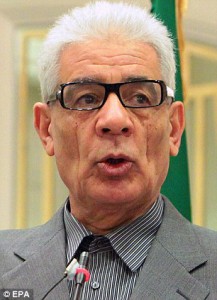
Musa_KousaA cache of highly clas­si­fied intel­li­gence doc­u­ments was recently dis­covered in the aban­doned offices of former Liby­an spy mas­ter, For­eign Min­is­ter and high-pro­file defect­or, Musa Kusa.

These doc­u­ments have over the last couple of weeks provided a fas­cin­at­ing insight into the grow­ing links in the last dec­ade between the former UK Labour gov­ern­ment, par­tic­u­larly Tony Blair, and the Gad­dafi régime.  They have dis­played in oily detail the degree of toady­ing that the Blair gov­ern­ment was pre­pared to coun­ten­ance, not only to secure luc­rat­ive busi­ness con­tracts but also to gloss over embar­rass­ing epis­odes such as Lock­er­bie and the false flag MI6-backed 1996 assas­sin­a­tion plot against Gaddafi.

These doc­u­ments have also appar­ently revealed dir­ect involve­ment by MI6 in the “extraordin­ary rendi­tion” to Tripoli and tor­ture of two Liby­ans.  Iron­ic­ally it has been repor­ted that they were wanted for being mem­bers of the Liby­an Islam­ic Fight­ing Group, the very organ­isa­tion that MI6 had backed in its failed 1996 coup.

The sec­u­lar dic­tat­or­ship of Col Gad­dafi always had much to fear from Islam­ist extrem­ism, so it is per­haps unsur­pris­ing that, after Blair’s notori­ous “deal in the desert” in 2004, the Gad­dafi régime used its con­nec­tions with MI6 and the CIA to hunt down its enemies.  And, as we have all been end­lessly told, the rules changed after 9/11…

The tor­ture  vic­tims, one of whom is now a mil­it­ary com­mand­er of the rebel Liby­an forces, are now con­sid­er­ing suing the Brit­ish gov­ern­ment.  Jack Straw, the For­eign Sec­ret­ary at the time, has tried to shuffle off any blame, stat­ing that he could not be expec­ted to know everything that MI6 does.

Well, er, no — part of the job descrip­tion of For­eign Sec­ret­ary is indeed to over­see the work of MI6 and hold it to demo­crat­ic account­ab­il­ity, espe­cially about such ser­i­ous policy issues as “extraordin­ary rendi­tion” and tor­ture.  Such oper­a­tions would indeed need the min­is­teri­al sign-off to be leg­al under the 1994 Intel­li­gence Ser­vices Act.

There has been just so much hot air from the cur­rent gov­ern­ment about how the Gib­son Tor­ture Inquiry will get to the bot­tom of these cases, but we all know how tooth­less such inquir­ies will be, cir­cum­scribed as they are by the terms of the Inquir­ies Act 2005.  We also know that Sir Peter Gib­son him­self has for years been “embed­ded” with­in the Brit­ish intel­li­gence com­munity and is hardly likely to hold the spies mean­ing­fully to account.

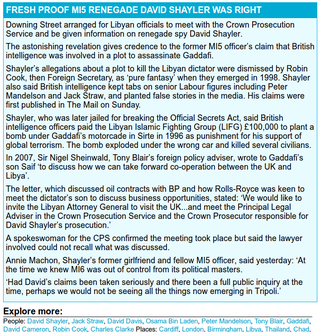
MoS_Shayler_11_09_2011So I was par­tic­u­larly intrigued to hear that the the cache of doc­u­ments showed the case of Dav­id Shayler, the intel­li­gence whis­tleblower who revealed the 1996 Gad­dafi assas­sin­a­tion plot and went to pris­on twice for doing so, first in France in 1998 and then in the UK in 2002, was still a sub­ject of dis­cus­sion between the Liby­an and UK gov­ern­ments in 2007. And, as I have writ­ten before, as late as 2009 it was obvi­ous that this case was still used by the Liby­ans for lever­age, cer­tainly when it came to the tit-for-tat nego­ti­ations around case of the murder in Lon­don out­side the Liby­an Embassy of WPC Yvonne Fletch­er in 1984.

Of course, way back in 1998, the Brit­ish gov­ern­ment was all too ready to crush the whis­tleblower rather than invest­ig­ate the dis­clos­ures and hold the spies to account for their illeg­al and reck­less acts.  I have always felt that this was a fail­ure of demo­cracy, that it ser­i­ously under­mined the future work and repu­ta­tion of the spies them­selves, and par­tic­u­larly that it was such a shame for the fate of the PBW (poor bloody whis­tleblower).

But it now appears that the Brit­ish intel­li­gence com­munity’s sense of omni­po­tence and of being above the law has come back to bite them.  How else explain their slide into a group-think men­tal­ity that par­ti­cip­ates in “extraordin­ary rendi­tion” and tor­ture?

One has to won­der if wily old Musa Kusa left this cache of doc­u­ments behind in his aban­doned offices as an “insur­ance policy”, just in case his defec­tion to the UK were not to be as com­fort­able as he had hoped — and we now know that he soon fled to Qatar after he had been ques­tioned about the Lock­er­bie case.

But wheth­er an hon­est mis­take or cun­ning power play, his actions have helped to shine a light into more dark corners of Brit­ish gov­ern­ment lies and double deal­ing vis a vis Libya.…