My RTTV interview today about Libya, torture, and UK double-dealing:
My RTTV interview today about Libya, torture, and UK double-dealing:
Nothing like being paid to read a book — a win-win situation for me.
Here’s a link to my review in the Sunday Express newspaper of a new history of MI6, called “The Art of Betrayal” by Gordon Corera, the BBC’s Security Correspondent.
And here’s the article:
REVIEW: THE ART OF BETRAYAL — LIFE AND DEATH IN THE BRITISH SECRET SERVICE
Friday August 19, 2011
By Annie Machon
THE Art of Betrayal: Life and Death in the British Secret Service
Gordon Corera Weidenfeld & Nicholson, £20
THE INTRODUCTION to The Art Of Betrayal, Gordon Corera’s unofficial post-war history of MI6, raises questions about the modern relevance and ethical framework of our spies. It also provides an antidote to recent official books celebrating the centenaries of MI5 and MI6.
Corera, the BBC’s security correspondent, has enjoyed privileged access to key spy players from the past few decades and, writing in an engaging, easy style, he picks up the story of MI6 at the point where the “official” history grinds to a halt after the Second World War.
Spy geeks will enjoy the swashbuckling stories from the Cold War years and he offers an intelligent exploration of the mentality of betrayal between the West and the former Soviet Union, focusing on the notorious Philby, Penkovsky and Gordievsky cases among many others.
For the more cynical reader, this book presents some problems. Where Corera discusses the aimless years of MI6 post-Cold War attempts at reinvention, followed by the muscular, morally ambiguous post‑9/11 world, he references quotes from former top spies and official inquiries only, all of which need to be read with a healthy degree of skepticism. To use a memorable quote from the Sixties Profumo Scandal, also mentioned in the book: “Well, they would say that, wouldn’t they?”
In Corera’s view, there has always been inherent tension in MI6 between the “doers” (who believe that intelligence is there to be acted upon James Bond-style and who want to get their hands dirty with covert operations) and the “thinkers” (those who believe, à la George Smiley, that knowledge is power and should be used behind the scenes to inform official government policy).
He demonstrates that the “doers” have often been in control and the image of MI6 staffed by gung-ho, James Bond wannabes is certainly a stereotype I recognise from my years working as an intelligence officer for the sister spy organisation, MI5.
The problem, as this book reveals, is that when the action men have the cultural ascendancy within MI6 events often go badly wrong through establishment complacency, betrayal or mere enthusiastic amateurism.
That said, the opposing culture of the “thinkers”, or patient intelligence gatherers, led in the Sixties and Seventies to introspection, mole-hunting paranoia and sclerosis.
Worryingly, many former officers down the years are quoted as saying that they hoped there was a “real” spy organisation behind the apparently amateur outfit they had joined, a sentiment shared by most of my intake in the Nineties.
Nor does it appear that lessons were learned from history: the Operation Gladio débâcle in Albania and the toppling of Iran’s first democratically-elected President Mossadeq in the Fifties could have provided valuable lessons for MI6 in its work in Afghanistan, Iraq, and Libya over the past two decades.
Corera is remarkably coy about Libya despite the wealth of now publicly-available information about MI6’s meddling in the Lockerbie case, the illegal assassination plot against Gaddafiin 1996 and the dirty, MI6-brokered oil deals of the past decade.
Corera pulls together his recurring themes in the final chapters, exploring the compromise of intelligence in justifying the Iraq war, describing how the “doers” pumped unverified intelligence from unproven agents directly into the veins of Whitehall and Washington.
Many civil servants and middle-ranking spies questioned and doubted but were told to shut up and follow orders. The results are all-too tragically well known.
Corera does not, however, go far enough.
He appreciates that the global reach of MI6 maintains Britain’s place in an exclusive club of world powers. At what price, though?
Here is the question he should perhaps have asked: in light of all the mistakes, betrayals, liberties compromised, lessons unlearned and deaths, has MI6 outlived its usefulness?
Annie Machon is a former MI5 intelligence officer and author.
Verdict 4/5
Here’s the film of my talk at the recent summer school at the Centre for Investigative Journalism in London a month ago:
Many thanks to Gavin and the rest of the CIJ team for such a stimulating and thought-provoking weekend!
 It was widely reported today that a number of well-respected British lawyers and civil liberties organisations are questioning the integrity of the much-trumpeted inquiry into UK spy complicity in torture.
And about time too. One hopes this is all part of a wider strategy, not merely a defensive reaction to the usual power play on the part of the British establishment. After all, it has been apparent from the start that the whole inquiry would be questionable when it was announced that Sir Peter Gibson would be chairing the inquiry.
Gibson has certain form. He was until recently the Intelligence Services Commissioner — the very person who for the last five years has been invited into MI5, MI6 and GCHQ for cosy annual chats with carefully selected intelligence officers (ie those who won’t rock the boat), to report back to the government that democratic oversight was working wonderfully, and it was all A‑OK in the spy organisations.
After these years of happy fraternising, when his name was put forward to investigate potential criminal complicity in torture on the part of the spies, he did the publicly decent thing and resigned as Commissioner to take up the post of chair of the Torture Inquiry.
Well, we know the establishment always like a safe pair of hands.… and this safety has also been pretty much guaranteed by law for the last six years.
Ever since the Inquiries Act 2005 was pushed through as law, with relatively little press awareness or parliamentary opposition, government departments and intelligence agencies have pretty much been able to call the shots when it comes to the scope of supposedly independent inquiries.
 Interestingly, Tory grandee Sir Malcolm Rifkind, the former Foreign Secretary who now chairs the Intelligence and Security Committee, has also weighed in to the debate. On BBC Radio 4’s Today programme he stated:
“I cannot recollect an inquiry that’s been proposed to be so open as we’re having in this particular case. When was the last time the head of MI5 and the head of MI6 – the prime minister has made quite clear – can be summoned to this inquiry and be required to give evidence?”
This from the senior politician who has always denied that he was officially briefed about the illegal assassination plot against Colonel Gaddafi of Libya in 1996; this from the man who is now calling for the arming of the very same extremists to topple Gaddafi in the ongoing shambles that is the Libyan War; and this from the man who is also loudly calling for an extension of the ISC’s legal powers so that it can demand access to witnesses and documents from the spy organisations.
No doubt my head will stop spinning in a day or two.…
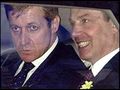 I have long suspected that Alastair Campbell, Labour’s former Director of Communications, may potentially have broken the UK’s Official Secrets Act. Now prima facie evidence is beginning to emerge that he did indeed breach the “clear bright line” against unauthorised disclosure of intelligence.
I know that the Metropolitan Police have their hands full investigating the meltdown that is the News of the World hacking scandal — and also trying to replace all those senior officers who had to resign because of it — but they do have a duty to investigate crime. And not just any old crime, in this case, but one that has potentially threatened the very basis of our national security.
Why do I say this?
 You’ll no doubt have some vague recollection that, in the run-up to the 2003 Iraq War, the British government produced a couple of reports “making a case for war”. The first, the September Dossier (2002), is the one most remembered, as this did indeed sex up the case for war, as well as include fake intelligence about Saddam Hussein trying to acquire uranium from Niger. Most memorably it led to the “Brits 45 minutes from Doom” front-page headline in Rupert Murdoch’s The Sun newspaper, no less, on the eve of the crucial war vote in Parliament.
There was also the notorious leaked Downing Street Memo, where the then-head of MI6, Sir Richard Dearlove ©, was minuted as saying that the intelligence and facts were being fitted around the [predetermined war] policy.
However, for the purposes of a possible Regina v. Campbell day in court, it is the second report that requires our attention.
It was published in February 2003, just before “shock and awe” was launched to liberate the grateful Iraqi people. This report became known as the “Dodgy Dossier”, as it was largely lifted from a 12 year old PhD thesis that the spin doctors had found on the internet. However, it also included nuggets of brand-new and unassessed intelligence from MI6. Indeed, even the toothless Intelligence and Security Committee in Parliament stated in paragraph 82 of its 2002–2003 Annual Report ( Download ISC_2003) that:
“We believe that material produced by the [intelligence] Agencies can be used in publications and attributed appropriately, but it is imperative that the Agencies are consulted before any of their material is published. This process was not followed when a second document was produced in February 2003. Although the document did contain some intelligence-derived material it was not clearly attributed or highlighted amongst the other material, nor was it checked with the Agency providing the intelligence or cleared by the JIC prior to publication. We have been assured that systems have now been put in place to ensure that this cannot happen again, in that the JIC Chairman endorses any material on behalf of the intelligence community prior to publication.”
 At the time it was reported that Blair and Campbell had spontaneously distributed this report to journalists travelling with them on a tour of the Far East. The ISC confirmed that the intelligence had been passed to journalists without the permission of MI6 in its September 2003 special report — “Iraq Weapons of Mass Destruction: Intelligence and Assessments” (see pars 131 to 134):
“The document was originally given to a number of journalists over the weekend of
1 and 2 February and then placed in the Library of the House on 3 February. The Prime
Minister described the document as follows:
“We issued further intelligence over the weekend about the infrastructure of
concealment. It is obviously difficult when we publish intelligence reports, but I hope
that people have some sense of the integrity of our security services. They are not
publishing this, or giving us this information, and making it up. It is the intelligence
that they are receiving, and we are passing on to people. In the dossier that we
published last year, and again in the material that we put out over the weekend, it is
very clear that a vast amount of concealment and deception is going on.”
“Conclusions:
“The Committee took evidence on this matter from the Chief of the SIS on both
12 February and 17 July and separately from Alastair Campbell on 17 July. Both agreed
that making the document public without consulting the SIS or the JIC Chairman was
a “cock-up”. Alastair Campbell confirmed that, once he became aware that the
provenance of the document was being questioned because of the inclusion of
Dr Al-Marashi’s work without attribution, he telephoned both the Chief of the SIS and
the JIC Chairman to apologise.
“We conclude that the Prime Minister was correct to describe the document as
containing “further intelligence… about the infrastructure of concealment.… It is the
intelligence that they [the Agencies] are receiving, and we are passing on to people.”
“However, as we previously concluded, it was a mistake not to consult the
Agencies before their material was put in the public domain. In evidence to us the
Prime Minister agreed. We have reported the assurance that we have been given
that in future the JIC Chairman will check all intelligence-derived material on
behalf of the intelligence community prior to publication.”
 Crucially, Blair and Campbell had jumped the (old Iraqi super-) gun by issuing this information, but Campbell seems to have got away with it by describing such a breach of the OSA as a “cock-up”. Or perhaps just another precipitous “rush of blood to the head” on his part, as recently described in the long-suppressed testimony of SIS2 revealed around the Chilcot Enquiry and reported in The Guardian:
“Papers released by the Chilcot inquiry into the war show that an MI6 officer, identified only as SIS2, had regular contacts with Campbell: “We found Alastair Campbell, I think, an enthusiastic individual, but also somewhat of an unguided missile.” He added: “We also, I think, suffered from his propensity to have rushes of blood to the head and pass various stories and information to journalists without appropriate prior consultation” (my emphasis).
So why do I suggest that Campbell could be liable for prosecution? It appears that he was a “notified person” for the purposes of Section 1(1) of the OSA. While not employed by the intelligence agencies, notified persons have regular access to intelligence material and are subjected to the highest clearance — developed vetting — in the same way as the full-time spooks. As such, they are also bound by the law against disclosure of such material without the prior written permission of the head of the agency whose intelligence they want to disseminate. There is no room for manœuvre, no damage assessment, and no public interest defence. The law is clear.
And a report in today’s Telegraph about Andy Coulson and the phone-hacking scandal seems to show clearly that Campbell was just such a notified person:
“Unlike Alastair Campbell and other previous holders of the Downing Street communications director role, Mr Coulson was not cleared to see secret intelligence reports and so was spared the most detailed scrutiny of his background and personal life.….
“The only people who will be subject to developed vetting are those who are working in security matters regularly and would need to have that sort of information.
“The only special advisers that would have developed vetting would be in the Foreign Office, Ministry of Defence and maybe the Home Office. Andy Coulson’s role was different to Alastair Campbell’s and Jonathan Powell.
“Alastair Campbell could instruct civil servants. This is why [Coulson] wasn’t necessarily cleared. Given [the nature of] Andy Coulson’s role as more strategic he wouldn’t have necessarily have been subject to developed vetting.”
So it would appear that Alastair Campbell is bang to rights for a breach of the Official Secrets Act under Section 1(1). He released new, unassessed and uncleared MI6 intelligence within the dodgy dossier. This is not just some technical infraction of the law — although even if it were, he would still have a case to answer.
 No, this report led inexorably to our country going to war against Iraq, shoulder to shoulder with the US, and the resulting deaths, maimings, poisonings and displacement of millions of innocent Iraqi people. It has also directly increased the terrorist threat to the UK, as Tony Blair was officially warned pre-Iraq war by the then-head of MI5, Eliza Manningham-Buller. With the dodgy dossier, Campbell has directly harmed countless lives and our national security.
Of course, many of us might fantasise about warmongers getting their just deserts in The Hague. But perhaps the OSA could prove to be Al Campbell’s Al Capone-style tax evasion moment.
Now, what about The Right Honourable Tony Blair?
 The quangocrats charged with overseeing the legality of the work of the UK spies have each produced their undoubtably authoritative reports for 2010.
Sir Paul Kennedy, the commissioner responsible for overseeing the interception of communications, and Sir Peter Gibson, the intelligence services commissioner, both published their reports last week.
Gibson has, of course, honourably now stood down from his 5‑year oversight of MI5, MI6, and GCHQ in order to head up the independent enquiry into spy complicity in torture.
And both the reports say, naturally, that it’s all hunky-dorey. Yes, there were a few mistakes (well, admistrative errors — 1061 over the last year), but the commissioners are confident that these were neither malign in intent nor an indication of institutional failings.
So it appears that the UK spies gained a B+ for their surveillance work last year.
Both commissioners pad out their reports with long-winded descriptions of what precisely their role is, what powers they have, and the full, frank and open access they had to the intelligence officers in the key agencies.
They seem sublimely unaware that when they visit the spy agencies, they are only given access to the staff that the agencies are happy for them to meet — intelligence officers pushed into the room, primped out in their party best and scrubbed behind the ears — to tell them what they want to hear.
Any intelligence officers who might have concerns have, in the past, been rigorously banned from meeting those charged with holding the spies to democratic account.….
.…which is not much different from the oversight model employed when government ministers, the notional political masters of MI6, MI6 and GCHQ, sign off on bugging warrants that allow the aggressive investigation of targets (ie their phones, their homes or cars, or follow them around). Then the ministers are only given a summary of a summary of a summary, an application that has been titrated through many managerial, legal and civil service filters before landing on their desks.
So, how on earth are these ministers able to make a true evaluation of the worth of such an application to bug someone?
They just have to trust what the spies tell them — as do the commissioners.

My next talk in the UK will be a keynote at the renowned CIJ summer school on 16th July. One of the major themes this year is whistleblowing, for obvious Wikileaks-related reasons, and it appears I shall be in good company.
My talk is at 2pm on the Saturday. I understand the keynotes are open to the public, not just summer school attendees, so come along if you can and please spread the word!
The Guardian’s spook commentator extraordinaire, Richard Norton-Taylor, has reported that the current chair of the Intelligence and Security Committee (ISC) in the UK Parliament, Sir Malcolm Rifkind, wants the committee to finally grow a pair. Well, those weren’t quite the words used in the Grauny, but they certainly capture the gist.
If Rifkind’s stated intentions are realised, the new-look ISC might well provide real, meaningful and democratic oversight for the first time in the 100-year history of the three key UK spy agencies — MI5, MI6, and GCHQ, not to mention the defence intelligence staff, the joint intelligence committee and the new National Security Council .
 For many long years I have been discussing the woeful lack of real democratic oversight for the UK spies. The privately-convened ISC, the democratic fig-leaf established under the aegis of the 1994 Intelligence Services Act (ISA), is appointed by and answerable only to the Prime Minister, with a remit only to look at finance, policy and administration, and without the power to demand documents or to cross-examine witnesses under oath. Its annual reports are always heavily redacted and have become a joke amongst journalists.
When the remit of the ISC was being drawn up in the early 1990s, the spooks were apoplectic that Parliament should have any form of oversight whatsoever. From their perspective, it was bad enough at that point that the agencies were put on a legal footing for the first time. Spy thinking then ran pretty much along the lines of “why on earth should they be answerable to a bunch of here-today, gone-tomorrow politicians, who were leaky as hell and gossiped to journalists all the time”?
So it says a great deal that the spooks breathed a huge, collective sigh of relief when the ISC remit was finally enshrined in law in 1994. They really had nothing to worry about. I remember, I was there at the time.
This has been borne out over the last 17 years. Time and again the spies have got away with telling barefaced lies to the ISC. Or at the very least being “economical with the truth”, to use one of their favourite phrases. Former DG of MI5, Sir Stephen Lander, has publicly said that “I blanche at some of the things I declined to tell the committee [ISC] early on…”. Not to mention the outright lies told to the ISC over the years about issues like whistleblower testimony, torture, and counter-terrorism measures.
But these new developments became yet more fascinating to me when I read that the current Chair of the ISC proposing these reforms is no less than Sir Malcolm Rifkind, crusty Tory grandee and former Conservative Foreign Minister in the mid-1990s.
For Sir Malcolm was the Foreign Secretary notionally in charge of MI6 when the intelligence officers, PT16 and PT16/B, hatched the ill-judged Gaddafi Plot when MI6 funded a rag-tag group of Islamic extremist terrorists in Libya to assassinate the Colonel, the key disclosure made by David Shayler when he blew the whistle way back in the late 1990s.
Obviously this assassination attempt was highly reckless in a very volatile part of the world; obviously it was unethical, and many innocent people were murdered in the attack; and obviously it failed, leading to the shaky rapprochement with Gaddafi over the last decade. Yet now we are seeing the use of similar tactics in the current Libyan war (this time more openly) with MI6 officers being sent to help the rebels in Benghazi and our government openly and shamelessly calling for régime change.
 But most importantly from a legal perspective, in 1996 the “Gaddafi Plot” MI6 apparently did not apply for prior written permission from Rifkind — which they were legally obliged to do under the terms of the 1994 Intelligence Services Act (the very act that also established the ISC). This is the fabled, but real, “licence to kill” — Section 7 of the ISA — which provides immunity to MI6 officers for illegal acts committed abroad, if they have the requisite ministerial permission.
At the time, Rifkind publicly stated that he had not been approached by MI6 to sanction the plot when the BBC Panorama programme conducted a special investigation, screened on 7 August 1997. Rifkind’s statement was also reported widely in the press over the years, including this New Statesman article by Mark Thomas in 2002.
That said, Rifkind himself wrote earlier this year in The Telegraph that help should now be given to the Benghazi “rebels” — many of whom appear to be members of the very same group that tried to assassinate Gaddafi with MI6’s help in 1996 — up to and including the provision of arms. Rifkind’s view of the legalities now appear to be somewhat more flexible, whatever his stated position was back in the 90s.
Of course, then he was notionally in charge of MI6 and would have to take the rap for any political fall-out. Now he can relax into the role of “quis custodiet ipsos custodes?”. Such a relief.
I shall be watching developments around Rifkind’s proposed reforms with interest.
A recent interview on Press TV about the spies’ manipulation of the media:
My recent talk at the excellent How the Light Gets In philosophy festival at Hay-on-Wye. With credit and thanks to IAI TV and the staff of the Institute of Art and Ideas, the organisers the event.
This article in today’s Guardian about the ongoing repercussions of the Mark Kennedy undercover cop scandal earlier this year piqued my interest.
 It appears that the Crown Prosecution Service (CPS) has suppressed key evidence about the all-too-apparent innocence of environmental protesters in the run-up to their trials. In this case Mark Kennedy aka Stone, the policeman who for years infiltrated protest groups across Europe, had covertly recorded conversations during the planning sessions to break into Ratcliffe-on-Soar power station.
Kennedy offered to give evidence to prove that the unit he worked for at the time, the private and unaccountable ACPO-run National Public Order Investigations Unit (NPOIU), had witheld this key evidence. It now appears that the police are claiming that they passed all the information on to the CPS, which then seems to have neglected to hand it over to the protesters’ defence lawyers.
 Which makes it even more fascinating that in April this year the Director of Public Prosecutions, famous civil liberties QC Keir Starmer no less, took the unprecedented step of encouraging those same protesters to appeal against their convictions because of potential “police” cover-ups.
It’s just amazing, isn’t it, that when vital information can be kept safely under wraps these doughty crime-fighting agencies present a united front to the world? But once someone shines a light into the slithery dark corners, they all scramble to avoid blame and leak against each other?
And yet this case is just the tip of a titanic legal iceberg, where for years the police and the CPS have been in cahoots to cover up many cases of, at best, miscommunication, and at worst outright lies about incompetence and potentially criminal activity.
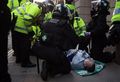 A couple of months ago George Monbiot provided an excellent summary of recent “misstatements” (a wonderfully euphemistic neologism) by the police over the last few years, including such blatant cases as the death of Ian Tomlinson during the London G20 protests two years ago, the ongoing News of the World phone hacking case, and the counter-terrorism style execution, sorry, shooting of the entirely innocent Jean Charles de Menezes, to name but a few.
Monbiot also dwelt at length on the appalling case of Michael Doherty, a concerned father who discovered that his 13 year-old daughter was apparently being groomed by a paedophile over the internet. He took his concerns to the police, who brushed the issue aside. When Doherty tried to push for a more informed and proactive response, he was the one who was snatched from his house in an early morning raid and ended up in court, accused of abusive and angry phone calls to the station in a sworn statement by a member of the relevant police force, sorry, service.
And that would have been that — he would have apparently been bang to rights on the word of a police secretary — apart from the fact he had recorded all his phone calls to the police and kept meticulous notes on the progress of the case. Only this evidence led to his rightful acquittal.
 As Monbiot rightly concludes, “justice is impossible if we cannot trust police forces to tell the truth”.
It appears that the notion of “citizen journalists” is just sooo 2006. Now we all need to be not only journalists but also “citizen lawyers”, just in case we have to defend ourselves against potential police lies. Yet these are the very organisations that are paid from the public purse to protect civil society. Is it any wonder that so many people have a growing distrust of them and concerns about an encroaching, Stasi-like, police state?
This is all part of engrained, top-down British culture of secrecy that allows the amorphous “security services” to think they can get away with anything and everything if they make a forceful enough public statement: black is white, torture is “enhanced interrogation”, and war is peace (or at least a “peacekeeping” mission in Libya.…). Especially if there is no meaningful oversight. We have entered the Orwellian world of NewSpeak.
But plus ca change, plus c’est la meme chose. This all happened in the 1970s and 80s with the Irish community, and also in the 1990s with the terrible miscarriage of justice around the Israeli embassy bombing in 1994. If you have the time, please do read the detailed case here: Download Israeli_Embassy_Case
We need to remember our history.

 Over the last few years there have been a number of egregious cases of police and state cover-ups in the UK around the deaths and wrongful prosecutions of innocent people.
This brings to my mind the appalling miscarriage of justice that occurred in the 1990s when two Palestinian students, a young woman called Samar Alami and a young man called Jawad Botmeh, were both wrongfully convicted of conspiracy to bomb the Israeli embassy in London in July 1994.
In this case a highly sophisticated car bomb as detonated outside the embassy. Thankfully nobody was killed, but a number of people suffered minor injuries. Alami and Botmeh had connections to Palestinian political support groups based in London at the time, many of whom were rounded up during the investigation. Botmeh had naively helped out a shadowy and never-identified figure called Reda Moghrabi, who asked for assistance in buying a second-hand car at auction. This was the car that was used in the explosion.
Why is this case an example of establishment cover-up? Well, this was one of the cases that former MI5 officer David Shayler blew the whistle on during the 1990s. He revealed the existence of two relevant documents that should have been disclosed to the defence but, for some unaccountable reason, were not.
The first, an agent report from a credible and trusted source, pointed to a non-Palestinian group planning the attack before it had even occurred. This report was not acted upon by the MI5 officer responsible, who then tried to cover up her mistake. She was caught out, and there was a much-discussed internal inquiry into the matter within MI5’s G Branch (international terrorism) in late 1994.
But there was another document — one written by G9/1, the senior MI5 officer who oversaw the post-incident investigation. His view was that Mossad, the external Israeli intelligence agency, had carried out a controlled explosion outside its own embassy (the shadowy and unidentified Reda Moghrabi being the potentially crucial missing link) in order to acquire the long-demanded additional security protection around Israeli interests in the UK, and also to shatter the Palestinian support networks in London — a long-term objective of Mossad.
The government at the time tried to dismiss these disclosures. However, the much-missed Private Eye investigative journalist, Paul Foot, and the indefatigable lawyer, Gareth Peirce, followed them up and pursued them tirelessly through the media and the courts.
And guess what? It turns out that these two key documents had indeed not been disclosed to the legal defence team during the trial of Alami and Botmeh — and not just by the hapless spooks. It emerged during the appeal hearing that no fewer than seven people from a variety of police and intelligence organisations had failed to disclose the relevant documentation to the defence. This cannot be explained away as an innocent oversight, a cock-up — it bears all the hallmarks of a deliberate, systemic establishment cover-up.
All this represented, at the very least, a need for a retrial but also a possible gross miscarriage of justice. And yet, while acknowledging that these documents did indeed exist during the appeal hearing and beyond, the presiding m’luds decided to ignore all case law and European law and let those two innocents rot in prison. After all, it would be terribly embarrassing to vindicate the actions of an intelligence whistleblower, wouldn’t it?
As a result, the poor pawns in this sick establishment game, Jawad Botmeh and Samar Alami, ended up serving their full sentences, despite the overwhelming body of evidence proving their innocence, and were finally released in 2008 and 2009 respectively.
For anyone interested in the detailed horror story behind this flagrant miscarriage of justice, here is the relevant chapter from my long-defunct book: Download The_Israeli_Embassy_Case
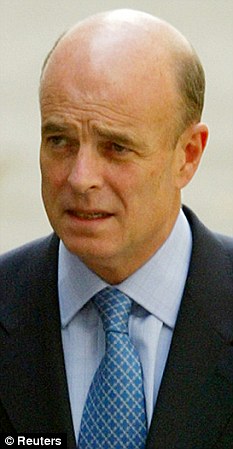 Former head of MI6, Sir John Scarlett — he of the dodgy September Dossier fame that led inexorably to the UK’s invasion of Iraq in 2003 and the death, maiming, depleted-uranium poisoning and displacement of hundreds of thousands of people — has complacently stated during his recent talk at the Hay Literary Festival that:
“One of the problems of intelligence work is that fact and fiction get very easily mixed up. A key lesson you have to learn very early on is you keep them separate.”
Well, no doubt many, many people might just wish he’d listened to his own advice way back in September 2002.
Scarlett is, of course, the senior UK spook who made the case for the Iraq war. Here’s the link: Download Iraq_WMD_Dossier.
No doubt you will remember the li(n)es: not only that Iraq’s non-existent “weapons of mass destruction” could be launched within 45 minutes, but also that fake intelligence documents had persuaded MI6 that Iraq was trying to buy uranium from Niger , as Colin Powell asserted during his persuasive speech to the UN in 2003.
Scarlett publicly took the rap and, by protecting Tony Blair and Alastair Campbell, was rewarded with the top job at MI6 and the inevitable knighthood. No doubt a suitable recognition for his entirely honourable behaviour.
But it gets worse — now he has apparently landed a lucrative job as an advisor on the situation in Iraq working for Norwegian oil mega-corporation, Statoil.
You couldn’t make it up…
… or perhaps you could if you’re a former top spy with an undeserved “K” and a lucrative oil contract who has difficulty separating fact from fiction.…..