Here is an interview I did today for RRTV about the evolving war in Libya:
Here is an interview I did today for RRTV about the evolving war in Libya:
 I recently stumbled across this excellent article in the Trinidad Express, of all places. It appears that the state of Trinidad and Tobago is in the throes of debating the legitimate role of intelligence agencies within a democracy.
Alana Wheeler, a Fulbright Scholar with a Masters degree in National Security Studies, contributes a clear and well-argued article that gets to the heart of these issues; what is “national security” and what is the best way to protect a nation’s integrity within a legal, proportionate and democratic framework?
If the democratic movements within countries like Tunisia, Egypt and Libya are allowed to coalesce organically and unhindered, no doubt this also be a key issue for their new constitutions — especially after decades of repression and fear meted out by brutal securocrats.
So why the hell can’t we have such an informed debate about these issues in the “mature democracies” of UK or the USA?
 Alleged Wikileaks source US Private Bradley Manning is now charged with “aiding the enemy”, amongst a bewildering array of 22 new charges. This is apparently a capital offence, although the US military has cosily said that they wouldn’t push for this barbaric sentence.
So just life without the hope of parole then.….
Putting aide the minor question of whether the USA should even be entitled to call itself a modern democracy when it still has the death penalty on its books, let’s just remind ourselves of what Manning is alleged to have revealed: the “Collateral Murder” military shoot-up, where innocent children, civilians and journalists were gunned down by US forces in a particularly nasty snuff video game that was then deliberately covered up by the Pentagon for years; many other heinous war crimes and records of daily brutality in Afghanistan and Iraq; and an “embarrass de richesses” of diplomatic cables.
I think “embarrass” is the key word here, on so many levels, and goes a long way to explaining the USA’s desperation to destroy Wikileaks founder, Julian Assange, by any means necessary.
But the phrase from the list of charges against the hapless Manning that leaps out at me is “aiding the enemy”. If — and it’s still a big legal if — Manning was indeed the source of all this crucial information, whom was he actually aiding?
Information that has appeared on Wikileaks over the last few years has been eclectic, international and very much in the public interest. It’s covered such nasties as Trafigura, the BNP, Scientology, Climategate, Guantanamo, the Australian internet blacklist, Sarah Palin, and much more.
It’s certainly not just restricted to the information that hit the headlines last year about the US hegemony. However, there is no doubt that it was the release of the Afghan, Iraq and diplomatic files that stirred up this particularly unpleasant hornets’ nest.
As global citizens I would suggest that we have every right to know what is done in our name. But, having said that, according to these new charges against poor Bradley Manning, the beneficiaries of Wikileaks — ie all of us — have now become the enemy.
When did we, the people, the global citizenry, become the enemy? It seems that our esteemed rulers are at last showing their true colours.…
On that note, do have a look at this video of former MI6 chief, Sir Richard Dearlove, speaking recently at the Cambridge Union Society. An interesting perspective on the British Establishment’s line on Wikileaks and Julian Assange:
 Peter Taylor, a respected journalist at the BBC, argues that if there had been more coöperation between MI5 and regional police Special Branches, then the 7/7 bombings in London in 2005 could have been prevented. His thesis appears to be that MI5 did not work closely enough with the police (the executive branch) of the UK’s intelligence community: the aptly-named Operation Crevice has exposed the cracks in the unified public façade of the UK intelligence community.
However, Taylor assures us that this problem is in the past, with MI5 officers and Special Branch police now happily working side by side in regional offices across the UK. So that’s OK then.
It continues to surprise me that seasoned British journalists repeatedly fall into the post‑9/11 group-think of the USA — that terrorism is a new phenomenon. Rather startlingly, Taylor’s article even asserts that the FBI had the Crevice information in real-time, while the West Yorks SB was left in the dark.
Those in the UK with a memory longer than a mayfly’s will be aware that this country endured 30 years of Irish Republican terrorism, and during the 1990s MI5 had lead responsibility for investigating this threat. So from 1993 the spooks did indeed work side-by-side with their regional SB counter-parts across the country. During this period the emphasis was on gathering both intelligence to pre-emptively thwart terrorist plots and also evidence to use in the ensuing court cases. And there were some notable successes.
So what changed in the following decade? Did the spooks retreat back behind the barricades of their London HQ, Thames House, as the ink dried on the Good Friday Agreement? Were the hard-won lessons of the 1990s so quickly forgotten?
Well, certainly other lessons from the civil war in Nortern Ireland appear to have been expunged from the collective intelligence memory. For example, the use of torture, military tribunals, internment and curfews were all used extensively in the early years of the NI conflict and all were spectacularly counter-productive, acting as a recruiting ground for new generations of terrorists. Yet these practices now once again appear to be implicitly condoned by MI5 and MI6 in the USA’s brutal “war on terror”.
So one would hope that this new BBC programme calls for a reappraisal of our intelligence infrastructure. Why should we mindlessly continue to accept the status quo, when this results in lessons being forgotten and mistakes being repeated? How about the BBC calling for a root and branch review of the threats the UK realistically faces, and the most efeective way to guard against them, while working within the democratic process?
Paradigm Shift TV (Sky 201 and 203) produced this film of my talk at the Cambridge Union Society in January 2011:
With thanks to Keith and Steve!

Law Enforcement Against Prohibition (LEAP).
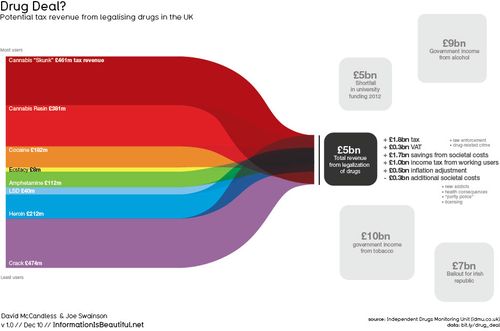
Prohibition has never worked, as proven throughout history.
Around the world many judges, lawyers, officers from the police, customs, and intelligence organisations, as well as many other experts, are challenging the failed concept of the “war on drugs”. This policy, in place for decades now in many countries despite its manifest, abject and repeated failure, criminalises great swathes of our populations, causes health problems, social problems and untold suffering, and funds organised crime and terrorist groups, rather than providing potentially enormous tax revenue to the state.
It is time for a mature, calm debate about the issue, rather than hysterical, tabloid headlines.
I am honoured to be one of this group speaking out.
LEAP Statement of Principles
1. LEAP does not promote the use of drugs and is deeply concerned about the extent of drug abuse worldwide. LEAP is also deeply concerned with the destructive impact of violent drug gangs and cartels everywhere in the world. Neither problem is remedied by the current policy of drug prohibition. Indeed, drug abuse and gang violence flourish in a drug prohibition environment, just as they did during alcohol prohibition.
2. LEAP advocates the elimination of the policy of drug prohibition and the inauguration of a replacement policy of drug control and regulation, including regulations imposing appropriate age restrictions on drug sales and use, just as there are age restrictions on marriage, signing contracts, alcohol, tobacco, operating vehicles and heavy equipment, voting and so on.
3. LEAP believes that adult drug abuse is a health problem and not a law-enforcement matter, provided that the abuse does not harm other people or the property of others.
4. LEAP believes that adult drug use, however dangerous, is a matter of personal freedom as long as it does not impinge on the freedom or safety of others.
5. LEAP speakers come from a wide divergence of political thought and social conscience and recognize that in a post-prohibition world it will take time to strike a proper regulatory balance, blending private, public and medical models to best control and regulate “illicit drugs.” LEAP speakers are free to advocate their view of better post-prohibition stratagems without toeing a LEAP “party line.”
6. LEAP recognizes that even in a post-prohibition world, still, drugs can be dangerous and potentially addictive, requiring appropriate regulation and control. Even in a free-market economy, reasonable regulation for the purposes of public health is a long-standing, accepted principle. Such regulation must not allow casual, unfettered or indiscriminate drug sales.
7. LEAP believes that government has a public health obligation to accurately ascertain the risks associated with the use of each “illicit drug” and a duty to clearly communicate that information to the public by means of labeling and warnings similar to what is done regarding food, tobacco, alcohol and medicine.
8. LEAP believes that an inordinate number of people have been misguidedly incarcerated for violation of zero-tolerant, nonviolent, consensual “drug crimes.” The end of drug prohibition will allow those persons to be promptly released, to have their record of conviction expunged, and their civil rights completely restored. However, the repeal of drug prohibition does not imply the exoneration from charges for connected offenses, such as violent crimes, gun crimes, theft, or driving under the influence of drugs. Furthermore, LEAP believes that people using alcohol or other drugs must be held accountable for any misbehavior, which harms other people or property of others, while under the influence of mind-altering substances.
9. LEAP believes that persons suffering from drug abuse afflictions and addiction, who want help, should be provided with a variety of help, including drug treatment and drug maintenance, even for uninsured addicts. LEAP believes that with an end to drug prohibition and regained control of criminal justice expenditures, a fraction of those savings would be more than sufficient to pay for expanded addiction services.
10. LEAP recognizes that different “illicit drugs” pose differing risks of harm. As such, in a post-prohibition world, LEAP recognizes that an appropriate set of regulations and control for one substance may not be a suitable or sufficient regulation and control for another substance. LEAP believes that the nation states of the world and various states within the United States must be given the regulatory latitude to try new models that wisely balance the notions of freedom over one’s own body with the need for common sense regulation of drugs to reduce death, disease, addiction and harm.
On 6 December I appeared on RTTV’s CrossTalk discussion programme alongside whistleblowing UK ex-diplomat Carne Ross, to talk about the implications of Wikileaks:
 November 5th has long had many levels of resonance for me: Bonfire Night of course, when I was a child — fireworks in the garden and burnt baked potatoes from the fire; since the age of seven, celebrating the birthday of my oldest friend; and, since 2002, the memory of having to stand up in the witness stand in an Old Bailey court room in London to give a mitigation plea at the trial of my former partner, seeing his sentence reduced from the expected thirteen months to a “mere” six, and then having to deal for weeks with the media fall-out. A strange mix of memories.
David Shayler endured a “Kafkaesque trial” in 2002 in the sense that he was not allowed to make a defence due to government-imposed gagging orders, despite all the relevant material already having been widely pubished in the media. The issues were summed up well in this New Statesman article from that time.
But the current debate about control orders used against so-called terrorist suspects — my emphasis — adds a whole new dimension to the notorious phrase.
This recent, excellent article in The Guardian by lawyer Matthew Ryder about control orders sums it up. How can you defend a client if you are not even allowed access to the information that has led to the original accusation?
The Liberal Democrats, in the run-up to the General Election earlier this year, pledged to do away with control orders, as they are an affront to the British model of justice. However, MI5 is putting up a strong defence for their retention, but then they would, wouldn’t they?
Much of the “secret” evidence that leads to a control order appears to come from telephone intercept, but why on earth can this evidence not be revealed in a court of law? It’s not like the notion of telephone bugging is a state secret these days, as I argued in The Guardian way back in 2005.
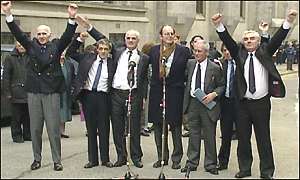 Bearing all of the above in mind, do have a read of this interview with Paddy Hill, one of the victims of the notorious wrongful convictions for the IRA Birmingham pub bombings in 1974. After being arrested, threatened, tortured and traumatised, he was forced to confess to a terrible crime he had not committed.
As a result, he had to endure sixteen years in prison before his innocence was confirmed. He is still suffering the consequences, despite having found the strength to set up the “Miscarriages of Justice Organisation” to help other victims.
And then have a think about whether we should blindly trust the word of the security forces and the police when they state that we have to give away yet more of our hard-won freedoms and rights in the name of the ever-shifting, ever-nebulous “war on terror”.
Do we really need to hold terrorist suspects in police cells for 28 days without charge? Will we really continue to allow the head of MI6 to get away with blithely asserting, unchallenged, that British intelligence does its very best not to “benefit” from information extracted via unthinkable torture, as former UK ambassador Craig Murray so graphically described in his blog on 29th October?
I’ve said it before, and I shall say it again: the Universal Declaration of Human Rights was put in place for a reason in 1948. Let’s all draw a breath, and remember, remember.….
For the first time in 100 years “C”, the head of the UK foreign intelligence service SIS (commonly known as MI6) has gone public.
Former career diplomat Sir John Sawers (he of Speedo fame) yesterday made a speech to the UK Society of Editors in what appeared to be a professionally diplomatic rear-guard action in response to a number of hot media topics at the moment.
Choosing both his audience wisely and his words carefully, he hit on three key areas:
Torture: Legal cases are currently going through UK courts on behalf of British victims of torture, in which MI5 and MI6 intelligence officers are alleged to have been complicit. The Metropolitan Police are currently investigating a number of cases. Over the last week, a British military training manual on “enhanced” interrogation techniques has also been made public. However, Sawers unblushingly states that MI6 abides by UK and international law and would never get involved, even tangentially, in torture cases. In fact, he goes on to assert that the UK intelligence agencies are training the rest of the world in human rights in this regard.
Whistleblowing: In the week following the latest Wikileaks coup — the Iraq War Diaries, comprising nearly 400,000 documents detailing the everyday horror of life in occupied Iraq, including war crimes such as murder, rape and torture committed by both US and UK forces — Sawers states that secrecy is not a dirty word: the intelligence agencies need to have the confidence that whistleblowers will not emerge to in order to guard agent and staff identities, as well as maintaining the confidence of their international intelligence partners that their (dirty?) secrets will remain, um, secret. One presumes he is advocating against the exposure of war crimes and justice for the victims.
This, one also presumes, is the justification for US politicians who propose cyber-attacks against Wikileaks and the declaration by some US political insiders that Julian Assange, spokesman of the organisation, should be treated as an unlawfully designated “unlawful combatant”, subject to the full rigour of extra-judicial US power, up to and including assassination.
Spurious media claims of unverified “damage” are the hoary old chestnuts always dragged out in whistleblower cases. After Wikileaks released its Afghan War Blog in July, government and intelligence commentators made apocalyptic predictions that the leak had put military and agent lives at risk. US Defense Secretary Robert Gates has since gone on the record to admit that this was simply not true.
During the Shayler whistleblowing case a decade ago, the government repeatedly tried to assert that agent lives had been put at risk, and yet the formal judgement at the end of his trial stated that this was absolutely not the case. And again, with the recent Wikileaks Iraq War Blog, government sources are using the same old mantra. When will they realise that they can only cry wolf so many times and get away with it? And when will the journalists regurgitating this spin wake up to the fact they are being played?
Accountability: Sawers goes on to describe the mechanisms of accountability, such as they are. He accurately states, as I have previously described ad nauseam, that under the 1994 Intelligence Services Act, he is notionally responsible to his political “master”, the Foreign Secretary, who has to clear in advance any legally dubious foreign operations (up to and including murder – the fabled “licence to kill” is not fiction, as you can see here).
The 1994 ISA also established the Prime Minister’s Intelligence and Security Committee (ISC) in Parliament, which many commentators seem to believe offers meaningful oversight of the spies. However, as I have detailed before, this is a mere fig leaf to real accountability: the ISC can only investigate issues of policy, finance and administration of the spy agencies. Disclosures relating to crime, operational incompetence or involvement in torture fall outside its remit.
But what happens if intelligence officers decide to operate beyond this framework? How would ministers or the ISC ever know? Other spy masters have successfully lied to their political masters in the past, after all.
Sir John has the gall to say that, if an operation is not cleared by the Foreign Secretary, it does not proceed. But what about the Gadaffi Plot way back in 1996, when MI6 was sponsoring a group of Islamic extremist terrorists in Libya to try to assassinate Colonel Gadaffi without, it has been asserted, the prior written approval of the then-Foreign secretary, Tory politician Malcom Rifkind? This was reported extensively, including in this article by Mark Thomas in the New Statesman. What happens if rogue MI6 officers blithely side-step this notional accountability — because they can, because they know they will get away with it — because they have in the past?
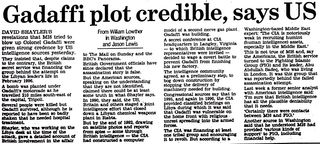 In the interests of justice, UK and international law, and accountability, perhaps a new Conservative/Coalition government should now reassess its approach to intelligence whistleblowers generally, and re-examine this specific disclosure about Libya, which has been backed up by international intelligence sources, both US and French, in order to achieve some sort of closure for the innocent victims in Libya of this MI6-funded terrorist attack? And it is finally time to hold the perpetrators to account — PT16, Richard Bartlett, and PT16B, David Watson, who were the senior officers in MI6 responsible for the murder plot.
As civilised countries, we need to rethink our approach to the issue of whistleblowing. Lies, spin, prosecutions and thuggish threats of assassination are beneath us as societies that notionally adhere to the principles of democracy. If we can only realistically hope that the actions of our governments, military forces, and intelligence agencies are transparent and accountable via whistleblowers, then we need to ensure that these people are legally protected and that their voices are heard clearly.
Last year I had the honour to meet Julian Assange, the founder of the brilliant whistleblower website, WikiLeaks, that has been causing such a stir recently with the release of the decrypted US military film, “Collateral Murder”, and recently with the Afghan War Logs.
I have nothing but respect for WikiLeaks — it shines a torch into the dark corners of corrupt government and big business, and is the way forward in holding these organisations, which largely believe themselves to be above the law, at least somewhat to account.
Julian was kind enough to invite me to take part in a panel discussion with him at the Hacking at Random festival in the Netherlands last year. The discussion focused on whistleblowing and government accountability. Here’s the video:
 In July I was invited back to speak at the Secret Garden Party, a music, politics, and arts festival held annually somewhere, er, secret in the UK.
What a fab weekend. I have a well-known antipathy to sleeping under canvas, but this was an excellent festival — and even the compost loos were not too grim.
Listed as one of the “Star Acts” in the printed festival programme (I blush), I had the luxury of an hour and a half to speak in the première debate tent in the Rebels and Intellectuals section of the festival — The Forum — a concept that the organiser, Ben de Vere, promises to transplant to London sometime in the near future.
Anyway, I seriously recommend putting this festival in your diaries for next year, and keep an eye open for the spread of The Forum.….
Here’s the video:
So last week I was on holiday with my lovely Dutchman in Cologne on the Rhine in Germany, a city steeped in history and now chiefly famous for its Gothic cathedral, widely reputed to be pretty much the last building left standing in the city at the end of WW2. Easily resisting both this religious hotspot and, with slightly more difficulty, the siren calls of the brauerei, we decided on a bit of culture, some museums and a stroll along the river.
However, it turns out that not one but two buildings had survived WW2 in their entirety. Tucked away on a backstreet, we found the second survivor: the Gestapo HQ, which had been preserved as it was found at the end of the war to serve as a ghastly warning to history.
 Well, as someone who regularly speaks at conferences across the world about human rights, totalitarianism and encroaching police states, I felt I had to have a look. The building is a nondescript office block that looks perfectly innocent from the outside. Three floors are open to the public. On the first is the museum, with the history of the rise to power of the Nazis. It was hideously fascinating to read how freedoms and rights were incrementally eroded as the state slipped ever more from democracy. The majority of the German people went sleep-walking into national socialism. As soon as Hitler had any sort of political power his attack-dogs, the SS, used disproportionate, sudden, and shocking violence against Germany’s own citizens to crush any nascent resistance. So from 1933 onwards the population was terrorised, as “undesirables” were routinely snatched from their homes for questioning, torture and imprisonment.
 And the propaganda in the media that was on display.…. Shall I just say, even more unsubtle than that which is used against us today. I suppose these dark arts have developed over the intervening years.
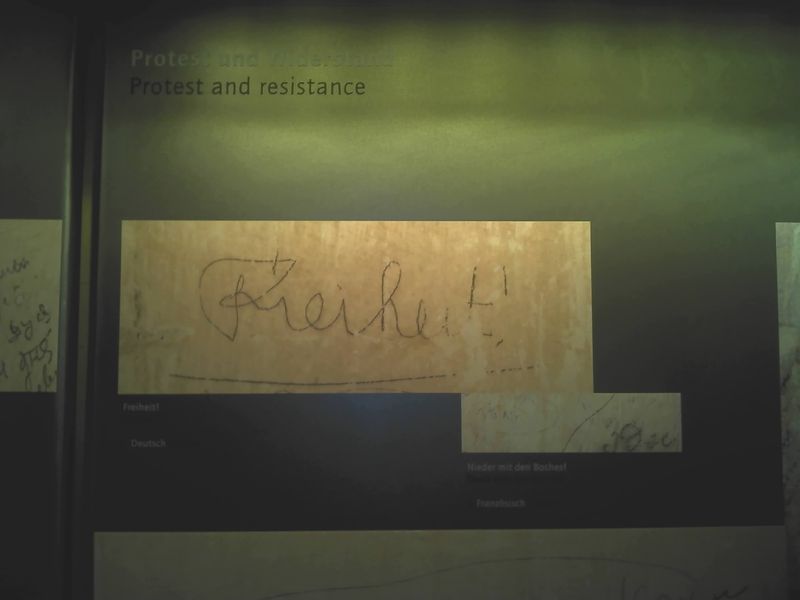
 But it was the lower floors that packed the strongest punch. The basement, just below street level, held the cells — tiny, dank spaces where as many as 30 people had been herded together. And the walls are covered in graffiti in all the languages of Europe — sad, desperate messages to the future from people who were “disappeared”. They seemed to want to leave a record of the fact simply that they had existed: they had loved, they missed their families, they were trying to hold their heads high despite the agonies inflicted daily, they were innocent, they were about to die.…..
 There was one more level — the reinforced rat hole deep underground, which served both as the air-raid shelter for the Gestapo officers (the prisoners were left upstairs in their cells during the raids), and as the torture rooms. Considerately, the Gestapo carried out their most brutal interrogations underground, so that the screams could not be heard at street level.
As we emerged, somewhat silent, from this museum, I noticed that we, and many other visitors, all turned to stare at this building: it looked so bland and innocuous from the outside. But then people would inspect the basement windows that hid the cells. The smokers in the group all sparked up as soon as they were outside, dragging hard on their cigarettes. Others just stood silently.
So the museum does its job. It is a powerful warning from the grave. Homo homini lupus: man is wolf to man, ever has been and ever will be, absent adequate legal restraint. This is why the Universal Declaration of Human Rights was put in place in 1948, to prevent such atrocities from happening again.
Yet, at the risk of sounding sententious, such abuse is going on around the world right now, particularly in the cause of the endless, nebulous “war on terror”. We have been lazy, blind and foolish, letting our basic rights slide away. People are disappeared, extraordinarily rendered, to foreign prisons and tortured for years. Assassination lists have been drawn up by US intelligence agencies; suspects face kangaroo, military-style courtrooms, where they face the death penalty but are not allowed to know the full case against them; our governments aggressively, illegally, invade other countries, and yet the politicians who lie to take us into these wars, thereby causing the needless death, poisoning, maiming and displacement of millions of people, are not called to account for their crimes, as they should be under the Nuremberg Principles, the Rome Statute, and the International Criminal Court.
We, the citizens of still just-about-functioning democracies, should be ashamed. We need to re-remember our history and take a stand — before it’s too late.
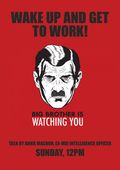 In January I had the pleasure of speaking in The Netherlands at the excellent geekfest known as ETH‑0. Rather than just banging on about the spooks, I thought it was time to take a step back and examine what exactly we mean when we talk about totalitarianism, police states, and how far down the road our countries have gone.
I also wanted to drive home to an audience, many of whom are too young to remember the Cold War, what exactly it would be like to live under a police state with its endemic surveillance.
And here’s the talk:
 I’ve been following the extraordinary case of Gary McKinnon for years now in a long range kind of way, but we are now in the final throes of his prolonged fight against extradition to the USA, and he needs all the support we can give him. The Daily Mail recently started a campaign against his extradition: it’s not often I agree with the Wail, but I’m wholeheartedly in favour of this initiative.
For those of you who have been living in a bunker for the last 7 years, Gary McKinnon is the self-confessed geek who went looking for evidence of UFOs and ETs on some of America’s most secret computer systems at the Pentagon and NASA.
And, when I say secret, obviously I don’t mean in the sense of encrypted or protected. The Yanks obviously didn’t feel that their national defence warrants even cursory protection, as Gary didn’t have to hack his way in past multiple layers of protection. Apparently the systems didn’t even have passwords.
Gary, who suffers from Asperger’s Syndrome, is no super hacker. Using a basic PC and a dial-up connection in his bedroom, he managed to sneak a peek at the Pentagon computers, before kindly leaving a message that the US military might like to have a think about a little bit of basic internet security. Hardly the work of a malignant, international cyber-terrorist.
UK police investigated Gary soon after this episode, way back in 2002. All he faced, under the UK’s 1990 Computer Misuse Act, would have been a bit of community service if he’d been convicted. Even that was moot, as the Crown Prosecution Service decided not to prosecute.
And that, as they say, should have been that.
However, in 2003 the UK government passed yet another draconian piece of law in response to the “war on terror” — the Extradition Act. Under this invidious, one-sided law, the US authorities can demand the extradition to America of any British citizen, without presenting any evidence of the crime for which they are wanted. Needless to say, this arrangement only works one way: if the Brits want to extradite a suspect from the US they still have to present prima facie evidence of a crime to an American court. The Act also enshrines the questionable European arrest warrant system in British law.
So how on earth did the half-wits in Parliament come to pass such an awful law? Were they too busy totting up their expense fiddles to notice that they were signing away British sovereignty? This law means that it is easier for a US court to get a Brit in the dock than it is for them to get a US citizen from another state. In the latter case, evidence is still also required.
Let’s get this straight. The UK authorities decided not to prosecute in this country. Even if they had, Gary would probably have been sentenced to community service. However, if he is extradited, he will get up to 70 years in a maximum security prison in the US.
So a year after Gary’s bedroom hack, and after the CPS had decided there was no case to answer, the US authorities demanded Gary’s extradition retroactively. The UK government, rather than protecting a British citizen, basically said “Yes, have him!”. Gary has been fighting the case ever since.
 He has not been alone. Many people from across the political spectrum see this unilateral law as invidious. And the government reckoned without his mum. Janis Sharp has fought valiantly and indefatigably to protect her son from this unjust extradition. She has lobbied MPs, talked to newspapers, gained the support of many public and celebrity figures. She even recently met the PM’s wife, Sarah Brown, who was reportedly in tears for Gary. Yet still the majority of the parliamentary half-wits refuse to do anything.
In fact, it gets worse. Over the last few years many MPs have signed Early Day Motions supporting Gary’s fight against extradition. But in a recent debate in the House of Commons about the need to revise the provisions of the Extradition Act, 74 of these MPs betrayed him and voted for the government to keep the Act in place. Only 10 Labour MPs stuck to their guns and defied the party Whip. One Labour MP, Andrew MacKinley, will stand down at the next election in protest at this hypocrisy.
This week is crunch time: on Friday a final judicial ruling will be made about the case. It was the last throw of the legal dice for Gary. If this fails, he will have to rely on political intervention, which is possible, to prevent his harmful, unjust and unnecessary extradition to the USA. Please visit the Free Gary website and do all you can in support.