My recent talk at the excellent How the Light Gets In philosophy festival at Hay-on-Wye. With credit and thanks to IAI TV and the staff of the Institute of Art and Ideas, the organisers the event.
My recent talk at the excellent How the Light Gets In philosophy festival at Hay-on-Wye. With credit and thanks to IAI TV and the staff of the Institute of Art and Ideas, the organisers the event.
This article in today’s Guardian about the ongoing repercussions of the Mark Kennedy undercover cop scandal earlier this year piqued my interest.
 It appears that the Crown Prosecution Service (CPS) has suppressed key evidence about the all-too-apparent innocence of environmental protesters in the run-up to their trials. In this case Mark Kennedy aka Stone, the policeman who for years infiltrated protest groups across Europe, had covertly recorded conversations during the planning sessions to break into Ratcliffe-on-Soar power station.
Kennedy offered to give evidence to prove that the unit he worked for at the time, the private and unaccountable ACPO-run National Public Order Investigations Unit (NPOIU), had witheld this key evidence. It now appears that the police are claiming that they passed all the information on to the CPS, which then seems to have neglected to hand it over to the protesters’ defence lawyers.
 Which makes it even more fascinating that in April this year the Director of Public Prosecutions, famous civil liberties QC Keir Starmer no less, took the unprecedented step of encouraging those same protesters to appeal against their convictions because of potential “police” cover-ups.
It’s just amazing, isn’t it, that when vital information can be kept safely under wraps these doughty crime-fighting agencies present a united front to the world? But once someone shines a light into the slithery dark corners, they all scramble to avoid blame and leak against each other?
And yet this case is just the tip of a titanic legal iceberg, where for years the police and the CPS have been in cahoots to cover up many cases of, at best, miscommunication, and at worst outright lies about incompetence and potentially criminal activity.
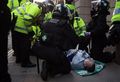 A couple of months ago George Monbiot provided an excellent summary of recent “misstatements” (a wonderfully euphemistic neologism) by the police over the last few years, including such blatant cases as the death of Ian Tomlinson during the London G20 protests two years ago, the ongoing News of the World phone hacking case, and the counter-terrorism style execution, sorry, shooting of the entirely innocent Jean Charles de Menezes, to name but a few.
Monbiot also dwelt at length on the appalling case of Michael Doherty, a concerned father who discovered that his 13 year-old daughter was apparently being groomed by a paedophile over the internet. He took his concerns to the police, who brushed the issue aside. When Doherty tried to push for a more informed and proactive response, he was the one who was snatched from his house in an early morning raid and ended up in court, accused of abusive and angry phone calls to the station in a sworn statement by a member of the relevant police force, sorry, service.
And that would have been that — he would have apparently been bang to rights on the word of a police secretary — apart from the fact he had recorded all his phone calls to the police and kept meticulous notes on the progress of the case. Only this evidence led to his rightful acquittal.
 As Monbiot rightly concludes, “justice is impossible if we cannot trust police forces to tell the truth”.
It appears that the notion of “citizen journalists” is just sooo 2006. Now we all need to be not only journalists but also “citizen lawyers”, just in case we have to defend ourselves against potential police lies. Yet these are the very organisations that are paid from the public purse to protect civil society. Is it any wonder that so many people have a growing distrust of them and concerns about an encroaching, Stasi-like, police state?
This is all part of engrained, top-down British culture of secrecy that allows the amorphous “security services” to think they can get away with anything and everything if they make a forceful enough public statement: black is white, torture is “enhanced interrogation”, and war is peace (or at least a “peacekeeping” mission in Libya.…). Especially if there is no meaningful oversight. We have entered the Orwellian world of NewSpeak.
But plus ca change, plus c’est la meme chose. This all happened in the 1970s and 80s with the Irish community, and also in the 1990s with the terrible miscarriage of justice around the Israeli embassy bombing in 1994. If you have the time, please do read the detailed case here: Download Israeli_Embassy_Case
We need to remember our history.

 Over the last few years there have been a number of egregious cases of police and state cover-ups in the UK around the deaths and wrongful prosecutions of innocent people.
This brings to my mind the appalling miscarriage of justice that occurred in the 1990s when two Palestinian students, a young woman called Samar Alami and a young man called Jawad Botmeh, were both wrongfully convicted of conspiracy to bomb the Israeli embassy in London in July 1994.
In this case a highly sophisticated car bomb as detonated outside the embassy. Thankfully nobody was killed, but a number of people suffered minor injuries. Alami and Botmeh had connections to Palestinian political support groups based in London at the time, many of whom were rounded up during the investigation. Botmeh had naively helped out a shadowy and never-identified figure called Reda Moghrabi, who asked for assistance in buying a second-hand car at auction. This was the car that was used in the explosion.
Why is this case an example of establishment cover-up? Well, this was one of the cases that former MI5 officer David Shayler blew the whistle on during the 1990s. He revealed the existence of two relevant documents that should have been disclosed to the defence but, for some unaccountable reason, were not.
The first, an agent report from a credible and trusted source, pointed to a non-Palestinian group planning the attack before it had even occurred. This report was not acted upon by the MI5 officer responsible, who then tried to cover up her mistake. She was caught out, and there was a much-discussed internal inquiry into the matter within MI5’s G Branch (international terrorism) in late 1994.
But there was another document — one written by G9/1, the senior MI5 officer who oversaw the post-incident investigation. His view was that Mossad, the external Israeli intelligence agency, had carried out a controlled explosion outside its own embassy (the shadowy and unidentified Reda Moghrabi being the potentially crucial missing link) in order to acquire the long-demanded additional security protection around Israeli interests in the UK, and also to shatter the Palestinian support networks in London — a long-term objective of Mossad.
The government at the time tried to dismiss these disclosures. However, the much-missed Private Eye investigative journalist, Paul Foot, and the indefatigable lawyer, Gareth Peirce, followed them up and pursued them tirelessly through the media and the courts.
And guess what? It turns out that these two key documents had indeed not been disclosed to the legal defence team during the trial of Alami and Botmeh — and not just by the hapless spooks. It emerged during the appeal hearing that no fewer than seven people from a variety of police and intelligence organisations had failed to disclose the relevant documentation to the defence. This cannot be explained away as an innocent oversight, a cock-up — it bears all the hallmarks of a deliberate, systemic establishment cover-up.
All this represented, at the very least, a need for a retrial but also a possible gross miscarriage of justice. And yet, while acknowledging that these documents did indeed exist during the appeal hearing and beyond, the presiding m’luds decided to ignore all case law and European law and let those two innocents rot in prison. After all, it would be terribly embarrassing to vindicate the actions of an intelligence whistleblower, wouldn’t it?
As a result, the poor pawns in this sick establishment game, Jawad Botmeh and Samar Alami, ended up serving their full sentences, despite the overwhelming body of evidence proving their innocence, and were finally released in 2008 and 2009 respectively.
For anyone interested in the detailed horror story behind this flagrant miscarriage of justice, here is the relevant chapter from my long-defunct book: Download The_Israeli_Embassy_Case
Here’s the text of an article I wrote for The Guardian a while ago, where I suggest we need a fresh perspective and some clear thinking on the role of the spies in the UK.
Worth reiterating, following the pre-emptive arrest of protesters:
 The cascade of revelations about secret policemen, starting with PC Mark Kennedy/environmental activist “Mark Stone”, has highlighted the identity crisis afflicting the British security establishment. Private undercover police units are having their James Bond moment – cider shaken, not stirred – while MI5 has become ever more plod-like, yet without the accompanying oversight. How has this happened to our democracy without any public debate?
From the late 19th century the Metropolitan Police Special Branch investigated terrorism while MI5, established in 1909, was a counter-intelligence unit focusing on espionage and political “subversion”. The switch began in 1992 when Dame Stella Rimington, then head of MI5, effected a Whitehall coup and stole primacy for investigating Irish terrorism from the Met. As a result MI5 magically discovered that subversion was not such a threat after all – this revelation only three years after the Berlin Wall came down – and transferred all its staff over to the new, sexy counter-terrorism sections. Since then, MI5 has been eagerly building its counter-terrorism empire, despite this being more obviously evidential police work.
Special Branch was relegated to a supporting role, dabbling in organised crime and animal rights activists, but not terribly excited about either. Its prestige had been seriously tarnished. It also had a group of experienced undercover cops – known then as the Special Duties Section – with time on their hands.
 It should therefore come as little surprise that Acpo, the private limited company comprising senior police officers across the country, came up with the brilliant idea of using this skill-set against UK “domestic extremists”. Acpo set up the National Public Order Intelligence Unit (NPOIU). This first focused primarily on animal rights activists, but mission creep rapidly set in and the unit’s role expanded into peaceful protest groups. When this unaccountable, Stasi-like unit was revealed it rightly caused an outcry, especially as the term “domestic extremist” is not recognised under UK law, and cannot legally be used as justification to aggressively invade an individual’s privacy because of their legitimate political beliefs and activism. So, plod has become increasingly spooky. What of the spooks?
As I mentioned, they have been aggressively hoovering up the prestigious counter-terrorism work. But, despite what the Americans have hysterically asserted since 9/11, terrorism is not some unique form of “eviltude”. It is a crime – a hideous, shocking one, but still a crime that should be investigated, with evidence gathered, due process applied and the suspects on trial in front of a jury.
A mature democracy that respects human rights and the rule of law should not intern suspects or render them to secret prisons and torture them for years. And yet this is precisely what our spooks are now allegedly doing – particularly when colluding with their US counterparts.
Also, MI5 and MI6 operate outside any realistic democratic oversight and control. The remit of the intelligence and security committee in parliament only covers the policy, administration and finance of the spies. Since the committee’s inception in 1994 it has repeatedly failed to meaningfully address more serious questions about the spies’ role. The spooks are effectively above the law, while at the same time protected by the draconian Official Secrets Act. This makes the abuses of the NPOIU seem almost quaint. So what to do? A good first step might be to have an informed discussion about the realistic threats to the UK. The police and spies huddle behind the protective phrase “national security”. But what does this mean?
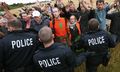 The core idea should be safeguarding the nation’s integrity. A group of well-meaning environmental protesters should not even be on the radar. And, no matter how awful, the occasional terrorist attack is not an existential threat to the fabric of the nation in the way of, say, the planned Nazi invasion in 1940. Nor is it even close to the sustained bombing of government, infrastructure and military targets by the Provisional IRA in the 70s-90s.
Once we understand the real threats, we as a nation can discuss the steps to take to protect ourselves; what measures should be taken and what liberties occasionally and legally compromised, and what democratic accountability exists to ensure that the security forces do not exceed their remit and work within the law.
 An interesting story on Channel 4 TV news today: four London police officers are being prosecuted for beating up Babar Ahmad in 2003 while arresting him on suspicion of terrorism charges. And it turns out that the key evidence for the prosecution comes not from Ahmad’s complaint, nor from photographs of his injuries, but from the product of an eavesdropping device, more commonly known as a bug, planted in his home by the UK Security Service, MI5.
It’s interesting in itself that MI5 has released this information for court proceedings against Met counter-terrorism officers. I shall resist speculating now, but shall be watching developments with interest.
But the point I want to make quickly today is about the use of intercept material as legal evidence in UK courts. This can potentially be crucial for lawyers when speaking to their clients, journalists who wish to protect their sources, polticial activists, and those who simply wish to protect their inherent right to privacy as the encroaching electronic surveillance state continues to swell.
It can also be potentially useful information for MPs talking to their constituents. Indeed, returning to the years-long case of Babar Ahmad, there was a media furore in 2008 when it was revealed that the Met had authorised the bugging of his conversations with his MP Sadiq Khan during prison visits.
And who was the commanding officer who authorised this? Step forward former Met Counter Terrorism supremo, Andy Hayman, that much esteemed defender of British civil liberties who recently suggested “dawn raids” and “snatch squads ” be used against political activists.
Unlike most other western countries, the UK does not allow the use of telephone intercept as evidence in a court of law. As I’ve written before, it’s a hangover from the cold war spying game. MI5 has traditionally seen phone taps as a source of intelligence, not evidence, despite the fact that much of their work is notionally more evidentially based in the 21st century. It also still remains a subject of debate and a fiercely fought reargard action by the spies themselves, who claim telecheck is a “sensitive technique”.
As if we don’t all know that our phones can be bugged.….
However, eavesdropping devices that are planted in your property — your home, your office, even your car — can indeed produce evidence that can be used against you in a court of law. All this requires a Home Office Warrant (HOW) to make it legal, but Home Secretaries are traditionally reluctant to refuse a request in the interests of “national security”. Moreover, if the owner of the property agrees to a bug, even without a HOW, they can be legally used. So if you live in rented accommodation, befriend your landlord!
Not a lot of people know all that — but we should.
 I did two sessions at Hay-on-Wye philosophy and music festival — How the Light gets In in May 2011.
The first was a debate called “An Age of Transparency” with neo-conservative commentator Douglas Murray, and philosopher Nigel Warburton.
The second was my talk about “Spies, Lies, and Life on the Run”.
Here’s a link to a video of my talk.

 Here’s a link to my article in The Guardian today, exploring the confused roles of modern British spies, and looking at some ways to sort out the mess. Both the police and the spooks seem to be having a bit of an identity crisis at the moment…
Are environmental activists really a spying priority?
Revelations about policemen spying on environmental activists suggest we need a sense of perspective on threats to the nation.
The cascade of revelations about secret policemen, starting with PC Mark Kennedy/environmental activist “Mark Stone”, has highlighted the identity crisis afflicting the British security establishment. Private undercover police units are having their James Bond moment – cider shaken, not stirred – while MI5 has become ever more plod-like, yet without the accompanying oversight. How has this happened to our democracy without any public debate?
From the late 19th century the Metropolitan Police Special Branch investigated terrorism while MI5, established in 1909, was a counter-intelligence unit focusing on espionage and political “subversion”. The switch began in 1992 when Dame Stella Rimington, then head of MI5, effected a Whitehall coup and stole primacy for investigating Irish terrorism from the Met. As a result MI5 magically discovered that subversion was not such a threat after all – this revelation only three years after the Berlin Wall came down – and transferred all its staff over to the new, sexy counter-terrorism sections. Since then, MI5 has been eagerly building its counter-terrorism empire, despite this being more obviously evidential police work.
Special Branch was relegated to a supporting role, dabbling in organised crime and animal rights activists, but not terribly excited about either. Its prestige had been seriously tarnished. It also had a group of experienced undercover cops – known then as the Special Duties Section – with time on their hands.
It should therefore come as little surprise that Acpo, the private limited company comprising senior police officers across the country, came up with the brilliant idea of using this skill-set against UK “domestic extremists”. Acpo set up the National Public Order Intelligence Unit (NPOIU). This first focused primarily on animal rights activists, but mission creep rapidly set in and the unit’s role expanded into peaceful protest groups. When this unaccountable, Stasi-like unit was revealed it rightly caused an outcry, especially as the term “domestic extremist” is not recognised under UK law, and cannot legally be used as justification to aggressively invade an individual’s privacy because of their legitimate political beliefs and activism. So, plod has become increasingly spooky. What of the spooks?
As I mentioned, they have been aggressively hoovering up the prestigious counter-terrorism work. But, despite what the Americans have hysterically asserted since 9/11, terrorism is not some unique form of “eviltude”. It is a crime – a hideous, shocking one, but still a crime that should be investigated, with evidence gathered, due process applied and the suspects on trial in front of a jury.
A mature democracy that respects human rights and the rule of law should not intern suspects or render them to secret prisons and torture them for years. And yet this is precisely what our spooks are now allegedly doing – particularly when colluding with their US counterparts.
Also, MI5 and MI6 operate outside any realistic democratic oversight and control. The remit of the intelligence and security committee in parliament only covers the policy, administration and finance of the spies. Since the committee’s inception in 1994 it has repeatedly failed to meaningfully address more serious questions about the spies’ role. The spooks are effectively above the law, while at the same time protected by the draconian Official Secrets Act. This makes the abuses of the NPOIU seem almost quaint. So what to do? A good first step might be to have an informed discussion about the realistic threats to the UK. The police and spies huddle behind the protective phrase “national security”. But what does this mean?
The core idea should be safeguarding the nation’s integrity. A group of well-meaning environmental protesters should not even be on the radar. And, no matter how awful, the occasional terrorist attack is not an existential threat to the fabric of the nation in the way of, say, the planned Nazi invasion in 1940. Nor is it even close to the sustained bombing of government, infrastructure and military targets by the Provisional IRA in the 70s-90s.
Once we understand the real threats, we as a nation can discuss the steps to take to protect ourselves; what measures should be taken and what liberties occasionally and legally compromised, and what democratic accountability exists to ensure that the security forces do not exceed their remit and work within the law.
As I’ve mentioned before, the former heads of UK intelligence agencies have a charming habit of speaking out in support of the rule of law, civil liberties, proportionality and plain common sense — but usually only after they have retired.
Perhaps at their leaving parties their consciences are extracted from the security safe, dusted off and given back — along with the gold watch?
 Even then, post-retirement, they might try to thrice-deny potentially world-changing information, as Sir Richard Dearlove did when questioned by the fearless and fearsomely bright Silkie Carlo about the leaked Downing Street Memo at his recent speech at the Cambridge Union. (The links are in two parts, as the film had to be mirrored on Youtube — Dearlove claimed copyright on the orginal Love Police film and had it taken down.)
And “out of context”, my left foot — he could potentially have saved millions of lives in the Middle East if he’d gone public with his considered professional opinion about the intelligence facts being fitted around a preconceived war policy in the run-up to the invasion of Iraq.
Wouldn’t it be lovely if these esteemed servants of the state, replete with respect, status and honours, could actually take a stand while they are still in a position to influence world events?
 My former boss, Baroness Eliza Manningham-Buller, has been unusually vociferous since her retirement in 2007 and elevation to the peerage. She used her maiden speech to the House of Lords to object to the proposed plans to increase police detention of terrorist suspects without charge from 28 to 42 days; she recently suggested that the “war on terror” is unwinnable and that we should, if possible, negotiate with “Al Qaeda” (well, it worked with the Provisional IRA); and that the “war on drugs” had been lost and the UK should treat recreational drug use as a health rather than a criminal issue. She steals all my best lines.…
But credit where credit is due. Despite the fact that she used the full power of the British state to pursue terrorist suspects up until 2007 and investigate drug barons in the 1990s, she did apparently try to make a stand while en poste in the run-up to the Iraq War. Last year she gave evidence to the Chilcot Enquiry, stating that she had officially briefed the government that an invasion of Iraq would increase the terrorist threat to the UK.
So it’s obvious that once a UK Prime Minister has come over all Churchillian he tends to ignore the counsel of his chief spooks, as we’ve seen with both the Downing Street Memo the Chilcot Enquiry.
With that in mind, I’ve read with interest the recent press reports that the UK authorities apparently knew about Colonel Gaddafi retaining stockpiles of mustard gas and sarin (despite the fact that the world was assured in 2004 that it was his renunciation of WMDs that allowed him back into the international diplomatic fold) .
So the key question is surely: is this another erroneous “45 minutes from attack” moment, with Gaddafi’s alleged stockpiles of WMD a perfect scaremongering pretext to push for a full-on régime change in Libya; or is this genuine, and we were all lied to about Gaddafi’s destruction of his WMD stockpiles for economic advantage and fat, juicy oil contracts?
The Wall Street Journal recently ran an article quoting the concern of “government insiders” about Gaddafi’s potential future terrorism threat against the West, up to and including WMDs, should he cling on to power. Well, yes, it would hardly be surprising if he were now to be as mad as a wasp with his ex-new best buddies. Despite the sordid rapprochement in the last decade, he has been for much of his life an inveterate enemy of the West and sponsor of worldwide terrorism.
Rather than waiting for his “K” and his retirement, would it not be wonderful if the current head of MI5, Jonathan Evans, could extract his conscience from that dusty security safe and make a useful and informed statement to shed some light on the mess that the Libyan war is rapidly becoming? He could potentially change the course of world history and save untold lives.
 What a difference a year makes in the mayfly minds of the old media.
In February 2010 The Guardian’s resident spook watcher, Richard Norton-Taylor, reported that the serving head of MI5, Jonathan Evans, had been forced in 2008 to confess to the credulous and compliant Intelligence and Security Committee in Parliament that the spies had lied, yet again, about their complicity in torture.
This confession came shortly after the ISC had released its “authoritative” report about rendition and torture, asserting that there had been no such complicity. How did the ISC get this so utterly wrong?
It turns out that in 2006 Baroness Eliza Manningham-Buller, Evans’s predecessor in the MI5 hot-seat, had misled the ISC about MI5’s awareness of the use of torture against terrorist suspects, particularly the hapless Binyam Mohamed, whose case was wending its way through the British courts. Bullying-Manner (as she is known in the corridors of power) appears to have been covering up for her predecessor, Sir Stephen Lander, who was quoted in The Telegraph in March 2001 as saying “I blanche at some of the things I declined to tell the committee [ISC] early on”.….
 But Evans had to come clean to the ISC because of the Mohamed court case, and Norton-Taylor wrote, by the Grauny’s standards, his fairly hard-hitting article last year.
Yesterday, however, he seems to be back-tracking frantically. Following an interview by the BBC with former Pakistani President Pervez Musharraf appearing to confirm that MI5 did indeed turn a blind eye to the use of torture, Richard Norton-Taylor and other members of our esteemed Fourth Estate are once again quoting Baroness Manningham-Buller’s dicredited li(n)es to the ISC as gospel truth, and forgeting both the serving head of MI5’s unavoidable confession and the evidence from the Mohamed court case itself.
The ISC was put in place following the 1994 Intelligence Services Act as a democratic fig-leaf: it is not a fully-functioning, independent oversight committee, as it is only able to report on matters of spy policy, finance and administration. It has no powers to investigate properly allegations of crime, torture or operational incompetence, is unable to demand documents or interview witnesses under oath, and is appointed by and answerable only to the Prime Minister. It has been lied to by the spies and senior police time and time again — the very people it notionally oversees. As I have written before, the ISC has since its inception failed to address many key intelligence matters of the day, instead spending its time nitpicking over details.
In the face of this utter lack of intelligence accountability and transparency, is it any wonder that sites like Wikileaks have caught the public’s imagination? Wikileaks is an obvious and necessary reaction to the endemic secrecy, governmental back-scratching and cover-ups that are not only wrong in principle in a notional democracy, but have also resulted directly in illegal wars, torture and the erosion of our traditional freedoms.
 Peter Taylor, a respected journalist at the BBC, argues that if there had been more coöperation between MI5 and regional police Special Branches, then the 7/7 bombings in London in 2005 could have been prevented. His thesis appears to be that MI5 did not work closely enough with the police (the executive branch) of the UK’s intelligence community: the aptly-named Operation Crevice has exposed the cracks in the unified public façade of the UK intelligence community.
However, Taylor assures us that this problem is in the past, with MI5 officers and Special Branch police now happily working side by side in regional offices across the UK. So that’s OK then.
It continues to surprise me that seasoned British journalists repeatedly fall into the post‑9/11 group-think of the USA — that terrorism is a new phenomenon. Rather startlingly, Taylor’s article even asserts that the FBI had the Crevice information in real-time, while the West Yorks SB was left in the dark.
Those in the UK with a memory longer than a mayfly’s will be aware that this country endured 30 years of Irish Republican terrorism, and during the 1990s MI5 had lead responsibility for investigating this threat. So from 1993 the spooks did indeed work side-by-side with their regional SB counter-parts across the country. During this period the emphasis was on gathering both intelligence to pre-emptively thwart terrorist plots and also evidence to use in the ensuing court cases. And there were some notable successes.
So what changed in the following decade? Did the spooks retreat back behind the barricades of their London HQ, Thames House, as the ink dried on the Good Friday Agreement? Were the hard-won lessons of the 1990s so quickly forgotten?
Well, certainly other lessons from the civil war in Nortern Ireland appear to have been expunged from the collective intelligence memory. For example, the use of torture, military tribunals, internment and curfews were all used extensively in the early years of the NI conflict and all were spectacularly counter-productive, acting as a recruiting ground for new generations of terrorists. Yet these practices now once again appear to be implicitly condoned by MI5 and MI6 in the USA’s brutal “war on terror”.
So one would hope that this new BBC programme calls for a reappraisal of our intelligence infrastructure. Why should we mindlessly continue to accept the status quo, when this results in lessons being forgotten and mistakes being repeated? How about the BBC calling for a root and branch review of the threats the UK realistically faces, and the most efeective way to guard against them, while working within the democratic process?
Paradigm Shift TV (Sky 201 and 203) produced this film of my talk at the Cambridge Union Society in January 2011:
With thanks to Keith and Steve!
 It’s a busy couple of months for talks, and I have the pleasure of speaking at the Durham Union Society tomorrow night (16th February).
My talk will be focusing on the modern role of intelligence agencies, the war on terror, what it’s like to be recruited to work as a spook, whistleblowing, Wikileaks, police states and civil liberties. An eclectic mix.
The talk is open to all students, not just members of the Union, so if you’re in the area and have the time, do come along!
The Secret Service: “A very British mess”
Olivia Crellin interrogates Annie Machon on her life after MI5
by Olivia Crellin
Thursday 3rd February 2011
Annie Machon, former MI5 agent, is the image of glamour and guts. Her blonde hair, of the bombshell variety, frames a face that, far from being that of the reserved and stealthy spook, exudes energy, enthusiasm, and openness.
 Unlike her former partner, the whistleblower David Shayler, Machon seems to have emerged relatively unscathed from the years immediately following the couple’s attempts to reveal serious MI5 blunders in 1996.
Now working as a self-professed “author, media pundit, journalist, campaigner and prominent public speaker”, she has made a “new way of life” out of selling herself, her past, and her story. And she’s doing a good job.
Machon, who studied Classics at Cambridge, is the most recent in a long line of famous spies to have emerged from the University – most notably the Cambridge Spies who defected to the Russians during the Cold War.
Best known for her whistle-blowing on issues such as MI5’s alleged involvement in the attempted assassination on Gaddafi, Machon is an oft-consulted expert on current affairs topics such as Wikileaks, the infiltration of activist groups, and the 9/11 Truth Movement, critiquing what she sees as contemporary society’s descent into a “police state”.
Commenting on the “very British mess” that is the current UK Intelligence Services, Machon’s answers to my questions blend personal anecdote with hard-hitting assertions. She sounds convincing. Despite no longer having any insider information, she still has plenty to say.
Recruited during the “marginally golden ethical era” of the 1990s, Machon’s experience of MI5 was nevertheless riddled with antiquation, confusion, insularity and suffocation.
Drawing attention to MI5 and MI6’s “culture of just-follow-orders”, an ethos that former head of MI5 Dame Stella Rimington also acknowledged, Machon believes that the UK Intelligence Services have, for a long time, been their own worst enemy.
Entrenched in unnecessary laws, a “hangover” from the organisation’s counter-espionage origins, Machon states that until the spooks “open up a little bit to constructive criticism from the other side, so that [MI5] can get a bit of fresh air, they’re going to spiral down into… torture and things.”
While Machon asserts that there was no use of torture in her time with the agency – it was considered “counter-productive” and “unethical” – she did hear some horror stories from the older boys’ experience in Northern Ireland including one case concerning an agent, codenamed Steak Knife, who was permitted to torture and even kill his fellow intelligence officers in order to keep his cover in the “Nutting Squad” of the IRA – “A sick James Bond gotten out of hand.”
Machon refers to these stories as “a sort of petri dish of the abuses that we are seeing now with the Muslim community”. Just as the trend to target one group of society returns, the use of torture, as experienced in Ireland, comes full circle. “It makes me shiver,” Machon tells me, “that people who were perhaps my friends, idealistic twenty-somethings when I was an officer, who I might’ve had drinks with, had dinner with, whatever, might be those people now.”
While there seems to be a “democratic will” to get rid of “some of the more Draconian laws from under the last government”, Machon believes that instances such as Mark Kennedy’s undercover infiltration of an activist group demands society to take a closer look at the ways in which we protect national security. “Once you start eroding someone’s civil liberties on one front, it’ll cascade. That’s how Germany found itself in a Fascist state in the 1930s,” the former-spy asserts. “They didn’t wake up one morning and Hitler was in power. It’s a very slippery slope.” This is why Machon, above all other issues, is calling for an “adult debate” about the workings of Secret Intelligence in a “mature democracy”.
One organization that Machon sees as contributing to this debate is Wikileaks. Machon praised this form of new media, calling it “fantastic” as a “high-tech conduit to enable whistleblowers” in contrast to the “self-censorship and fear” of the mainstream press, which blocks the flow of such information to the public.
Machon advised students at the Cambridge Union to find alternative sources of information for their news, citing countries’ deceptive use of false-flag terrorism. “I’m not saying that every major terrorist atrocity might be a dirty trick, but you have to keep that possibility in the back of your mind,” she warned.
“It’s all about a sort of breach of trust,” Machon concludes, which is “corrosive for a democracy.” Whether it’s an issue like 9/11, or the bailing out of the banks or the war in Iraq, Machon asserts that the erosion of civil liberties is finally forcing society to “become democratically engaged again, which cannot be bad.”
In many ways Annie Machon is serving her country as stealthily and determinedly as if she had never left MI5. Taking the “same sort of fundamental drive to try and make a difference, to try and change things for the better,” into this new arena of her work, she hands me a red-and-black business card with her shades-toting self on it and the phrase “Using Our Intelligence” emblazoned on the front.
“There’s always the debate,” she tells me cryptically, “is it better to be inside the tent pissing out or outside the tent pissing in?”
 Well I had a fab time revisiting the old place last week to do a talk at the Union Society — somewhere I spent many happy hours, oh, aeons ago!
Many thanks to Rebecca and the rest of the team for organising and hosting the event, and to Silkie for setting the whole ball rolling.
It was a busy weekend. The Friday evening began with an all-too-brief appearance at the first meeting of a new group, MI7 — can I say that, or is it a state secret? — organised by Silkie and Charlie Veitch of the Love Police.
 It was strange to go back to the Union as a speaker after so long and so many unusual experiences. The audience seemed to stay wide awake for my hour-long talk, and the questions afterwards were interesting, lively and varied. I was also encouraged to see that ideas deemed to be “radical” only a few years ago are now going mainstream.
The next day was taken up with interviews for The Cambridge Student and Varsity student newspapers, Sky 203 Channel, and a photo shoot with QH Photography for a gallery exhibition in London later this year.
The Cambridge Student journalists gamely allowed the interview to be film by Sky 203 — not the easiest of scenarios.
“Varsity” newspaper did a colourful and intelligent interview — thanks Olivia! — which was rapidly followed on the newspaper website today with this puff piece about MI6.
I can only assume that this is merely balanced news reporting, especially as the Master of Pembroke College, Chair of the Trustee Board of the Union Society, and former head of MI6, Sir Richard Dearlove, will be speaking at the Union in a couple of weeks.….
 Certainly an interesting juxtaposition!
The photo shoot was fun, and the results will be appearing in London at the end of this year. As you can see from the photo on the left, Huy takes a mean picture.
I also ran into Ryan J‑W Smith, who is in the process of completing his intriguing film, 2Plus2Makes4. Limited private and festival screenings are expected this summer.
The film synopsis asks some fundamental questions:
“How close are we to sliding into Orwell’s totalitarian nightmare, ‘1984’? Controversial, shocking, powerful and honest — starring Tony Benn, Gore Vidal, former MI5, CIA, FBI agents, Senators, Presidential Nominees, etc. A ‘Must-See’ feature documentary from award-winning filmmaker, Ryan J‑W Smith. Smith’s previous films have received 16 International Film Festival Selections, 5 ‘Best Film’ Nominations, and 4 ‘Best Film’ wins.”