This did make me laugh — The Onion News strikes again! Who says the Americans have no understanding of satire?
Diebold voting computers leak critical info, messing up the whole charade around the 2008 US Presidential election.
This did make me laugh — The Onion News strikes again! Who says the Americans have no understanding of satire?
Diebold voting computers leak critical info, messing up the whole charade around the 2008 US Presidential election.
Interview in Emel Magazine, November 2007
Table Talk
Espionage, intrigue and life-on-the-run are all part and parcel of Annie Machon’s history. Sadia Chowdhury speaks to the former MI5 agent about the consequences of exposing what goes on behind the scenes at one of the world’s most renowned secret
services.
 It was the Saturday night of the August bank-holiday weekend in 1997 when Annie Machon and her boyfriend packed their bags and took the first two seats they could find out of Britain. They had spent the last ten months of
their lives trying to settle into their new jobs knowing that a day would come when they would blow the whistle on their former employer
and turn their lives upside down.
Machon had turned her back on a six-year career as a spy to stand by the man she loved. Her boyfriend was David Shayler, a high-flying MI5 officer who exposed, what he said, was the Intelligence Service’s plot to assassinate the Libyan leader, Muammar Gaddafi.
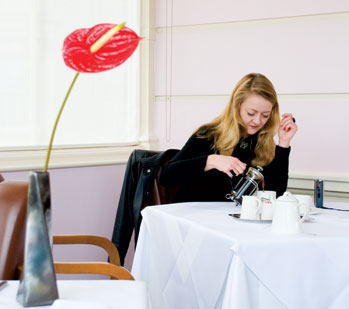
The two are no longer together but as we meet for coffee in a London hotel, Machon shows no regret at the way things took shape. Dressed entirely in black, it’s her sunshine blonde hair that lights up an otherwise dull background to the city’s scaffold-clad landscape.
Her life as an MI5 officer was no James Bond film, but you can still see that Machon is the perfect spy. With an unsuspecting face and a handshake that feels like you have known her all your life, the 39 year old campaigner rescinds the myth of the glamorous, martini-sipping spy world. “No, it’s much, much more mundane”, she laments before telling me that much of the job can constitute mind numbing behind-the-desk work.
But unknown to Machon at the time, a career that started off as a simple application to work for the Foreign Office, soon developed into a plot fit for a blockbuster Hollywood movie.
“My first reaction was ‘It’s MI5!’ I was really quite frightened”, she says, recalling a letter from the Ministry of Defence which offered her alternative jobs with the Intelligence Services. “My father was with me when I opened the latter and he just said ‘let’s see what happens’. ”
What ‘happened’ was ten months of intensive application processes for the Cambridge Classics student to undergo at the establishment. Recovering from a post-Cold War reputation marred with embarrassing revelations and intelligence failures, Machon says her recruiters insisted they were aiming to work within the legal framework for the
first time.
It was 1990, only one year after the Security Service Act placed the Service on a statutory
basis: a fact that helped Machon believe what she was being told. “They were saying ‘we obey the law, we work within the law; we don’t do all the political stuff like we used to’. But unfortunately my first posting was in the political section so I learnt quite quickly that they had lied to me.”
Machon confesses a sceptical attitude soon developed after she was instructed to uncover “old communists” summarising files on anybody who stood for parliament in the 1992 elections. Sharing her strong concerns was one David Shayler, a former Sunday Times journalist who had worked with her in F2, the counter-subversion section of MI5.
Within a year, the two fell in love — a bond that was to see them stand together against what she describes as a catalogue of errors and crimes committed by MI5. “There was a lot of concern about how MI5 wasn’t obeying the law and how it was getting its priorities wrong,” Machon says, hastening to add that other officers had approached management with their concerns only to be told to shut up. “Most organisations are pyramid shaped and MI5 has this bulge in the middle, full of managers who aren’t going anywhere because they’re not very good at their jobs. But they don’t get sacked and they were the ones blocking a lot of the new ideas that were coming in.”
One consequence of this incompetence, Machon explains, left MI5 with blood on its hands. Machon and Shayler were moved to T Branch, where they worked on countering Irish terrorist threats. Shayler was to claim later that MI5 could have prevented the 1993 IRA bombing of Bishopsgate in the City of London, which left one dead and 44 injured.
“You’re in the firing line,” Machon tells me plainly, pausing a moment as the waitress brings coffee to our table. She goes on to describe the events that lead her to leave MI5 before slowly pushing down on the filter. It was still the early 1990s and Machon’s partner Shayler was now head of the Libyan desk, responsible for ‘Middle Eastern terrorism’.
He was allegedly briefed by his MI6 counterpart about a plot to assassinate the Libyan leader. It is thought the plan involved funding and equipping a Libyan opposition group which Machon describes as an “Islamic extremist network” to carry out the deed. In March 1996, a bomb exploded in the coastal city of Sirte, missing Gaddafi’s motorcade but killing several civilians. Shayler claimed that MI6 had been involved in the failed assassination attack without the authorisation of the then foreign secretary — as
required under English and international law. The Intelligence Services denied any involvement in this, or several other cases that Shayler accuses the Service of being complicit in. One of those incidents took place in July 1994, when a car bomb exploded outside the Israeli embassy in London injuring 20 people: an attack Shayler says had prior knowledge of and could have prevented.
Half-way through her coffee, Machon goes back to the events of 1996 when she and Shayler decided to leave. “It was incremental because you got posted every two years to a new section and you think ‘okay, that section was wrong but the new section has different managers and is going to be better’. But we moved three times and every time we saw the same mistakes happen. Then the Gaddafi plot pushed our decision to leave.” Nor was it just Shayler and Machon who quit the Intelligence Service that year. Fourteen other officers who had all been recruited around the same time left MI5 in the same year — up from an average of two or three departures a year.
“It took about a year to get the whole thing working. After about ten months, we got this
phone call — David was called by The Mail on Sunday to meet the editor and we were given three days notice that our lives were going to be turned upside down.” Machon recalls how the Mail’s editor offered Shayler cash to leave the country and avoid arrest.
“At that stage after a year of build-up, we just packed up and left.
The couple flew out to Holland, then on to France, spending the next month on the run moving from hotel to hotel almost every night. Machon then decided to return to the UK, and doesn’t hesitate as she relates the story — one she’s probably told a thousand times but one that still brings a look of amusement to her face. “I flew back with my lawyer John
Wadham, head of Liberty, the human rights organisation. He had already told the police that I was coming back — on which flight, at what time, and that I was going to hand myself in. So it was a bit of a shock to be met at immigration by six Special Branch officers who pulled me off to a counter-terrorism suite in Charing Cross police station!”
Machon was released after a day of questioning and a week later joined Shayler back in
France. “We had ten months holed up in this freezing cold, really remote farm house. And during that time we tried to negotiate with the government saying ‘look, we have all this other evidence to give you so you can build an enquiry’, but they just strung it out, kept us quiet, and did nothing.”
It was a particularly stressful time for both Shayler and Machon; as whistleblowers they had depended on support from the press, but with Diana’s death just a week after their story broke, Machon says they lost the support that had been building amongst the media. “We didn’t know what to do. We had no chance of getting another job because once you blow the whistle, other big organisations don’t trust you.” But does she regret what she did? “No. You can’t regret anything in life. I am still proud of what David and I did. Someone has got to take a stand sometimes.”
The question is of course, whether she will have trouble taking that stand now: especially as after a decade since The Mail on Sunday article was released and after having spent years on the run together, Machon and Shayler split up last year. David Shayler now lives in Devon and frequents the media over a different revelation: his recent conviction that he is the Messiah. In a recent television appearance he said “As the Holy Spirit is God incarnate as essence, I am God incarnated as spirit and man.” Machon takes a moment to contemplate and in reaction to my question simply says, “The stress just got to him.” Her answers now become shorter and shorter. “We separated last year”, before adding, “I’m sure eventually we’ll regain our friendship.”
But doesn’t Machon think her former partner’s claims will ruin their credibility? “I think yes, it has destroyed his credibility and I think that’s tragic. It’s a gift for the intelligence agency — they can turn around and say ‘oh, well, he always was mad — he’s a fantasist’,
which is unfortunate because what we were talking about was so important in terms of where our democracy is and who really runs this country.”
A final sip of coffee concludes our meeting as Machon prepares to leave the grey cityscape backdrop for yet another appointment. Though scorn of recent revelations seeks to undermine what the two ex-spies were fighting for, when it comes to struggling to unveil the truth, Annie Machon for one cannot be as easily dismissed.
My article in AltVoices.org, June 2007:
THE OFFICIAL SILENCING ACT
Last month the UK’s draconian secrecy laws were again used to criminalise two honourable whistleblowers. The UK’s supine mainstream media failed both to question the validity of these convictions and to hold the government to account.
by Annie Machon
On May 9 David Keogh, a 50-year-old communications officer in the Cabinet Office, and Leo O’Connor, 44, a researcher for an anti-war Labour MP, were convicted of breaching the Official Secrets Act (1989).
Keogh’s crime was to have leaked an “extremely sensitive” memo to O’Connor, detailing a conversation about Iraq between Tony Blair and George W. Bush in April 2004.
Keogh passed the document to O’Connor to give to his MP in the hope it would reach the public domain, expose Bush as a “madman”, and lead to questions in Parliament. The memo was deemed to be so secret that much of the trial was held in camera.
Keogh was found guilty of two breaches of the OSA, O’Connor of one, and they received sentences of six months and three months respectively.
 This bald summary of the case was all that appeared in the mainstream UK media. No doubt many people will have taken this case at face value. After all, the UK should be able to protect its national security and impose tough legal sanctions for treachery, shouldn’t it?
Except that this was not treachery. Keogh and O’Connor were not passing the UK’s secrets to an enemy power. They acted from conscience to expose possible wrongdoing at the highest level.
The media should have use this trial to address the ongoing debate in the UK about the continual use and abuse of the OSA. Unfortunately for the British people, the media toed the official line and kept quiet.
The UK’s secrecy laws are a very British muddle. The first OSA was enacted in 1911 to prosecute traitors. This law remained in place until the 1980s, when the Thatcher government was rocked by the allegations of civil servant Clive Ponting about a cover-up over the attack on the Argentine ship the General Belgrano during the Falklands War.
During his trial, Ponting relied on the public interest defence available under the 1911 Act. He was acquitted, and the Conservative government immediately drew up a new law, the 1989 OSA. This new law was designed primarily to intimidate and silence whistleblowers. Treachery is still prosecuted under the 1911 Act.
The 1989 Act, opposed at the time by Tony Blair and most of the current Labour government, ensures that anyone who is or has been a member of the intelligence community faces two years in prison if they disclose information relating to their work without permission, regardless of whether they are blowing the whistle on criminal activity.
Since coming to power in 1997, Blair’s government has repeatedly used this Act to suppress legitimate dissent, silence political opposition and protect criminals within the intelligence establishment.
In 1997, MI6 whistleblower Richard Tomlinson had no option but to plead guilty during his trial, and was sentenced to six months in prison.
Around the same time MI5 whistleblower David Shayler disclosed the illegal 1995 MI6 plot to assassinate Colonel Gaddafi of Libya, as well as a string of other crimes committed by MI5.
During his trial Shayler argued that, under Article 10 of the European Convention of Human Rights, legislation such as the OSA is only proportionate in suppressing a whistleblower’s right to speak out in order to protect “national security”.
However, his judges effectively ruled that this right should also be curtailed for “national interest” considerations. This nebulous concept, undefined for the purposes of the OSA, is routinely wheeled out to spare the blushes of politicians and incompetent spy agencies.
In 2002 Shayler did win from the courts the defence of “necessity”. However, the Law Lords specifically denied him this defence without hearing his evidence. Shayler was convicted in November 2002 of three breaches of the OSA and sentenced to six months in prison.
In 2003 the late Dr David Kelly would also have faced an OSA trial for his alleged comments about the government “sexing up” the notorious dodgy dossier before the war in Iraq.
The 1989 OSA does not just apply to those in and around the intelligence community. Other civil servants, as well as journalists who publish their disclosures, face the same prison sentence if the prosecution can prove “damage to national security”. Keogh and O’Connor were convicted under these provisions, although the prosecution reportedly relied only on the “national interest” argument.
The UK government is increasingly concerned about security leaks during the unending “war on terror”, and is now talking about doubling to four years the sentence for whistleblowing.
By failing to challenge this or to campaign for the restoration of the public interest defence, journalists are complicit in criminalising honourable people. The media’s craven attitude allows the government and intelligence agencies to continue literally to get away with murder.
Thanks to Wikileaks the concept of whistleblowing is once again, rightly, back in the prime-time news slots.
To highlight the British legal doublethink when it comes to whistleblowing cases, I reproduce below an article I wrote in 2006 for the excellent UK Campaign for Press and Broadcasting Freedom organisation (CPBF).
Basically, the ruling stated that a whistleblower cannot repeat their own disclosures in public, even though anyone else in the world can:
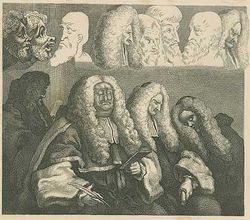 In 2006 I hadn’t heard of Mr “Justice” Eady (he had yet to reach his maximum velocity), but he seems to have built up of bit of form since then. He is now most notorious for his punitive rulings in many “libel tourism” cases and celeb sex scandals, not to mention the odious concept of the super-injunction, startlingly exemplified in the Trafigura case about allegations of dumping toxic waste off the Ivory Coast — one of Wikileaks’s earlier media successes.
Obviously Eady, the man in charge of ruling on UK freedom of expression cases, was the person to go to if you had something to hide.
Thankfully he was replaced earlier this year by Michael Tugendhat QC, who fluently represented the media’s corner during the Shayler whistleblowing years, and some of Eady’s most egregious decisions have already been overturned by his successor.
 Another success for British justice — Annie Machon (31÷7÷06)
It was another resounding success for British justice, according to Annie Machon. Mr Justice Eady granted a permanent injunction against David Shayler in the High Court today (Friday 28 July). In a breathtaking ruling, Eady stated that David was not entitled to present evidence or cross-examine his accusers (again), but instead issued a summary judgement based on assertions made by MI5.
This means that David can now only talk about a restricted range of disclosures — specifically what appeared in the Mail on Sunday on 24 August 1997. This means that he cannot talk about a whole range of topics which are in the public domain and have already been cleared via the injunction and for the publication of my book, Spies, Lies and Whistleblowers.
Specifically, this means that, while I and the rest of the world can talk about state-sponsored false-flag terrorism, including the Gaddafi plot, David is banned. Very convenient when the 911 campaign is taking off.
The temporary injunction was issued in September 1997 on the explicit understanding that a full legal hearing would be needed before it could be made permanent. David has now been denied this.
Also, the injunction has been abused repeatedly, for example allowing the government to spin lies against him when he wished to reveal the wrongful conviction of two innocent Palestinians, Samar Alami and Jawad Botmeh, for the bombing of the Israeli embassy in London in 1994. Also, when he tried to alert the government to murder and a major terrorist attack organised by MI6 officers in the Gaddafi plot, he did so legally via the injunction.
For his pains, he was the one thrown in prison in Paris in 1998.
The injunction has also repeatedly been used to intimidate journalists (one of whom was tried and convicted) and to stop the media investigating the criminality of MI5 and MI6. With this ruling, the judge has also abolished at one stroke the media’s right to publish whistleblowers’ testimony if they can argue it caused no damage to national security.
If any future whistleblower emerges from the intelligence services, and is injuncted, the media has lost this defence, enshrined by parliament in criminal law (Section 1.5 of the OSA). And why is an injunction necessary anyway? There already exists a criminal sanction under the Official Secret Act. The judge was kind enough to say that the injunction was for David’s own good and would stop him having to break the OSA again! We are through the looking glass.
Yours in wonderland, Annie
This is an article of mine that appeared in The Guardian on Wednesday August 03 2005 .
MI5 must back use of phone-taps
When I worked in MI5 in the 1990s, the use of telephone intercept material (codenamed Linen) was even then a hot topic of discussion. Most of the newer officers and the legal advisers advocated its use. The MI5 old guard tried to claim that it was a sensitive
technique and if used in court, telephone intelligence would be lost.
Everyone knows telephone lines can be bugged. And if, in a specific court case, evidence of particular sensitivity occurred in an intercept, its existence could be protected by public interest immunity certificates.
The withholding of Linen is a hangover from the cold war, when telephone taps were used purely to gather intelligence on espionage and political targets. Now that MI5 is doing largely police-style, evidential work to bring terrorists to trial, it needs to update its methods.
Intelligence gathered from bugs planted in a suspect’s property is already used as evidence in British courts, although this is arguably a more sensitive technique. Most western democracies allow the use of intelligence derived from telephone bugs.
Most Belmarsh internees are incarcerated on the basis of “secret and reliable intelligence” — ie telephone taps — which cannot be used in a court of law to charge them. Perhaps MI5 does not want Linen exposed to the scrutiny of a court of law in these cases because the intelligence is so weak.
In the early 1970s, the then prime minister, Harold Wilson, was dissuaded from employing Judith Hart as a minister because of “secret and reliable intelligence”. It turned out that all she had done was ring up a friend who happened to work in the Communist party HQ and call her “comrade”, a practice common in leftwing circles at the time.
MI5 needs to drag itself into the 21st century and allow its intelligence to be used as evidence. It needs to ensure that the new breed of terrorists threatening our country can feel the full force of British justice, nota bullet in the back of the head.
Annie Machon is the author of Spies, Lies and Whistleblowers: MI5 and the David Shayler Affair
Irish Sunday Tribune, July 2005
What really went on in the secret service?
Suzanne Breen
‘THEY’RE probably out there now, walking about, looking for targets, ” says former spy, Annie Machon, as she surveys the bustling bars, restaurants and shops in Gatwick Airport. MI5 used Heathrow and Gatwick in training courses. Officers would be sent to the airports and instructed to come back with one person’s name, address, date of birth, occupation and passport or driving licence number … the basic information for MI5 to open a personal file.
“They’d have to go up to a complete stranger and start chatting to them. One male officer nearly got arrested. It was much easier for women officers … nobody’s suspicious of a woman asking questions.”
Tall, blonde and strikingly elegant, Machon (37) could have stepped out of a TV spy drama. She arrives in a simple black dress, with pearl earrings, and perfect oyster nails. She is charmingly polite but, no matter how many questions you ask, she retains the slightly detached, inscrutable air that probably made her good at her job.
A Cambridge Classics graduate, her book, <em>Spies, Lies and Whistleblowers</em>, has just been published. She worked in ‘F’ branch … MI5’s counter-subversion section … and ‘T’ branch, where she had a roving brief on Irish terrorism. MI5 took 15 months to vet the book. Sections have been blacked out. If Machon discloses further information without approval, she could face prosecution under the Official Secrets Act.
She left MI5 deeply disillusioned. In 1997, she went on the run from the UK with her boyfriend, former fellow spy David Shayler (39). He was subsequently jailed for disclosing secrets, including that MI6 had allegedly funded a plot to assassinate Colonel Gaddafi.
Machon had “responsibility and freedom” in MI5 when combating Irish terrorism. “It was wonderful when you got results, when you stopped a bomb. That was why I’d joined. There was a huge understanding of the IRA and the Northern Ireland conflict. We weren’t just a bunch of bigots saying “string up the terrorists”. Some managers might have had that attitude but it wasn’t shared by most officers. They acknowledged the IRA as the most professional terrorist organisation they’d dealt with. Loyalists, and republican splinter groups like the INLA, were a lot less sophisticated.”
Machon didn’t witness state collusion but is “watching with interest” as cases unfold. She voices some ethical concerns: MI5 ran a Garda officer as an undeclared agent, which was illegal in the Republic. If it wanted to tap a phone in the Republic, no warrant was needed and there was no oversight procedure. An MI5 officer simply asked GCHQ, which intercepts communication, to set it up.
MI5’s approach to the law led to bizarre situations:
“Officers covertly entered a house in Northern Ireland to install bugging equipment. They trashed it up and stole things to make it look like a burglary. But MI5 lawyers said it wasn’t legally acceptable to steal so the officers had to go and put the goods back which made it look even more suspicious.”
Machon attended security meetings in Northern Ireland. Her life was never in danger, she says. The only colleagues she knew who were killed were on the Chinook helicopter which crashed off the Mull of Kintyre in 1994.
Machon had joined the intelligence services three years earlier. She worked from an office in Bolton Street, Mayfair, one of MI5’s three buildings in London. “It was very dilapidated. There were ancient phones, with wires crossing the floor stuck down with tape. It had battered wooden desks and threadbare carpets. There were awful lime-green walls. The dress code in MI5 was very Marks and Spencer. MI6 (which combats terrorism abroad) was much smarter, more Saville Row.”
MI5’s presence in the building was meant to be a secret but everybody knew, says Machon: “The guide on the open-top London tour bus which passed by would tell passengers, ‘and on your right is MI5’. We were advised to get out of taxis at the top of the street, not the front door, but all the drivers knew anyway. Later, we moved to modern headquarters in Thames House.”
Being a spy isn’t what people think, Machon says. “It wasn’t exactly James Bond, with glamorous, cocktail-drinking espionage. There were exciting bits, like meeting agents in safe houses, but there were plenty of boring days. Mostly, I’d be processing ‘linen’ — the product from telephone taps … or reading intercepted mail or agents’ reports. You get to know your targets well from eavesdropping on their lives. You learn all sorts of things, like if they’re sleeping with someone behind their partner’s back. It’s surreal knowing so much about people you don’t know; and then it rapidly becomes very normal.”
 Machon claims the intelligence services were often shambolic, and blunders meant three IRA bombs in 1993 … including Bishopsgate, which cost £350m …could have been prevented. “MI5 has this super-slick image but sometimes it was just a very British muddle. Tapes from telephone taps would be binned without being transcribed because there wasn’t the personnel to listen to them. On occasions, MI5 did respond quickly, but then it could take weeks to get a warrant for a phone tap because managers pondered so long over the application wording … whether to use ‘but’ or ‘however’, ‘may’ or ‘might’.
“Mobile surveillance (who follow targets) were bloody good. There were some amazingly capable officers who were often wasted. Despite everything promised about MI5 modernising, it remained very hierarchical, with the old guard, which had cut its teeth in the Cold War, dominating. They were used to a static target. They’re not up to the job of dealing with mobile extremist Islamic terrorism. We’ve been playing catch-up with al Qaeda for years.”
Machon says MI5 pays surprisingly badly: “I started on £15,000 … entrants now get about £20,000. A detective constable in the Met was on twice my salary. Of course, it’s about more than money but you must reward to keep good people. If you pay peanuts, you end up with monkeys.”
Machon grew up in Guernsey, in the Channel Islands, the daughter of a newspaper editor. “I was apolitical. My only knowledge of spying was watching John Le Carre’s drama Tinker, Tailor, Soldier, Spy.” After taking Foreign Office exams, she received a letter on MoD notepaper. “There may be other jobs you would find more interesting, ” it said. Intrigued, she rang. It was MI5.
During the recruitment process, every aspect of her life from the age of 12 was investigated. “I’d to nominate four friends from different phases of my life. After they were questioned, they had to nominate another four people. I confessed to smoking dope twice. I was quizzed about my sexual history by a sweet old lady who looked like my grandmother but resembled Miss Marple in her interrogation. She asked if I was gay. The rules have since changed, but then MI5 regarded homosexuality as a defect. If you lied and were found out, you’d be sacked on the spot. In theory, they regarded promiscuity as a weakness, but there were plenty of extra-marital affairs. One couple were twice caught shagging in the office. The male officer, who was very bad at his job, was put on ‘gardening leave’ … sent home on full pay. The woman, an Arabic-speaking translator who was great at her job, was sacked.”
A culture of “rampant drunkenness” existed, says Machon: “There was an operation against a Czech diplomat who was also a spy. The officer running it got pissed, went round with his mates to the diplomat’s house, and shouted operational details through the letter-box at him.”
Recruits were encouraged to tell family and close friends they were MI5, and anyone else that they worked for the MoD.
 MI5 had one million personal files (PFs), Machon says. “I came across files on celebrities, prominent politicians, lawyers, and journalists. It was ridiculous. There were files on Jack Straw, Mo Mowlam, Peter Hain, Patricia Hewitt, Ted Heath, Tony and Cherie Blair, Gareth Peirce, and Mohamed Al Fayed. There was a file on ‘subversives’ in the music industry, including the Sex Pistols and UB40.
At recruitment, I was told MI5 no longer obsessed about ‘reds under the bed’, yet there was a file on a schoolboy who had written to the Communist Party asking for information for a school project. A man divorcing his wife had written to MI5 saying she was a communist, so a file was opened on her. MI5 never destroys a file.”
The ranking in importance of targets could be surprising. PF3 was (and is) Leon Trotsky; PF2, Vladimir Ilych Lenin; PF1 was Eamon De Valera.
MI5 currently has around 3,000 employees. About a quarter are officers; the rest are technical, administrative and other support staff, according to Machon.
In recent years, MI5 appointed two female director generals … Stella Rimmington, and the current director general, Dame Eliza Manningham-Butler. “I always found Stella very cold and I wasn’t impressed with her capabilities. There was an element of tokenism in her appointment. Eliza is like Ann Widdecombe’s bossy sister, ” says Machon, mischievously raising an eyebrow. “She scares a lot of men. She is seen as hand-bagging her way to the top.”
Machon says the only way of responding to the growing terrorist threat is for the present intelligence infrastructure to be replaced by a single counter-terrorist agency. The intense rivalry between MI5, MI6, Special Branch and military intelligence means they’re often more hostile to each other than to their targets. ID cards and further draconian security legislation will offer no protection, she says.
Machon was active in the anti-war campaign. She believes there is an “80% chance” that Dr David Kelly, the government scientist who questioned the claim that Iraq could launch weapons of mass destruction within 45 minutes, didn’t commit suicide but was murdered on MI5’s instructions.
Other suspicious minds wonder if Machon and Shayler ever left MI5. Could it be an elaborate plot to make them more effective agents? By posing as whistleblowers, they gain the entry to radical, leftwing circles.
Machon dismisses this theory: “It would be very deep cover indeed to go to those lengths. Gareth Peirce is our solicitor. She trusts us and she’s no fool.” Machon says while they have no regrets, they’ve paid a huge emotional and financial price for challenging the secret state. They survive on money from the odd newspaper article and TV interview. Home is a small terraced house in Eastbourne, east Sussex, where they grow tomatoes and have two cats.
Are they still friends with serving MI5 officers? “No comment!” says Machon with a smile. These days, she goes places she never did.
When she addresses leftwing meetings, someone often approaches at the end. “You must know my file?” they say.
‘Spies, Lies & Whistleblowers’ by Annie Machon is published by The Book Guild, £17.95
August 2005
A BOY who wrote a letter to the British Communist Party for a school project ended up with his own MI5 file, a former Security Service officer claimed yesterday.
The boy had asked for information for his school topic, but his letter was secretly opened by MI5 in the 1970s when the Communist Party was still regarded as a hotbed of subversion, according to Annie Machon, who worked for the domestic intelligence service from 1991 to 1996.
Ms Machon is the partner of David Shayler, the former MI5 officer jailed under the Official Secrets Act for disclosing information acquired in the service.
In a book which has been passed for publication by her former employers, Ms Machon says that the schoolboy’s letter was copied, as was all correspondence to the British Communist Party at that time, “and used to create a PF (personal file), where he was
identified as a ‘?communist sympathiser’ ”.
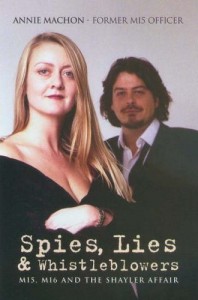 On another occasion, a man who was divorcing his wife wrote to MI5 claiming that she was involved in Communism, and she was the subject of a personal file, Ms Machon claims in her book, Spies, Lies & Whistleblowers.
She saw the two files, among “more than a million” when working at MI5, and claimed that they had been in the Security Service archives for 20 years. “Why was this information still available to desk officers some 20 years after these individuals had first come to attention, in less than suspicious circumstances?” she writes.
Mr Shayler also made allegations about the contents of personal Security Service files
in 1997, after he left the agency. He said that there were files on Jack Straw, Peter Mandelson, Peter Hain, Mo Mowlam, John Lennon and the Sex Pistols, among others. Mr Shayler was charged under the Official Secrets Act for disclosing other secret information acquired when he was a serving intelligence officer, and was sentenced at the Old Bailey
to six months in prison in 2002.
Ms Machon, 36, who worked in three departments of MI5 — counter-subversion, Irish terrorism and international terrorism — joins a relatively short list of former Security Service officers who have managed to write books without ending up in jail.
The last former MI5 officer to get clearance was Dame Stella Rimington, who was
Director-General of the service from 1992 to 1996.
Peter Wright, who made allegations of bugging and burglary by the Security Service in Spycatcher, published in 1987, got away with it by moving to Tasmania.
Ms Machon repeats allegations made by Mr Shayler that MI6 helped to fund an assassination attempt against Colonel Gaddafi, the Libyan leader, in 1996. It was dismissed by Robin Cook, the former Foreign Secretary, as “pure fantasy”.
My article in the Campaign for Press and Broadcasting Freedom journal:
In November 2002 I witnessed one of the worst media stitch-ups in recent times. The London press has helped ministers, many of whom voted against the Official Secrets Act (OSA) when it was passed in 1989, to persecute, convict and imprison MI5 whistleblower, David Shayler, with barely a murmur.
From the start, the government focused on traducing David’s character to divert attention not only from his allegations but also from Tony Blair’s failure to even hear what David had to say.
In case we forget, this includes MI5 files on government ministers, MI5 failing to stop IRA bombs going off in the UK, the wrongful conviction of two innocent Palestinians for the Israeli embassy bombing in London in 1994, and an illegal phone tap on a Guardian journalist.
Most heinous of all was the fact that in 1995 two MI6 officers gave £100,000 of taxpayers’ money to extremists linked to Al Qaeda to assassinate Colonel Gadaffi of Libya. The attack went wrong, killing innocent civilians. Malcolm Rifkind, the Foreign Secretary of the day, did not sanction the assassination attempt, making it a crime under the 1994 Intelligence Services Act.
It also meant that shadowy MI6 officers were deciding British foreign policy, not our elected ministers. So did our fearless national media call for the intelligence services to be held to account? No. Instead craven editors of national newspapers — who were only too
ready to enjoy the front-page stories David provided — have left him to face the consequences of whistleblowing alone.
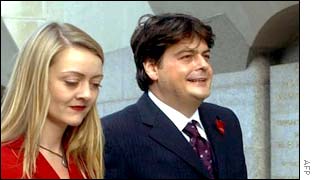 After surviving three years of exile, he returned to the UK voluntarily in August 2000. He then had to wait over two years for trial. After conviction, he spent three weeks locked up for 23 or 24 hours a day in an overcrowded 12’ x 8’ cell in HMP Belmarsh before being transferred to HMP Ford.
He had already served nearly four months in prison in Paris, awaiting an unsuccessful extradition attempt. At trial, the government felt that the risk of embarrassment loomed large. The Home Secretary, David Blunkett, and the Foreign Secretary, Jack Straw, therefore signed Public Interest Immunity certificates (PIIs), “gagging orders”, against David to prevent him from saying anything in open court.
The judge, Mr Justice Moses of Matrix Churchill fame, acceded to these without a blush, and then imposed reporting restrictions on the proceedings. The “D” Notice Committee then advised against any media coverage of these interventions. Even though David had to conduct his own defence in the courtroom, the judge and the prosecution censored
any questions he needed to put to anonymous MI5 witnesses.
David was also prevented from explaining why he had gone to the press. Despite David going into this trial with both hands tied behind his back, and despite the judge ordering the jury to convict, it still took a group of twelve randomly chosen people more than three hours to convict David. When they did so, some of the jurors were in tears. Although the courtroom was packed with journalists, the media wilfully ignored the facts of the case.
The documents alleged by the prosecution to contain “agent information” were just that – information gathered from agents and summarized for general government consumption. In fact, in summing up and sentencing, Mr Justice Moses made no reference to agent lives being put at risk. He also made it abundantly clear that he accepted that David was not motivated by money; and that David believed he was acting in the public interest (even though the law did not allow such a defence in this case).
That is why the judge gave him the relatively light sentence of six months. Had David been a traitor, as sections of the media trumpeted, he would have been tried under Section 1 of the 1911 OSA and received a fourteen year sentence. A whistleblower does not operate in a vacuum. Journalists play an important role in airing these subjects in our
“free” press.
In journalistic parlance, David Shayler has been a fantastically valuable source for over five years. This has not been reflected in his treatment. With a few extremely honourable exceptions, most hacks were merely interested in leeching David of information rather than protecting a man who risked everything to expose murder, terrorist funding and incompetence on the part of the intelligence services.
The truth is frightening. Editors, MPs and ministers are scared of the shadowy people who really run this country: the intelligence services. By not holding the services to account, the government and media is letting them get away, literally, with murder.
Stuart Jeffries of The Guardian interviewed me in November 2002:
The Spy who Loved Me
Annie Machon quit her job at MI5 and endured three years on the run — all for the sake of her partner David Shayler, who was jailed last week. She tells Stuart Jeffries why.
Annie Machon fell in love with a spy codenamed G9A/1. It was 1991 and she had been working in MI5’s counter-subversives section for two months. “The first thing I noticed about him is that he’s leonine,” she says over lunch. “I think he’s drop-dead gorgeous. We’d be in section meetings which we’d get dragged to occasionally and told what to think. He stood out because he asked the awkward questions. He was very clear-cut and challenging.”
G9A/1 was David Shayler, the renegade British spy who last week was sentenced to six months for breaking the Official Secrets Act after leaking secret documents to the press. He’s the one regularly branded as a fat, sweaty, boozy, big-mouthed traitor. The kind of upstart who might take his martini stirred rather than shaken. “Yes, that’s what they say, isn’t it?” says Machon, as she lights another cigarette. She exhales. “He’s nothing like that. Everybody loves to portray him as this slob from the north-east. But he’s not only a whistleblower trying to do something honourable. He’s also really intelligent. I love him, and am very proud of him for what he did.”
Some people think you’re the brains behind Shayler. “That’s not true. When I started at MI5, I went in as GD5. GD stands for general duties. It’s very gradist. Dave went in as GD4, which meant that they were fast tracking him. They thought he was really sharp. And they were right. In fact, he’s very sparky and great company. We just clicked, basically.” How did MI5 bosses feel about office romances? “They encouraged them. They regarded those sorts of relationships as politically expedient, and operationally quite sensible. There were quite a few couples at MI5.”
How did Annie Machon, a classics graduate from Girton College, Cambridge, get recruited as a spook in the first place? A nudge in the quad, a glass of sherry with a shifty don? “No, I had sat the exam to be a diplomat. Then I got a letter.” She was impressed by the 10-month recruitment process. “It was very thorough with lots of tests and background checks. It seemed like a professional organisation. We were supposed to be part of the new generation. People from different backgrounds and different experiences were supposed to be brought in — people who could think on their feet and think laterally. We both joined thinking it sounded good for the country, which sounds quite idealistic now.”
When did scepticism set in? “Very quickly.” Machon and Shayler were employed to look for reds under the bed, but they couldn’t find any, even though they studied the file on that dangerous leftwing subversive Peter Mandelson ever so assiduously. “We were basically trying to track down old communists, Trotskyists and fascists, which to us seemed like a waste of time. The Berlin Wall had come down several years before. We were both horrified that during the 1992 election we were summarising files on anybody who stood for parliament. We were also horrified by the scale of the investigations. We both argued most vociferously that we shouldn’t be doing this.”
After two years, both Machon and Shayler were moved to T‑branch, where they worked on countering Irish terrorist threats on the mainland. “We were both doing well. We were good operatives and they wanted the best in that section. I don’t want to be egotistical but that was the truth.”
The pair hoped that this relatively new section would operate better. “There were several young and talented agents who did their best. But because of management cock-ups they couldn’t do their jobs properly and peoples’ lives were lost.” What was the problem? “They had all these old managers who had been there for donkey’s years. They were caught in the wrong era — instead of dealing with static targets, they had a mobile threat in the IRA and they just couldn’t hack it. It was a nightmare, especially because there were so many agencies involved — MI5, Special Branch, the RUC, GCHQ. They all had their own interests. That was why Bishopsgate happened.” Shayler later claimed that MI5 could have stopped the 1993 IRA bombing of Bishopsgate in the City of London, which left one dead and 44 injured.
Why didn’t you leave then? “It was very easy to get into a stasis. You have lots of friends there. But when you get to a more established section like the Middle East terrorism section and you see it’s the same, then you think about quitting.”
In 1995, Shayler discovered that MI6 had paid an agent who was involved in the plot to assassinate the Libyan leader, Muammar Gadafy. Why was that wrong? “Apart from the immorality of it, the general consensus from the intelligence community was that the assassination of a well-established head of state by an Islamic fundamentalist in a very volatile area was not a good idea. It was crazy, but these bozos at MI6 wanted to have a crack at him.”
Then there was the case in which MI5 tapped a journalist’s phone. “For us, that’s what broke the camel’s back. A tap was only to be used in extremis, and this was nothing like that.”
Why didn’t you go quietly? “Well, other officers did. In the year we left, 14 officers resigned. The average figure was usually four. It was very scary. Dave is someone who thinks he should fight for what he believes in. And I knew what he was talking about. I knew he had to have the support against the massed forces of darkness. When you work there, the only person you can report something to is the head of MI5 but if you’re complaining about alleged crimes on behalf of MI5, they’re not going to allow you to do that, so you’re in a Catch 22 situation.”
In August 1997, Shayler sold his story to the Mail on Sunday. The day before publication the couple fled to Utrecht in Holland. “We left before the piece came out because they would have knocked down our doors and arrested Dave. I felt terrified. But we managed to stay one step ahead.” Why was he the whistlebower rather than you? “He had more access to what was going on — he was right in the middle of the Gadafy plot — and felt very strongly about it.”
The couple ended up in a French farmhouse. “It was in the middle of nowhere. No TV, no car. For 10 months we spent every day together. He would write his novel during the day.” What were you doing? “I was keeping house. We enjoyed each other’s company.” No rows? “Plenty.”
The couple tried to negotiate to return to Britain without Shayler being prosecuted, but with an undertaking that his allegations be officially investigated. “We got a complete lack of interest.” Then, during a stay in Paris, Shayler was arrested in a hotel lobby. “We’d just been watching Middlesbrough on TV. They lost, of course. Then I didn’t see him for two months.” He spent nearly four months in La Santé, Paris’s top-security prison which also houses Carlos the Jackal who used to yell “David English!” to the renegade spy from his cell. “I was bereft.” How are you going to deal with his current imprisonment? “I’ll just deal with it. It’s horrible, but I’m tough.”
A French judge ruled the extradition demand was politically motivated and released him. The couple then rented a flat in Paris and holed up for a year. “As far as the British authorities were concerned, we could rot. They didn’t want us to come back. We made a little money from journalism, but this wasn’t the life we wanted.” Why in August 2000 did the spies decide to come home? “We had managed to negotiate a return without risking months of remand. Dave thought he would be able to present his case to peers: yes, he did take £40,000 from the Mail on Sunday but that isn’t why he told the story. He never got the chance. In the trial they tied his hands behind his back. He couldn’t say anything to the jury. The reporting restrictions were extraordinary.”
She visited Shayler in jail for the first time on Tuesday. How was he? “He’ll be all right.” Now what? “I wait. And in the meantime, we get our legal case together. We’re going to Europe, British justice is useless.”
Wouldn’t you like to put all this behind you and get on with your lives. “We will. But not yet. It could take five years to clear his name.” Machon, poised and clad in black, turns a cigarette in her fingers. “You know, when I started this case I was in my 20s. Now I’m 34. I don’t think I’ll have finished with it until I’m in my 40s. I wish I’d never got involved with MI5. I wouldn’t touch them with a bargepole if I had my time again.” I leave Machon alone at a café table writing a letter to the man no longer codenamed G9A/1.
The BBC report after David Shayler’s conviction in November 2002:
Former MI5 agent David Shayler is facing jail after being convicted of revealing security secrets.
Shayler, 36, was found guilty on three charges of breaking the Official Secrets Act.
He revealed secret documents to the Mail on Sunday newspaper in 1997, arguing he had a public duty to expose malpractice within the security services.
But the prosecution argued Shayler, who will be sentenced on Tuesday, had potentially placed the lives of secret agents at risk. It said he betrayed a “life-long duty of confidentiality” by revealing classified matters.
Shayler, who represented himself, also told the Old Bailey jury he feared for his life at the time, because of something “far more serious” than anything published in the paper. Shayler was remanded on bail for sentencing and could face up to two years’ imprisonment on each of the three counts.
Shayler copied 28 files on seven topics before leaving MI5 in October 1996.
‘Incompetence’
Soon after, he accused MI5 of incompetence and leaked sensitive information to the Mail on Sunday, including allegations of financial links between the Provisional IRA and Libya. He then fled to France with the £40,000 he earned from his revelations, but returned to Britain after three years knowing he faced arrest.
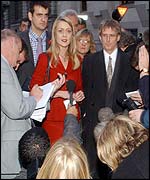 Outside court Shayler’s girlfriend Annie Machon — also a former MI5 officer — said: “David is a whistle-blower, pure and simple. I’m shocked at the verdict. He deserves to be protected, not prosecuted. David revealed malpractice, crime and incompetence on behalf of the intelligence service and he did it in the public interest. He still believes it was right to do so. We believe judges in Europe will be more sceptical about the Official Secrets Act in this country.”
John Wadham, director of civil rights group Liberty and also Shayler’s solicitor, said they would consider taking the case to appeal and would continue their application to the European Court of Human Rights.
Pre-trial ruling
Maurice Frankel from the Campaign for Freedom of Information, said there needed to be fundamental changes to the way in which such cases were dealt with.
A House of Lords hearing before the trial ruled that Shayler could not reveal details of the “serious” matter that allegedly put his life in danger. It also refused him permission to argue his case with a “public interest defence” under the European Charter of Human Rights.
 But following the conviction, Liberal Democrat home affairs spokesman Simon Hughes said: “Whatever the rights and wrongs of Mr Shayler’s actions, there should be a change in the law to ensure that a public interest defence can be undertaken.”
During the trial, Nigel Sweeney QC, for the Crown, said disclosure of even one piece of classified information could be the “final piece in the jigsaw” allowing hostile countries or organisations to identify British agents.
Mr Sweeney told the trial: “The nation’s agents may be unmasked.”
But Shayler told the court: “I was seeking to expose the truth.
‘No harm’
“I’m not the first person in history to stand up and tell the truth and be persecuted, and I doubt I’ll be the last.
His argument that no agents’ lives were put at risk was dismissed as “irrelevant” by the judge.
The jury was told current legislation allowed alternative action for whistle-blowing, such as telling the police or a government minister, instead of going to the media.
Jurors were allowed to see the weighty file of secret documents — but the names of agents and other ultra-sensitive information was obscured.
DAVID SHAYLER’S girlfriend says she has no regrets about giving up her lucrative career in the City to spend three years “on the run” with a man widely denounced as a self-publicist.
Annie Machon, 32, herself a former MI5 officer and a Cambridge classics graduate, gave up her job as a management consultant to join Shayler in his self-imposed exile. She said yesterday “You don’t sacrifice that amount of time and give up your whole life for someone who just wants to have a bit of fun and do this for publicity,” .
“I went on the record, initially, because of all the misinformation that was coming out about him, backroom briefings, all sorts of lies, that he was unemployed, that he was denied promotion, that he wasn’t up to the job, even that he was sacked from MI5.
 “I haven’t had much sleep,” she said after Shayler’s release on bail from Charing Cross police station in central London. “I have been quite apprehensive for some weeks, since we decided we should try to come back. Obviously neither of us knew what to expect. He’s got nothing to hide. He wants to put his case to push for more openness.
“It’s good that people are picking up on his cause and are beginning to talk about the issues he’s raised, rather than about his personality.” Money paid for a newspaper exclusive about his story sustained the two for most of their exile. They subsist now on his weekly column in Punch magazine.
But she feels neither can go back to their jobs as management consultants, which they took after they left MI5. “I think things have changed so much and we’ve been through so much it would be very difficult to go back three years to what we were then.”
The two have been together for seven and a half years since meeting in an MI5 library, but there is no talk of marriage. Instead, she seems content with social normality instead of a life spent looking over her shoulder. Returning to London with a media circus in train is a very different experience from when she skulked through the capital, expecting to be followed, bugged or arrested.
“It’s been three years almost to the day,” she said, “and it has definitely taken an emotional toll. In fact, the stress of the whole thing has been quite intense.”
Last night, she and Shayler were planning a quiet family dinner. “It will be the first time in three years that we have been able to dine out openly together in Britain,” she said. “I hope there will be no more looking over our shoulders.”
How big a price can a woman pay for standing by her man? The partner of exiled MI6 whistleblower David Shayler lives and loves on the run — with Big Brother watching her every move
Annie Machon and her boyfriend, David Shayler, the former MI5 officers now living in Paris, have got used to feeling watched. Their phone plays up. Their emails go missing. Even the walls of their flat seem to look down on them. If they want to discuss “an issue”, they find a safe café to do it in. A different one each time? “Of course,” says Machon with a slight curve to her lips. And in bed? “We have discussed that, yes,” she says. “You just try and blank it out and get on with your life.”
She is poised and controlled. She remains cool even when recalling “sweaty coppers” reading out her love letters in the course of an interrogation. Even when describing the state of her underwear (“inside out, with the crotches turned up as if they’d been sniffing them”) after their flat in Pimlico had been searched.
Machon, who is 31, has been at Shayler’s side since he fled to France in 1997 to escape prosecution for breaking the Official Secrets Act when his claims of MI5 incompetence were first published in a Sunday newspaper. They packed for a fortnight. They’ve been gone two and a half years.
Shayler is a straightforward love or hate figure. He is either the whistleblower, fired by moral purpose to draw attention to bungling within the intelligence services, from revelations that they monitored “subversives” including such threats to national security as Harriet Harman and the reggae band UB40, to his more recent allegations that MI6 was behind an illegal assassination attempt on Muammar Gadafy, the Libyan president. Or, as MI5 would have it (in an interesting mélange of contradictions), he is the traitor, the self-publicist, the breaker of official secrets, the fantasist.
Machon has remained a much more enigmatic figure. At first she was just “Shayler’s girlfriend”. With her blonde hair and big blue eyes, she looked like a deb, a nursery school teacher, caught up in events beyond her control. A former MI5 officer herself, she made no direct allegations while supporting Shayler in his. But this may not have been caution so much as sound management.
Unlike Shayler (who spent four months in jail before extradition proceedings failed; he is now being sued in the civil courts) she is at liberty to come and go in Britain. “It’s important that I remain free to travel, important I remain out of reproach.”
Machon was in London to deliver to Scotland Yard a dossier supporting Shayler’s Gadafy claims (an MI6 file recently posted on the internet also appears to confirm the allegations). She holds press conferences. She meets with MPs. With lawyers. She wants accountability. She wants freedom of expression. She wants amnesty. She wants Shayler to be listened to. Taken seriously. To be allowed home. Then she wants to be left alone.
We meet at Vauxhall underground station, close by the MI6 building, although she doesn’t
want to hang around long. The closest café is too close. She walks very fast to the next. She doesn’t look over her shoulder once. She sees connections where others might see blank walls. There are advertisements for laptops nearby. She refers to the recent stories of the mugged MI5 officer, whose laptop was nicked and the drunken MI6 officer who mislaid his. “What a coincidence,” she smiles sardonically. If she and Shayler win their case, she says she doesn’t think they’ll ever come back to London. “Dave would feel quite uncomfortable living here,” she says. “I would too. It’s just that sense of unease all the time.”
She is all in black, although her nails are gold. She is pale and slim, unlike Shayler whose plumpness in photographs can make him look like a yob. (“He put on weight at MI5, actually. Socialising after work — that drinking culture he talked about — and also a sense
of unease. He eats when he’s feeling stressed. He’s joined a health club now. He swims nearly every day.”)
It’s not the only reason they seem an unlikely couple. A Middlesbrough boy, with working-class roots, Shayler is said to be chippy about public-school Oxbridge types.
Machon, who is the daughter of a pilot turned newspaperman, and from an old Guernsey family, went to a private girls’ school and then to Cambridge, where she studied classics. “Yes, yes, I know. I think he did think I was a bit posh at first, but he squared it with the fact that I was a scholarship girl. Also we both moved around a lot when we were young. We had that in common.”
Machon says that as soon as they met in an MI5 library they made each other laugh and that their relationship is “passionate”. There are hints of that in her story. The night before she came back to England for the first time, suspecting she would be arrested, but not sure whether they would confiscate her passport, they lay in bed and held each other and cried, “not knowing when we would see each other again”. Then, after 10 months in hiding at a farmhouse in south-west France, when he was suddenly taken into custody, for days she walked around with “no one’s hand in mine”.
Interestingly, too, while Machon looks as though butter wouldn’t melt in her mouth,
she found out soon after joining MI5 (after sitting the foreign office exams), that psychological profiling had marked her out as a maverick. “I was having a bit of a debate with my manager in the office and she said, ‘I’ve been warned about you’.” She smiles enigmatically. “I was quite flattered.”
She and Shayler had already left MI5 when Shayler decided to go public, both had nice well-paid jobs as management consultants. They had a nice social life, nice Pimlico flat.
She didn’t want him to go to the papers. “It wasn’t so much doubt as fear. I knew they’d come after us and I knew what they could do against us. If you’ve worked for MI5 it doesn’t help your paranoia, put it that way.”
She slips a lighter out of her cigarette packet and lights up. “And I must say I was shown to be right. Not that I’d ever say I told you so to Dave.”
The papers ran the story on a bank holiday weekend. Machon and Shayler got the last plane out of Heathrow on the Saturday night, to Amsterdam. They braced themselves. Then Diana, Princess of Wales was killed. “In one sense it was a relief because the pressure was taken off us. In another it was terrible. An injunction had been put on the paper and if she hadn’t died, Fleet Street would have been up in arms about gagging the free press, they would have been more balanced in their assessment of Dave, demanding
inquiries. As it was, there were a lot of backroom briefings against him, saying he was a loudmouth, unbalanced, and we were buried there.”
She uses the word “buried” a lot. It’s hard to tell whether it is a good thing or a bad thing for someone who needs publicity (“it’s our only protection”) and yet longs to hide. On the run, they “buried themselves” in the French countryside, a different hotel every night, paying cash.
After that they were “buried” again in a remote farmhouse near Perpignan, “freezing cold, miles from the shops”, living off their £40,000 newspaper earnings, where Shayler wrote his novel (it has since been banned) and she kept house. The British government pretended to negotiate with them, she says. “They thought we’d run out of money and rot abroad. They wanted to bury us.”
It was only when Shayler was in prison, when the worst had happened, that she got
her confidence back. “I found I was tougher than I thought. Dave had always been the more ebullient character. And suddenly when he was arrested, even though I was desperately lonely, it was, ‘Right, you’ve got to do it.’ ”
Actually, there was worse to come: an approach by an armed Libyan a week after Shayler’s release. He offered a six-figure sum in exchange for names linked to the Gadafy plot and evidence on Lockerbie (Shayler had been an expert). He followed them
when they refused. A few nights later their buzzer rang for five minutes in the night: “We cowered in the corner with our kitchen knives.” They reported the incident to MI5, and were told it was a matter for the French, who told them it was a matter for the Brits.
What does Machon hope for now? She says she can’t think what to do with her life. “I’m a different person to the one I was two years ago.” Maybe an old house in Normandy: Shayler could continue writing, novels, his column for Punch.
What about children? “I don’t want those. Neither of us does. We never have. I’m not at all maternal. I’ve never felt the desire. My brother is 11 years younger and I don’t have a
romantic view of children. I know what they’re like.”
I was going to suggest that when she hits her mid-30s she might change her mind, but then I saw the look in her eye and changes of mind didn’t seem to come into it.
Francis Wheen on the hounding by the authorities of MI5 whistleblower David Shayler:
 In his original interview with the Mail on Sunday, Shayler exploded the official myth that MI5 monitors only those “subversives” who wish to “overthrow democracy by violent means”, revealing that, in fact, it kept files on such harmless pussycats as Jack Straw, Peter Mandelson, Harriet Harman and the reggae band UB40. The government was outraged — not by the evidence of spooky skulduggery but by Shayler’s whistleblowing.
Tony Blair’s spokesman warned the newspaper that “the heavies would move in” unless future articles were submitted to Downing Street for vetting. When the editor refused to obey, the treasury solicitor obtained an injunction banning the media from reporting any further remarks by Shayler about misconduct or mismanagement in the security service.
Shortly afterwards, at MI5’s request, Special Branch officers raided the London flat Shayler had shared with Machon. The search warrant permitted them to look for
“evidence of an offence under the official secrets act” — which they interpreted, rather eccentrically, as a licence to smash the furniture, hurl table lamps to the floor and remove several pairs of Machon’s knickers.
Then came the absurd pantomime at Gatwick airport. Machon was obviously not going to put up a struggle: her lawyer had told the police when and where she was due, and she was armed with nothing more lethal than an overnight bag. Nevertheless, Special Branch
thought it necessary to send no fewer than six brutes to hustle her away. This crude intimidation continued during six hours of questioning at Charing Cross police station, when her interrogators read out love letters she had exchanged with Shayler — billets doux that had no conceivable relevance to the Official Secrets Act.
If Shayler had committed a serious offence, as Straw maintained, why were no charges brought against the editors and journalists who published his disclosures? The question answers itself: bullies pick on the powerless, and ministers were reluctant to antagonise the mighty Associated Newspapers. Instead, the authorities took out their frustration by harassing innocent bystanders. Shayler’s brother, Philip, was detained, as were two of his friends.
Like Machon, they were eventually released without charge — although not before the police had helpfully informed Philip’s employers that he was wanted in connection with “financial irregularities”.
From his French exile, Shayler continued to press for an inquiry. In October 1997, the
government set up a cabinet office review of the intelligence agencies to be chaired by John Alpass, a former deputy director of the security service. As Shayler points out, Alpass was scarcely a disinterested party, as “any adverse criticism of MI5 would have reflected badly on his time there”. Nevertheless, Shayler submitted a 6,000-word memo on “management problems in MI5”.
The committee refused to read it. He was given a similar brush-off by the parliamentary intelligence and security committee, supposedly responsible for holding the spooks to
account.
Last summer, in the hope of exciting some official interest, Shayler told the Mail on Sunday that MI6 had secretly paid a Libyan emigré £100,000 to assassinate Colonel Muammar Gadafy. Although the point of Shayler’s revelation was that ministers had neither known nor approved of the plot, Robin Cook felt able to issue an instant denial. “I’m perfectly clear that these allegations have no basis in fact. It is pure fantasy.”
Why, then, did the government refuse to let the MoS publish the article, arguing that it would endanger national security? And why did Straw immediately ask France to arrest
and extradite Shayler? If the story was fantasy, he hadn’t broken the official secrets act. If it was true, and British intelligence had indeed conspired to murder a foreign head of state, then it would not be Shayler who had some explaining to do.
Unable to cope with this glaring contradiction, his enemies took refuge in invective. “In a
better world,” the Daily Telegraph harrumphed, “David Shayler and his like… would be horse-whipped.”
After his release from a French jail last November, the Sunday Telegraph came up with an even more extreme solution, pointing out that if he were a renegade French spy his former employers would probably have killed him. “One wonders how Shayler would react to being shot at by MI5 agents,” the newspaper mused. “But these days,” it added regretfully, “MI5 is scrupulous in its observation of the letter of the law.”
Scrupulous as ever, MI5 tried assassinating his reputation instead, letting it be known
that he was always regarded in the service as “a Walter Mitty, a loose cannon” and “a rebel who likes to sail close to the wind”. (The last phrase, incidentally, came from a school report written before Shayler had even taken his A‑levels.)
Many tame MPs and hacks have repeated these insults without pausing to think through their logic. If Shayler is as manifestly dotty as they claim and yet managed to join the fast track at MI5 and win a performance bonus in his final year, doesn’t this confirm that the security service is indeed run by dangerous clodhoppers, as Shayler claims?
 Logic, however, is seldom allowed to intrude into this case — except for the deranged logic of Catch 22. Shayler wrote a spy novel, The Organisation, assuming that this at least would be allowed. No such luck.
The treasury solicitor contacted the major London publishers warning that Shayler must not write anything, “whether presented as fact or fiction, which may be construed as relating to the security service or its membership or activities or to security or intelligence activities generally .” (My italics.) In other words, Shayler can’t publish true stories, even if the government says they are fiction; but he can’t publish fiction for fear that it might have a kernel of truth. And yet other ex-spies — John Le Carre, Ted Allbeury — have written umpteen novels about British intelligence without having injunctions hurled at them.
“It is barely believable in this day and age that a UK citizen should have to live in exile for telling the truth — or, if you believe the government, for making up stories about the intelligence services,” Shayler says. “It is doubly difficult to accept when we see that this has happened at the behest of a Labour government.”
Personally, I don’t find it at all difficult: Labour politicians have always been suckers for cloak-and-dagger nonsense. Lest we forget, it was the last Labour government that expelled the American journalists Philip Agee and Mark Hosenball at the behest of MI5, without troubling to give any reasons, and then tried to jail a colleague of mine from the New Statesman for the heinous offence of collecting ministry of defence press releases. “New” Labour has revived the tradition by prosecuting a respected defence orrespondent, Tony Geraghty, and tormenting the hapless Shayler.
Only last month the treasury solicitor sent a stern letter to Shayler’s lawyers. “Your client has been writing to various members of the government, enclosing a pamphlet which he has written entitled Secrets and Lies,” he noted. “The disclosure of this information constitutes yet a further breach by your client of the injunction against him… I am not instructed to deal in detail with the points made by your client, save to say that his allegations of impropriety on the part of the security service are rejected.”
How can ministers know that the allegations are false without bothering to check? Easy: MI5’s director, Stephen Lander, has assured Straw that everything is tickety-boo.
At the height of the Spycatcher panic, the British cabinet secretary admitted that Whitehall often found it necessary to be “economical with the truth”, and there are very few people naïve enough to assume that the professional dissimulators who run MI5 and MI6 can always be believed. Fortunately for Lander, this select band of credulous oafs includes every senior member of the Labour cabinet.
If David Shayler were a member of the Provisional IRA, Tony Blair would be happy to negotiate deals and indemnities with him. Since he is merely a public-spirited whistleblower who has never murdered anyone, he is condemned to harassment, vilification and indefinite exile.
This interview by E Jane Dickson was published in The Independent newspaper in January 1999, and covers the time “on the run”, the failed extradition attempt, and living in exile in Paris.
The pale noon of Paris fails to penetrate the hotel lobby where David Shayler is waiting. It is not a fashionable establishment; rather, one of those rackety joints where Anglophones gather to swap memories of Hershey bars and HP sauce. But, for the professional couple in the back booth, this is both a refuge and an operational HQ. This is where Annie Machon stayed when she came to visit David Shayler in gaol. This is where they gather their friends and resources and try to work out how on earth Shayler is going to get home.
 Last November, when David Shayler walked free from La Sante prison, he looked like New Labour’s worst nightmare: an unreconstructed hairy lefty in a Middlesbrough FC shirt, shouting the odds about freedom of information in our brave new Britain. The French court had refused to extradite Shayler, a former MI5 agent who blew the whistle on incompetence in the Security Service, on the grounds that his revelations were a political act. He is, for the moment, a free man, but should he set foot outside any French border, it is understood that the extradition process will start all over again. “It could be worse,” says Shayler, on the way to lunch at a nearby restaurant. “lt could have been Belgium that I wasn’t extradited from.”
The grim humour is typical. For a man going nowhere, Shayler laughs a lot, but his eyes are deeply shadowed by 18 months of uncertainty. In August 1997, five months after the left the Service, Shayler decided to speak out against the culture of obsessive bureaucracy and bungling he had witnessed in MI5.
In an article in the Mail on Sunday he alleged that secret files had been held on prominent Labour politicians, including Jack Straw, Harriet Harman and Peter Mandelson. For many, this revelation was so unsurprising as to be hardly worth breaking the Official Secrets Act for. In the late Seventies and early Eighties, the thrilling prospect of your very own MI5 file was all too often the prime reason for joining university Labour clubs. It was enough, however, for the Government to slap an injunction on the Mail on Sunday to prevent any further revelations and for Shayler to skip the country with pounds 20,000 from the Mail on
Sunday for expenses.
Much more damaging were Shayler’s subsequent claims that the Government had been party to an assassination attempt on Colonel Gadaffi, the Libyan leader, something the Foreign Office strenuously denies, and that the Government had had prior warning of
terrorist attacks including the bombing of the Israeli Embassy in Kensington Palace Gardens and the IRA bombing of the City of London. Because of a chain of incompetence within MI5, Shayler alleged, these warnings were not acted upon, resulting in avoidable injury and loss of life.
“I’m not a spy and I’m not a traitor,” says Shayler. His words are measured and inflected, like a mantra or confession of faith. “I’m not a spy and I’m not a traitor. I simply raised issues that I believe are of great importance to the nation. If I had wanted to be a traitor,
it would have been very easy for me to do it while I was in MI5. I could have sold information for millions of pounds and nobody would have been any the wiser. I didn’t do that because I believe in standing up for what I believe in.”
The Government, however, takes a dim view of Shayler’s patriotic principles and has pursued him with the full weight of international law. After a year on the run, when they buried themselves in rural France, Shayler and Machon were tracked down to Paris where he was appearing on the David Frost breakfast programme. Shayler was watching Middlesbrough play on satellite television when he was arrested. Two months in prison gave him plenty of time to consider his position, and he paces his argument like a marathon runner who knows every inch of the track.
Occasionally, however, he gathers a head of outrage that sends him pumping for the finishing line. “At one point,” he says, pink with indignation, “it looked like I was going to be extradited and General Pinochet wasn’t. Jack Straw stood up and said that they were thinking about sending Pinochet back to Chile on compassionate grounds. I read that in a French newspaper, in a French prison, and I was thinking ‘this is absolutely ridiculous’. This is a man who has murdered and tortured thousands of people. I have written a
bloody newspaper article and he {Straw} is going for me and not for this other guy. IRA prisoners are being released, people who have been in campaigns to murder people, and yet I’m being hounded for telling the truth.”
David Shayler hardly fits the perceived idea of a secret agent. Born in Middlesbrough and educated at state schools and Dundee University, he was part of MI5’s redbrick recruitment drive, a post- Cold-War initiative to democratise the Security Service. He applied for the job through the careers pages of The Independent in 1990. “Are you waiting for Godot?” ran the enigmatic advertisement, which stressed the need for people with interviewing and analytical skills.
Shayler, who had previously failed to complete The Sunday Times graduate training
programme, thought that he was applying for a job in newspapers. In the course of his second interview, he explained how, as editor of his university newspaper, he had courted controversy by publishing the banned text of Spycatcher. This information, which might have given less subtle minds pause for thought, did not deter his future employers.
Shayler rose, not rapidly, but respectably through the ranks. He met Annie Machon, a Cambridge graduate with an impeccable service record, in the MI5 library and, by 1997, the couple were sufficiently disaffected to leave and find jobs “outside” as management consultants.
 “The obvious question,” says Machon, a neatly glamorous woman in ankle-length fake fur, “is why didn’t I blow the whistle when I had been there even longer than Dave? I know exactly what he’s talking about and so do a lot of other people there. They all agree with him but most people just say, ‘Well, you can’t change the system,’ and quietly leave to go on to other jobs. At the time, I really didn’t want Dave to go public. I knew what it would mean for us and I asked him not to do it. But in the end,” she says, threading her fingers round Shayler’s, “somebody has to stand up and be counted.”
Shayler seems faintly bewildered by the drubbing he has received at the hands of a free press. Much has been made of a quote by Shayler’s old headmaster, who remembers a clever boy who liked to “sail close to the wind”. “The papers just fell for this idea that because somebody was slightly rebellious when he was 17, he must be Public Enemy Number One,” says Shayler. The same teacher, pressed for further details of Shayler’s
contribution to school life, recalled a creditable performance as a madman in the school play. “The Sunday Telegraph ran a piece saying ‘Shayler was a madman’ and when my mum, who has been a Telegraph reader all her life, wrote to complain, they ran another photo with the caption, ‘Mummy’s Boy’.” Shayler spreads his curiously cherubic hands,
the soft, scrubbed paws of a choirboy, with nails gnawed to the quick. “You just can’t win.”
If Shayler is bewildered by his media image, Machon is “bloody furious” about it. “The name-calling makes me so indignant and it’s so personal. Dave is a big, well-built chap, and this is used against him, as if a heavy build is somehow morally dubious. It’s medieval,” she murmurs, gazing over to the flying buttresses of Notre Dame, “on a par with saying a hunched back is a sign of wickedness”.
Certainly the articulate and easy-humoured man on display today bears no resemblance to this shambling bogey of the Right. If he didn’t know the rules of engagement before, he certainly knows them now, so why on earth did he choose to have his image flashed
around the world in that filthy old football shirt? For the first time this afternoon, Shayler seems rattled. “I did it for the obvious reason that I wanted to stick two fingers up at ‘them’ and I thought that was the best way of doing it.” Annie sighs and pleads prettily for a spoonful of Shayler’s tiramisu. A woman less in love might have settled for a kick on the shins.
Whatever else it is, this is one hell of a love story. It has been said that Machon, the daughter of a Guernsey newspaper editor, is Shayler’s best asset, and while she spits fire at the idea, Shayler is the first to agree.
“Without a shadow of a doubt,” he says, “I couldn’t have done it without Annie. We have always had a very close relationship and this is the biggest and most controversial thing that came into it. When I was just starting with the whole idea of going public, Annie didn’t want to know about it; not because she was frightened for herself, but in case things went wrong, so that she couldn’t say anything that might damage me. That did put a bit of a
strain on our relationship, but the way it’s worked out has made us much closer. By far the worst thing about being in prison was being away from Annie. Not being able to hold her or kiss her; it sounds incredibly corny, but it was like a physical craving.”
It is the kind of closeness few couples could withstand. Since Shayler’s arrest, the
two go everywhere together, even to the shops for their morning baguette. When they were hiding out in la France profonde, 30km from the nearest train station, they often wouldn’t see another soul for days on end. “Fights were just impossible,” recalls Annie. “I’d stamp my foot and say, ‘Right then, I’m going … I’m going … up the lane.’ ”
Right now the big problem is finding reasons to get up in the morning. There is a limit to the number of romantic walks a couple can take, even in Paris. Neither has a job and funds are running low; to be precise, they have pounds 5,000, a gift from Shayler’s parents. Both speak competent French — Shayler’s improved dramatically while he was
in prison — and Shayler talks about taking up teaching English as a foreign language. They have found a cheap studio flat, but it is a temporary measure; soon they will need to apply for a Carte de Sejour, a permit to stay in France, and for that they will need proof of
income.
At the moment, they give shape to the week by regular visits to one of Paris’s Internet cafes, where they correspond with friends and supporters in Britain, and WH Smith, where they bone up on day-old news from home. There are almost daily calls to Liberty, the British civil liberties organisation, which has taken up Shayler’s case. Parisians,
Annie is pleased to report, have been amazingly friendly, not at all the stand-offish stereotype, but following family visits at Christmas the couple now find themselves feeling rather flat.
Shayler misses Middlesbrough FC and proper fried breakfasts; Annie misses having her
own things about her. After their Pimlico flat was raided by Special Branch, their worldly goods were parcelled out to friends and relatives around the UK. “You just don’t expect to be still living like students when you’re in your thirties,” she says. “There is a basic human need to settle down, which you don’t really understand until it’s denied you. And even though Dave is ‘free’ in France, we’re constantly looking over our shoulders. You never know if you’re being followed. And even if you’re not, the paranoia is exhausting. I think people underestimate what fear does to you on a daily basis. There were huge periods when we were absolutely terrified. “The one good thing to come out of all this,” jokes Machon, summoning feminine vanity like a reminder of normality “is I’ve lost loads of weight.”
The paranoia is understandable. While Britain may not want to do a deal with Shayler,
he remains vulnerable to other, possibly less scrupulous, agencies, who could use the information he is party to. “Our lives are far more like something from a Le Carre novel now than they were when we were working for MI5,” says Shayler, who started a novel of his own while he was in prison. He knows, however, that any work of fiction with the faintest reference to his former life will be injuncted before you can shake a Martini.
Meanwhile, his negotiations with the Government appear to have reached stalemate. The Parliamentary Intelligence and Security Committee has refused to hear his evidence and the Home Office has stated that while Shayler “insists on immunity from prosecution as his price for settling the civil proceedings, an agreement will not be possible”. For Shayler’s part, he has offered to return the money he received from the Mail on Sunday, some pounds 40,000 in total (hardly a sum to retire to Rio on). He also knows that any further revelations will risk redoubled attempts for his extradition, but he is running out
of ideas. “I said no new revelations,” he points out, “but that’s not a position I can maintain for ever.”
For all his bravura, you feel that in his heart, Shayler still can’t quite believe that the Government doesn’t care what he has to say; they just don’t want him to say it. And it is surely not unreasonable to expect more from a party that ran its Opposition on a civil liberties ticket. Most galling of all is the knowledge that if he had made his disclosures before the Conservative government tightened the Official Secrets Act in 1989, he could have cited the public interest defence which existed then and was only repealed after strenuous opposition from the Left.
“It is a matter of record that Tony Blair, Jack Straw and John Morris, the Attorney General, all voted against removing the public interest defence precisely because it would deter political whistleblowers,” explains Shayler. “So why have they changed their stance now they are in government? It seems there is no longer any embarrassment threshold in
these matters.”
Still he hasn’t given up hope — he still has his Middlesbrough FC season ticket. For Machon, without such an incentive, the prospect is not so bright. “I’m not sure how easy we’d find it to settle in England now, after everything that has happened,” she says.
“I’ll fight for the right for Dave to go back, but I’m not sure I want us to stay once we get there.” The point is, in any case, academic. “I can only assume,” says Shayler, with obvious hurt, “that the Government is quite happy to let me rot out here. I suppose they think that maybe I’ll just shut up and go away.”
The problem, both literal and metaphysical, is that Shayler simply has nowhere to go. So he might as well take the scenic route. He gathers Annie into him and their shadows merge on the grey bank of the Seine as they stroll, slowly, back the way they came.