Category Archives: Politics
UK spies get a B+ for intrusive surveillance in 2010
 The quangocrats charged with overseeing the legality of the work of the UK spies have each produced their undoubtably authoritative reports for 2010.
Sir Paul Kennedy, the commissioner responsible for overseeing the interception of communications, and Sir Peter Gibson, the intelligence services commissioner, both published their reports last week.
Gibson has, of course, honourably now stood down from his 5‑year oversight of MI5, MI6, and GCHQ in order to head up the independent enquiry into spy complicity in torture.
And both the reports say, naturally, that it’s all hunky-dorey. Yes, there were a few mistakes (well, admistrative errors — 1061 over the last year), but the commissioners are confident that these were neither malign in intent nor an indication of institutional failings.
So it appears that the UK spies gained a B+ for their surveillance work last year.
Both commissioners pad out their reports with long-winded descriptions of what precisely their role is, what powers they have, and the full, frank and open access they had to the intelligence officers in the key agencies.
They seem sublimely unaware that when they visit the spy agencies, they are only given access to the staff that the agencies are happy for them to meet — intelligence officers pushed into the room, primped out in their party best and scrubbed behind the ears — to tell them what they want to hear.
Any intelligence officers who might have concerns have, in the past, been rigorously banned from meeting those charged with holding the spies to democratic account.….
.…which is not much different from the oversight model employed when government ministers, the notional political masters of MI6, MI6 and GCHQ, sign off on bugging warrants that allow the aggressive investigation of targets (ie their phones, their homes or cars, or follow them around). Then the ministers are only given a summary of a summary of a summary, an application that has been titrated through many managerial, legal and civil service filters before landing on their desks.
So, how on earth are these ministers able to make a true evaluation of the worth of such an application to bug someone?
They just have to trust what the spies tell them — as do the commissioners.
UK Intelligence and Security Committee to be reformed?
The Guardian’s spook commentator extraordinaire, Richard Norton-Taylor, has reported that the current chair of the Intelligence and Security Committee (ISC) in the UK Parliament, Sir Malcolm Rifkind, wants the committee to finally grow a pair. Well, those weren’t quite the words used in the Grauny, but they certainly capture the gist.
If Rifkind’s stated intentions are realised, the new-look ISC might well provide real, meaningful and democratic oversight for the first time in the 100-year history of the three key UK spy agencies — MI5, MI6, and GCHQ, not to mention the defence intelligence staff, the joint intelligence committee and the new National Security Council .
 For many long years I have been discussing the woeful lack of real democratic oversight for the UK spies. The privately-convened ISC, the democratic fig-leaf established under the aegis of the 1994 Intelligence Services Act (ISA), is appointed by and answerable only to the Prime Minister, with a remit only to look at finance, policy and administration, and without the power to demand documents or to cross-examine witnesses under oath. Its annual reports are always heavily redacted and have become a joke amongst journalists.
When the remit of the ISC was being drawn up in the early 1990s, the spooks were apoplectic that Parliament should have any form of oversight whatsoever. From their perspective, it was bad enough at that point that the agencies were put on a legal footing for the first time. Spy thinking then ran pretty much along the lines of “why on earth should they be answerable to a bunch of here-today, gone-tomorrow politicians, who were leaky as hell and gossiped to journalists all the time”?
So it says a great deal that the spooks breathed a huge, collective sigh of relief when the ISC remit was finally enshrined in law in 1994. They really had nothing to worry about. I remember, I was there at the time.
This has been borne out over the last 17 years. Time and again the spies have got away with telling barefaced lies to the ISC. Or at the very least being “economical with the truth”, to use one of their favourite phrases. Former DG of MI5, Sir Stephen Lander, has publicly said that “I blanche at some of the things I declined to tell the committee [ISC] early on…”. Not to mention the outright lies told to the ISC over the years about issues like whistleblower testimony, torture, and counter-terrorism measures.
But these new developments became yet more fascinating to me when I read that the current Chair of the ISC proposing these reforms is no less than Sir Malcolm Rifkind, crusty Tory grandee and former Conservative Foreign Minister in the mid-1990s.
For Sir Malcolm was the Foreign Secretary notionally in charge of MI6 when the intelligence officers, PT16 and PT16/B, hatched the ill-judged Gaddafi Plot when MI6 funded a rag-tag group of Islamic extremist terrorists in Libya to assassinate the Colonel, the key disclosure made by David Shayler when he blew the whistle way back in the late 1990s.
Obviously this assassination attempt was highly reckless in a very volatile part of the world; obviously it was unethical, and many innocent people were murdered in the attack; and obviously it failed, leading to the shaky rapprochement with Gaddafi over the last decade. Yet now we are seeing the use of similar tactics in the current Libyan war (this time more openly) with MI6 officers being sent to help the rebels in Benghazi and our government openly and shamelessly calling for régime change.
 But most importantly from a legal perspective, in 1996 the “Gaddafi Plot” MI6 apparently did not apply for prior written permission from Rifkind — which they were legally obliged to do under the terms of the 1994 Intelligence Services Act (the very act that also established the ISC). This is the fabled, but real, “licence to kill” — Section 7 of the ISA — which provides immunity to MI6 officers for illegal acts committed abroad, if they have the requisite ministerial permission.
At the time, Rifkind publicly stated that he had not been approached by MI6 to sanction the plot when the BBC Panorama programme conducted a special investigation, screened on 7 August 1997. Rifkind’s statement was also reported widely in the press over the years, including this New Statesman article by Mark Thomas in 2002.
That said, Rifkind himself wrote earlier this year in The Telegraph that help should now be given to the Benghazi “rebels” — many of whom appear to be members of the very same group that tried to assassinate Gaddafi with MI6’s help in 1996 — up to and including the provision of arms. Rifkind’s view of the legalities now appear to be somewhat more flexible, whatever his stated position was back in the 90s.
Of course, then he was notionally in charge of MI6 and would have to take the rap for any political fall-out. Now he can relax into the role of “quis custodiet ipsos custodes?”. Such a relief.
I shall be watching developments around Rifkind’s proposed reforms with interest.
The Israeli Embassy Two — a gross miscarriage of justice

 Over the last few years there have been a number of egregious cases of police and state cover-ups in the UK around the deaths and wrongful prosecutions of innocent people.
This brings to my mind the appalling miscarriage of justice that occurred in the 1990s when two Palestinian students, a young woman called Samar Alami and a young man called Jawad Botmeh, were both wrongfully convicted of conspiracy to bomb the Israeli embassy in London in July 1994.
In this case a highly sophisticated car bomb as detonated outside the embassy. Thankfully nobody was killed, but a number of people suffered minor injuries. Alami and Botmeh had connections to Palestinian political support groups based in London at the time, many of whom were rounded up during the investigation. Botmeh had naively helped out a shadowy and never-identified figure called Reda Moghrabi, who asked for assistance in buying a second-hand car at auction. This was the car that was used in the explosion.
Why is this case an example of establishment cover-up? Well, this was one of the cases that former MI5 officer David Shayler blew the whistle on during the 1990s. He revealed the existence of two relevant documents that should have been disclosed to the defence but, for some unaccountable reason, were not.
The first, an agent report from a credible and trusted source, pointed to a non-Palestinian group planning the attack before it had even occurred. This report was not acted upon by the MI5 officer responsible, who then tried to cover up her mistake. She was caught out, and there was a much-discussed internal inquiry into the matter within MI5’s G Branch (international terrorism) in late 1994.
But there was another document — one written by G9/1, the senior MI5 officer who oversaw the post-incident investigation. His view was that Mossad, the external Israeli intelligence agency, had carried out a controlled explosion outside its own embassy (the shadowy and unidentified Reda Moghrabi being the potentially crucial missing link) in order to acquire the long-demanded additional security protection around Israeli interests in the UK, and also to shatter the Palestinian support networks in London — a long-term objective of Mossad.
The government at the time tried to dismiss these disclosures. However, the much-missed Private Eye investigative journalist, Paul Foot, and the indefatigable lawyer, Gareth Peirce, followed them up and pursued them tirelessly through the media and the courts.
And guess what? It turns out that these two key documents had indeed not been disclosed to the legal defence team during the trial of Alami and Botmeh — and not just by the hapless spooks. It emerged during the appeal hearing that no fewer than seven people from a variety of police and intelligence organisations had failed to disclose the relevant documentation to the defence. This cannot be explained away as an innocent oversight, a cock-up — it bears all the hallmarks of a deliberate, systemic establishment cover-up.
All this represented, at the very least, a need for a retrial but also a possible gross miscarriage of justice. And yet, while acknowledging that these documents did indeed exist during the appeal hearing and beyond, the presiding m’luds decided to ignore all case law and European law and let those two innocents rot in prison. After all, it would be terribly embarrassing to vindicate the actions of an intelligence whistleblower, wouldn’t it?
As a result, the poor pawns in this sick establishment game, Jawad Botmeh and Samar Alami, ended up serving their full sentences, despite the overwhelming body of evidence proving their innocence, and were finally released in 2008 and 2009 respectively.
For anyone interested in the detailed horror story behind this flagrant miscarriage of justice, here is the relevant chapter from my long-defunct book: Download The_Israeli_Embassy_Case
Former head of MI6 says that fact and fiction get mixed up
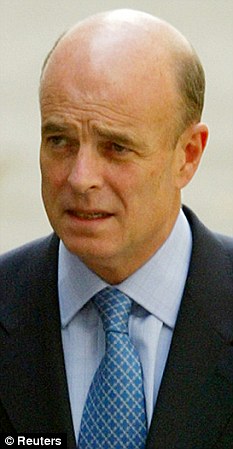 Former head of MI6, Sir John Scarlett — he of the dodgy September Dossier fame that led inexorably to the UK’s invasion of Iraq in 2003 and the death, maiming, depleted-uranium poisoning and displacement of hundreds of thousands of people — has complacently stated during his recent talk at the Hay Literary Festival that:
“One of the problems of intelligence work is that fact and fiction get very easily mixed up. A key lesson you have to learn very early on is you keep them separate.”
Well, no doubt many, many people might just wish he’d listened to his own advice way back in September 2002.
Scarlett is, of course, the senior UK spook who made the case for the Iraq war. Here’s the link: Download Iraq_WMD_Dossier.
No doubt you will remember the li(n)es: not only that Iraq’s non-existent “weapons of mass destruction” could be launched within 45 minutes, but also that fake intelligence documents had persuaded MI6 that Iraq was trying to buy uranium from Niger , as Colin Powell asserted during his persuasive speech to the UN in 2003.
Scarlett publicly took the rap and, by protecting Tony Blair and Alastair Campbell, was rewarded with the top job at MI6 and the inevitable knighthood. No doubt a suitable recognition for his entirely honourable behaviour.
But it gets worse — now he has apparently landed a lucrative job as an advisor on the situation in Iraq working for Norwegian oil mega-corporation, Statoil.
You couldn’t make it up…
… or perhaps you could if you’re a former top spy with an undeserved “K” and a lucrative oil contract who has difficulty separating fact from fiction.…..
The Age of Transparency?
 Well, this is an interesting case in the US. Thomas Drake, a former senior executive at the American National Security Agency (NSA), the US electronic eavesdropping organisation, is being charged under the 1917 US Espionage Act for allegedly disclosing classified information to a journalist about, gasp, the mismanagement, financial waste and dubious legal practices of the spying organisation. These days it might actually be more newsworthy if the opposite were to be disclosed.…
However, under the terms of the Espionage Act, this designates him an enemy of the American people on a par with bona fide traitors of the past who sold secrets to hostile powers during the Cold War.
It strikes me that someone who reports malpractice, mistakes and under-performance on the part of his (secretive) employers might possibly be someone who still has the motivation to try to make a difference, to do their best to protect people and serve the genuine interests of the whole country. Should such people be prosecuted or should they be protected with a legal channel to disclosure?
Thomas Drake does not sound like a spy who should be prosecuted for espionage under the USA’s antiquated act, he sounds on the available information like a whistleblower, pure and simple. But that won’t necessarily save him legally, and he is apparently facing decades in prison. President Obama, who made such a song and dance about transparency and accountability during his election campaign, has an even more egregious track record than previous presidents for hunting down whistleblowers — the new “insider threat”.
This, of course, chimes with the British experience. So-called left-of-centre political candidates get elected on a platform of transparency, freedom of information, and an ethical foreign policy (think Blair as well as Obama), and promptly renege on all their campaign promises once they grab the top job.
In fact, I would suggest that the more professedly “liberal” the government, the more it feels empowered to shred civil liberties. If a right-wing government were to attack basic democratic freedoms in such a way, the official opposition (Democrats/Labour Party/whatever) would be obliged to make a show of opposing the measures to keep their core voters sweet. Once they’re in power, of course, they can do what they want.
One stark example of this occured during the passing of the British Official Secrets Act (1989) which, as I’ve written before, was specifically designed to gag whistleblowers and penalise journalists. The old OSA (1911) was already in place to deal with real traitors.
And who voted against the passing of this act in 1989? Yes, you’ve guessed it, all those who then went on to become Labour government ministers after the 1997 Labour election landslide — Tony Blair, Jack Straw, the late Robin Cook and a scrum of other rather forgettable ministers and Attorney Generals.…. And yet it was this very New Labour government in the UK that most often used the OSA to halt the free-flow of information and the disclosures of informed whistleblowers. Obama has indeed learnt well.
It’s an oldie but still a goodie: as one of my lawyers once wryly told me, it doesn’t matter whom you vote for, the government still gets in.….
How the Light Gets In — speaking in Hay-on-Wye, May 30 2011
 I did two sessions at Hay-on-Wye philosophy and music festival — How the Light gets In in May 2011.
The first was a debate called “An Age of Transparency” with neo-conservative commentator Douglas Murray, and philosopher Nigel Warburton.
The second was my talk about “Spies, Lies, and Life on the Run”.
Here’s a link to a video of my talk.
So wasn’t the royal wedding lovely?
Well, yes, for some perhaps, and no doubt for the happy couple.
However, others spent the glorious day in a bare, concrete police cell, pre-emptively arrested for what they might do and untraceable to their loved ones and lawyers. Effectively they were “disappeared”, taken off the streets in case they uttered something that might mar the great day or, heaven forbid, caused some embarrassment.
A few days ago I wrote a piece highlighting my concerns about the threatened security response to possible protesters — drawing comparisons with the mindset, if not the violent tactics, of the thugs in Syria’s security apparatus. But still, in some deep recess of my mind and against all the accumulated evidence from my last 15 years, I found I still had an emotional, residual echo of the notion of British fair play that, really, we don’t do those kinds of things in the UK. Well, then I was a child, and spoke as a child.…
In the run up to the happy nuptials, the Metropolitan Police stated that it had no specific intelligence of any terrorist threat from either dissident Irish republicans, nor from any possible grouping emerging from the Middle East. Despite this, the security forces had launched a massive intelligence-gathering operation to hunt down known “anarchists” who might want to voice their protest against the concept of the monarchy. Activist pages on Facebook were suddenly deleted with no warning, but the company said it was because of registration issues, and not because of the police.
Yes, there may well have been some who wanted to cause violence — after which they could have been arrested legitimately under the terms of the law . However, what the police did in this case was in an altogether different league. Using the methodology if not the brutality of the Syrian mukhabarat, they organised house raids and snatch squads. They banned certain activists from London, and arrested others both in the days before the wedding and on the day itself.
Those caught in the security sweep included a Professor of Anthropology, Chris Knight, and his friends who were planning a bit of mildly amusing street theatre involving a fake guillotine and a Prince Andrew dummy (is that tautologous?).
Others swept up by the security forces included a bunch of environmentalist squatters who were busily tending their market garden, according to rightly concerned MP John McDonnell, and some random “zombies” who wanted to go to an alternative “not the royal wedding” garden party. Hardly the stuff of revolutionary nightmares.
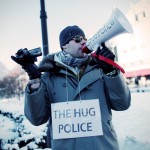 And then there’s the case of Charlie Veitch, now denounced across the UK media as the known anarchist. Yes, Charlie is anti-royalist and wanted to voice his views, but he runs an internationally-known activist organisation called the Love Police, for chrissakes. The peaceful intentions of the organisation might possibly be given away by the name.…
So what happened? On Thursday evening two police officers, tooled up with proto-Borg tech, muscled their way into the Cambridge home he shares with his girlfriend, Silkie Carlo, declaring that they were there to arrest him and search the place. They had the presence of mind to film the whole process and ask some pertinent questions.
Charlie’s alleged pre-crime? That he had posted a frighteningly prescient video on Youtube saying that he thought he was being spied on, but still critiquing the royal wedding and suggesting that fellow activists get together in Soho Square, London (quite a distance away from the festivities) on the day. OK, so he had a bit of a rant — but that’s what people do on Youtube. Agree with him or strongly disagree, it’s called his freedom of expression — a much-vaunted, traditional British liberty.
But in the eyes of the police, apparently he was “conspiring to cause a possible breach of the peace”, and needed to be locked up. It’s like we’ve time-travelled back to pre-revolutionary 18th century France, where the king could issue a lettre de cachet to send people to the Bastille.
So at the very time that Prince William and his blushing bride were created Duke and Duchess of Cambridge, a British citizen was raided, locked up and hidden away in a police cell in that very city for exercising free speech.
On Thursday night he was hauled off to the Cambridge nick, which then refused to confirm to his understandably upset girlfriend where he was being held, before being transfered to the Met Police on Friday morning and held incommunicado for the rest of the day. Family and lawyers then apparently spent fruitless hours ringing around all the London police stations trying to track him down. So Charlie had effectively been “disappeared”, like a dissident in a totalitarian régime.
So let’s get this straight — we’re talking about the Metropolitan Police spying on known activists (as we all now know they do, after the undercover cop scandal earlier this year) to prevent them from expressing their legitimate political views about the wedding of Kate and Wills. The security forces had already stated that there was no specific terrorist threat, so this was all about preventing an embarrassing incident on the big day. And I’m sorry, but I don’t think that Prevention of Embarrassment is covered by the legal code.
Plus, these arrests were pre-emptive to stop a possible crime which might be committed — and let’s face it, only breach of the peace at that. Not a biggy.
So we are basically looking at the police spying on and then pre-emptively arresting campaigners for being potential dissidents, for ThoughtCrime. How much more Orwellian can it get?
I mentioned the tactics of the Syrian security forces and their brutal crack-down. I’ve also previously written about how the slide towards fascism began in Germany in the 1930s with the brutalisation of internal oppositionists and dissidents .
So let’s really stop and think about this — do we really want to let these early indications slide by, uncontested? After all, we have the Olympics and the Diamond Jubilee next year, and no doubt the same, or extended, powers will come into force. How far will we let it go before we wake up to the threat?
As I’ve written before, with thanks to Pastor Martin Niemoeller:
First they came for the Irish in the 1980s,
But I was not Irish so I did not speak up.
Then they came for the Muslims after 9/11,
But I was not a Muslim, so I did not speak up.
Then they came for the “domestic extremists”,
But I was not an activist, so I did not speak up.
Then they came for me;
and there was nobody left to speak up for me.
A tale of two countries — pre-emptive policing in Britain and Syria
What a difference a mere month makes in the UK media. At the end of March The Independent newspaper produced this article in the wake of the huge TUC anti-cuts protest in London, where the British Home Secretary was castigated for considering greater police powers to prevent such “trouble” again, with particular reference to the forthcoming royal wedding.
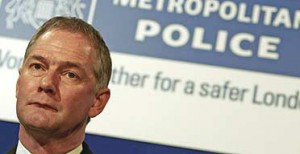 At the time former assistant commissioner at Scotland Yard, Andy Hayman, who had served as the head of the Metropolitan Police Counter-Terrorism squad and was, umm, reportedly a much-esteemed officer before his early resignation, adopted a muscular tone by calling for “snatch squads” and “dawn raids” to be carried out by police against suspected troublemakers. How terribly un-British.
Perhaps I’m starting at shadows, but with the above in mind two interesting aricles appeared in that very same newspaper today.
The first article that caught my eye confirmed there was indeed just such a security crackdown against suspected dissidents in the UK on the eve of the royal wedding. Lynne Owens, the Metropolitan Police assistant commissioner in charge of the royal policing operation, is quoted as saying:
““We have to be absolutely clear. If anyone comes to London intending to commit criminal acts, we will act quickly, robustly and decisively.” She said the Met was working with forces across the country and would use “spotters” to identify those causing trouble.”
The article goes on to say:
“As police teams step up their process of “pre-event investigation” and “intelligence gathering”, reports have come in from protesters that plain-clothed police are turning up at their homes to warn them against attending Friday’s event.”
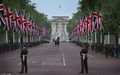 It seems that the poor old Met is having conniptions about potentially embarrassing protesters sullying the pageantry of the royal wedding and is putting our money where its mouth is. Last week The Telegraph also reported that counter-intelligence operations were being conducted against “anarchists” to prevent trouble on 29th April.
Interesting use of language, but I suppose that one newspaper’s “protester” will always be another’s “anarchist”.…
So what of the second article that concerned me? This described the brutal security crackdown in Syria, where the secret police were pre-emptively hunting down and arresting suspected dissidents:
“Syria’s feared secret police raided hundreds of homes yesterday as authorities stepped up attempts to crush the pro-reform movement.….”
UK Foreign Secretary, William Hague is quoted as saying that:
“Syria is now at a fork in the road… it can choose ever-more violent repression which can only ever bring short-term security for the authorities there.”
How much more need I say? Putting aside the fact that Hague seems to have acquired his very own fork(ed tongue), the only discernable difference at this stage is in the sheer scale of the brutality and repression, not the mind-set or intent.
It’s a slippery slope.….
Libya: my enemy’s enemy is my friend, until he becomes my enemy again…
UK Prime Minister, David Cameron, reportedly made the startling statement recently that the military intervention in Libya “unlike Iraq, is necessary, legal and right”.
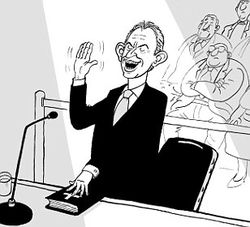 Would it not be wonderful if he could take the next logical step towards joined-up thinking and consider sending our esteemed Middle East Peace Envoy, a certain Mr T Blair, over for a spot of porridge at the International Criminal Court in The Hague? After all, Cameron has now clearly implied that the Iraq war was “unnecessary, illegal and wrong”.….
But back to Libya. With the ongoing crisis — now war — much is being written about how the previous UK government collaborated with the Gaddafi régime in the last decade — while tacitly glossing over the last year of Coalition government where, no doubt, similar levels of coöperation and back-slapping and money-grubbing were going on at the highest levels to ensure the continuing flow of oil contracts to the UK.
But, yes, we should be dissecting the Labour/Gaddafi power balance. Gaddafi had New Labour over the proverbial (oil) barrel from the late 1990s, when MI5 whistleblower David Shayler exposed the failed and illegal MI6 assassination plot against Colonel Gaddafi, using as fall-guys a rag-tag group of Islamic extremists. The newly-elected Labour government’s knee-jerk response at the time was to believe the spook’s denials and cover-up for them. Perhaps not so surprising, as the government ministers of the day were uncomfortably aware that the spies held files on them. But this craven response did leave the government position exposed, as Gaddafi well knew.
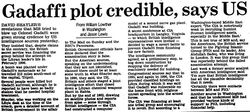 The CIA was fully cognisant of this failed plot at the time, as were the French intelligence services. The Gaddafi Plot is once again being referenced in the media, including the Telegraph, and a recent edition of the Huffington Post. The details are still relevant, as it appears that our enterprising spooks are yet again reaching out to a rag-tag group of rebels — primarily Islamists and the Senussi royalists based around Benghazi.
The lessons of the reckless and ill-thought out Gaddafi Plot were brushed under the carpet, so history may yet again be doomed to repeat itself. Yes, Gaddafi has been one of the biggest backers of terrorism ever, and yes he has brutalised parts of his own population, but if he were deposed how can the West be sure that those stepping into the power vacuum would not be even more dangerous?
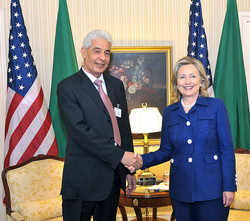 The Libyan government continued to use the 1996 MI6 assassination plot as leverage in its negotiations with the New Labour government right up until (publicly at least) 2009. Musa Kousa, the current Foreign Minister, played a key role throughout. For many years Kousa was the head of the Libyan External Security Organsiation and was widely seen as the chief architect of international Libyan-backed terrorism against the USA, the UK and France.
Another apparent example of this moral blackmail caught my eye recently — this report in the Daily Mail. Saif al-Islam Gaddafi was afforded MI6-backed protection when he was finally allowed into the UK in September 2002 to study at the LSE.
The timing was particularly interesting, as only months earlier Saif had won a libel case against the UK’s Sunday Telegraph newspaper. A grovelling apology was made by the newspaper, but Saif refrained from asking for “exemplary damages” — which he would almost certainly have won. The resulting pay-off for this restraint appears to be that a mere five months later he was welcomed into the UK with MI6-facilitated protection.
Saif’s relations with the UK had not always been so rosy. As background to this case, in 1995 the Sunday Telegraph had fallen hook, line and sinker for a MI6 classic propaganda operation. As The Guardian reported, the secretive MI6 media manipulation section, Information Operations, (I/Ops), had successfully spun a fake story to hapless spook hack, Con Coughlin, that Gaddafi Junior was involved in currency fraud. This story was fake, but the paper trail it produced was used by the spies as a pretext to prevent Saif from entering the UK at the time.
 By 2002 this was all old history, of course. Saif was welcomed to the UK, officially to study for his MA and PhD at the London School of Economics (and showing his gratitude to that august institution with a hefty donation of £1.5 million — it makes the new tuition fees for UK students seem better value for money), and unofficially to chum up to various Establishment enablers to end Libya’s pariah status, open up lucrative trade channels, and get the SAS to train up Libya’s special forces.
The UK military must be just loving that now.….
So I get the feeling that the UK government has over the last decade indeed “danced with the devil”. After decades of viewing Libya and Colonel Gaddafi as a Priority One JIC intelligence target, the UK government fell over itself to appease the Gaddafi régime in the wake of the bungled assassination attempt in 1996 and the libelling of his son. These were the sticks Gaddafi used; the carrots were undoubtedly the Saif/MI6-facilitated oil contracts.
Of course, all this is now pretty much a moot point, following Dave Cameron’s “necessary, legal and right” military intervention. If the wily old Colonel manages to hang on grimly to some semblence of power (and he has an impressive track-record of surviving against the odds), then I doubt if he’ll be happy to coöperate with British oil companies in the future. At the very least.
Gaddafi has already threatened “vengeance” against the West, and it was reported today that MI5 is taking this all-too-preditable risk seriously.
If Gaddafi is deposed, who can realistically predict the intentions and capabilities of those who will fill the power vacuum? We should have learnt from Afghanistan and Iraq: my enemy’s enemy is my friend — until he becomes my enemy again.….
RTTV interview — West caught between a rock and a hard place re Libya
Here is an interview I did today for RRTV about the evolving war in Libya:
The spies and Libya — time to dust off their conscience
As I’ve mentioned before, the former heads of UK intelligence agencies have a charming habit of speaking out in support of the rule of law, civil liberties, proportionality and plain common sense — but usually only after they have retired.
Perhaps at their leaving parties their consciences are extracted from the security safe, dusted off and given back — along with the gold watch?
 Even then, post-retirement, they might try to thrice-deny potentially world-changing information, as Sir Richard Dearlove did when questioned by the fearless and fearsomely bright Silkie Carlo about the leaked Downing Street Memo at his recent speech at the Cambridge Union. (The links are in two parts, as the film had to be mirrored on Youtube — Dearlove claimed copyright on the orginal Love Police film and had it taken down.)
And “out of context”, my left foot — he could potentially have saved millions of lives in the Middle East if he’d gone public with his considered professional opinion about the intelligence facts being fitted around a preconceived war policy in the run-up to the invasion of Iraq.
Wouldn’t it be lovely if these esteemed servants of the state, replete with respect, status and honours, could actually take a stand while they are still in a position to influence world events?
 My former boss, Baroness Eliza Manningham-Buller, has been unusually vociferous since her retirement in 2007 and elevation to the peerage. She used her maiden speech to the House of Lords to object to the proposed plans to increase police detention of terrorist suspects without charge from 28 to 42 days; she recently suggested that the “war on terror” is unwinnable and that we should, if possible, negotiate with “Al Qaeda” (well, it worked with the Provisional IRA); and that the “war on drugs” had been lost and the UK should treat recreational drug use as a health rather than a criminal issue. She steals all my best lines.…
But credit where credit is due. Despite the fact that she used the full power of the British state to pursue terrorist suspects up until 2007 and investigate drug barons in the 1990s, she did apparently try to make a stand while en poste in the run-up to the Iraq War. Last year she gave evidence to the Chilcot Enquiry, stating that she had officially briefed the government that an invasion of Iraq would increase the terrorist threat to the UK.
So it’s obvious that once a UK Prime Minister has come over all Churchillian he tends to ignore the counsel of his chief spooks, as we’ve seen with both the Downing Street Memo the Chilcot Enquiry.
With that in mind, I’ve read with interest the recent press reports that the UK authorities apparently knew about Colonel Gaddafi retaining stockpiles of mustard gas and sarin (despite the fact that the world was assured in 2004 that it was his renunciation of WMDs that allowed him back into the international diplomatic fold) .
So the key question is surely: is this another erroneous “45 minutes from attack” moment, with Gaddafi’s alleged stockpiles of WMD a perfect scaremongering pretext to push for a full-on régime change in Libya; or is this genuine, and we were all lied to about Gaddafi’s destruction of his WMD stockpiles for economic advantage and fat, juicy oil contracts?
The Wall Street Journal recently ran an article quoting the concern of “government insiders” about Gaddafi’s potential future terrorism threat against the West, up to and including WMDs, should he cling on to power. Well, yes, it would hardly be surprising if he were now to be as mad as a wasp with his ex-new best buddies. Despite the sordid rapprochement in the last decade, he has been for much of his life an inveterate enemy of the West and sponsor of worldwide terrorism.
Rather than waiting for his “K” and his retirement, would it not be wonderful if the current head of MI5, Jonathan Evans, could extract his conscience from that dusty security safe and make a useful and informed statement to shed some light on the mess that the Libyan war is rapidly becoming? He could potentially change the course of world history and save untold lives.
The role of intelligence agencies within a democracy
 I recently stumbled across this excellent article in the Trinidad Express, of all places. It appears that the state of Trinidad and Tobago is in the throes of debating the legitimate role of intelligence agencies within a democracy.
Alana Wheeler, a Fulbright Scholar with a Masters degree in National Security Studies, contributes a clear and well-argued article that gets to the heart of these issues; what is “national security” and what is the best way to protect a nation’s integrity within a legal, proportionate and democratic framework?
If the democratic movements within countries like Tunisia, Egypt and Libya are allowed to coalesce organically and unhindered, no doubt this also be a key issue for their new constitutions — especially after decades of repression and fear meted out by brutal securocrats.
So why the hell can’t we have such an informed debate about these issues in the “mature democracies” of UK or the USA?
RTTV interview — dancing with the devil — how not to deal with “rogue” states
Here is an interview I did for RTTV on 3 March 2011 about the possibility of Western intervention in the unfolding Libyan crisis:
Interestingly, a radio recording of the Dutch “rescue” mission I mentioned has appeared on the internet. It appears that the pilots were less than honest about their flight plans and intentions, saying that they were heading to their ship south of Malta rather than back towards Tripoli.… where they are eventually caught.
Also, do have a read of this excellent article by Seamus Milne of The Guardian about ramifications of possible Western intervention.
That said, it looks like this viewpoint is being ignored. The Daily Mail reported today that MI6 officers and SAS soldiers are massing in the East of Libya to assist the rebels. Well, at least they’re doing it openly now, unlike the illegal and failed Gaddafi Plot of 1996.