Here is a panel discussion I did at the International Journalism Festival in Perugia, Italy, in May 2014:
Here is a panel discussion I did at the International Journalism Festival in Perugia, Italy, in May 2014:
Here is an interview I did for German national TV, ZDF, while speaking at the European Media Art Festival in Osnabrueck in April:
ZDF Kulturzeit interview about EMAF from Annie Machon on Vimeo.
The 27th European Media Art Festival began this evening in Osnabrueck, Germany. In the wake of all the global intelligence whistleblowing that has gone on over the last few years, the theme for the artists of 2014 is “We, the Enemy”.
Do visit if you can — a lot of interesting and political art installations are on display, as well as films, music, and talks. I shall be doing a talk on speaking on Friday afternoon.
I had the pleasure of making a short speech at the opening ceremony this evening, and did an interview for national German TV channel ARD last night to publicise the festival.
Uberwachungs kunst from Annie Machon on Vimeo.
My recent interview on RT about Ukraine and interventionism, both West and East:
US miscalculated will of Ukrainian people from Annie Machon on Vimeo.
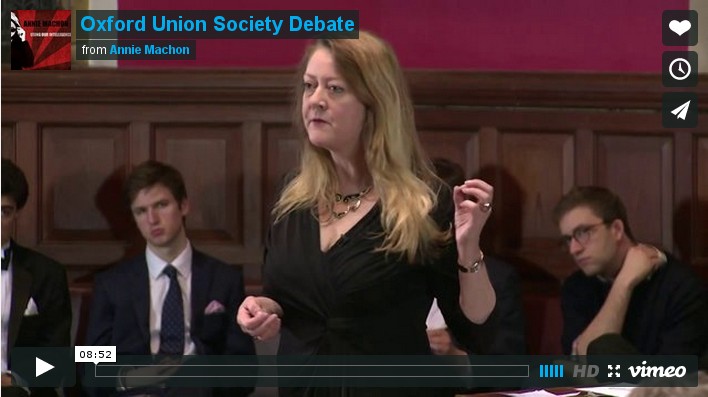
I recently had the pleasure of taking part in a debate at the Oxford Union Society. I spoke to the proposition that “this house believes Edward Snowden is a hero”, along with US journalist Chris Hedges, NSA whistleblower Bill Binney, and former UK government minister Chris Huhne.
The chamber was full and I am happy to report that we won the debate by 212 votes to 171, and that Oxford students do indeed see Edward Snowden as a hero. Here is my speech:
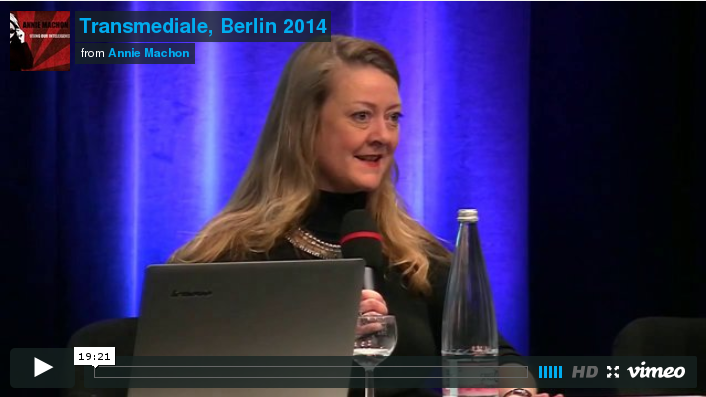
Last month I was on a panel discussion at the Berlin Transmediale conference with NSA whistleblower Bill Binney, Chelsea Manning rapporteur Alexa O’Brian, and activist Diani Barreto. Here is the link to the full two hour event, and here is my speech:
Published on RT Op Edge and Consortium News.
I regularly revisit the famous Pastor Martin Niemoeller poem from the Nazi era as his words remain resonant in our post‑9/11, “war on terror” world. Over the last week threads of various alarming stories have converged, so here is my latest update:
First they came for the Muslims, but I was not a Muslim so did not speak up.
Then they came for the whistleblowers, but I was not a whistleblower so did not speak up.
Then they came for the “domestic extremists”, but I was not an activist so did not speak up.
And when they came for me, there was nobody left to speak up for me.
Allow me to explain this current version. Regular readers of this website will be well aware of my horror at the global rape of basic human rights in the West’s fight against the “war on terror” since 9/11: the kidnappings, the torture, the CIA presidentially-approved weekly assassination lists, the drone bombings, the illegal wars.…
All these measures have indeed targeted and terrorised the Muslim community around the world. In the UK I have heard many stories of British Muslims wary of attending a family event such as a wedding of their cousins in Pakistan or wherever, in case they get snatched, tortured or drone bombed.
Now it appears that even British citizens who choose to donate to UK charities offering humanitarian relief in war zones such as Syria can be arrested under counter-terrorism laws.
 Moazzam Begg, the director of Cage (the UK NGO campaigning about the community impact of the war on terror) was again seized last week. As I have written before, this is a man who has already experienced the horrors of Bagram airbase and Guantanamo. When he was released he became a campaigner for others in the same plight and set up the Cage campaign which has gained quite some traction over the last few years.
Over a year ago he visited Syria on a fact-finding mission, investigating those who had been summarily detained and tortured in the conflict. Last December he had his passport seized on spurious grounds He wrote about this trip quite openly, and yet now, a year on, has been arrested and charged with “training terrorists and fund raising” in Syria. This is a high-profile campaigner who operates in the full glare of the media. How credulous does one have to be to believe that Begg, after all his experiences and running this campaign, is now involved in “terrorism”? Really, anyone?
Since then other people involved in British charities offering aid to the displaced peoples of Syria have also been scooped up. But this is just affecting the British Muslim community, right? There’s “no smoke without fire”, and it does not impinge the lives of most people in the UK, so there has been no widespread outcry.…
.…so nobody speaks up.
Then we have the ongoing “war on whistleblowers” that I have discussed extensively. This affects every sector of society in every country, but most seriously affects whistleblowers emerging from central government, the military and the intelligence agencies. They are the ones most likely to witness the most heinous crimes, and they are the ones automatically criminalised by secrecy laws.
This is most apparent in the UK, where the Official Secrets Act (1989) specifically criminalises whistleblowing, and in the USA, where President Obama has invoked the 1917 Espionage Act against whistleblowers more times than all other presidents combined over the last century. If that is not a “war on whistleblowers”, I don’t know what is.
This, of course, is a paranoid over-reaction to the work of Wikileaks, and the brave actions of Chelsea Manning and Edward Snowden. This is what Obama’s government deems to be the “insider threat”. Yet it is only through greater transparency that we can operate as informed citizens; it is only through greater accountability that we can hope to obtain justice. And in this era, when we are routinely lied into illegal wars, what could be more important?
But intelligence and military whistleblowers are rare, specialised and easy to stigmatise as the “other” and now, the insider threat — not quite of the normal world. The issues they disclose can seem a bit remote, not linked to most people’s daily experiences.…
.…so nobody speaks up.
But now to my third revamped line of the Pastor Niemoeller poem: the activists or, to use current police terminology, the “domestic extremists”. This, surely, does impinge on more people’s experience of life. If you want to go out and demonstrate against a war, in support of Occupy, for the environment, whatever, you are surely exercising your democratic rights as citizens, right?
Er, well no, not these days. I have written before about how activists can be criminalised and even deemed to be terrorists by the police (think London Occupy in 2011 here). I’m thinking of the ongoing British undercover cop scandal which continues to rumble on.
For those of you outside the UK, this is a scandal that erupted in 2010. There is was a section of secret police who were infiltrated into activist groups under secret identities to live the life, report back, and even potentially work as enablers or agents provocateurs. As the scandal has grown it appears that some of these cops fathered children with their targets and spied on the grieving families of murder victims.
This sounds like the East German Stasi, but was happening in the UK in the last couple of decades. A government enquiry has just been announced and many old cases against activists will be reviewed to see if tarnished “evidence” was involved in the trials and subsequent convictions.
But again this does not affect most people beyond the activist community.…
.…so nobody speaks up.
 Now, people who have always assumed they have certain protections because of their professions, such as lawyers and journalists, are also being caught in this dragnet. Julian Assange’s lawyer, Jennifer Robinson, discovered she was on a flight watch list a few years ago. More recently Jesselyn Radack, human rights director of the US Government Accountability Project and legal advisor to Edward Snowden, was stopped and interrogated at the UK border.
And just this week a Dutch investigative journalist, Brenno de Winter, was unable to do his job since his name was placed on alert in all national government buildings. The police accused him of hacking-related crimes and burglary. They had to retract this when the smear campaign came to light.
Brenno has made his name by freedom of information requests from the Dutch public sector and his subsequent investigations, for which he was named Dutch Journalist of the Year in 2011. Hardly subversion, red in tooth and claw, but obviously now deemed to be an existential, national security threat to the Netherlands.
Nor is this a Dutch problem — we have seen this in the US, where journalists such as James Risen and Barrett Brown have been hounded merely for doing their jobs, and the Glenn Greenwald’s partner, David Miranda, was detained at London Heathrow airport under counter-terrorism laws.
Journalists, who always somewhat complacently thought they had special protections in Western countries, are being increasingly targeted when trying to report on issues such as privacy, surveillance, whistleblower disclosures and wars.
Only a few are being targeted now, but I hope these cases will be enough to wake the rest up, while there is still the chance for them to take action.…
.…before there is nobody left to speak up for us.
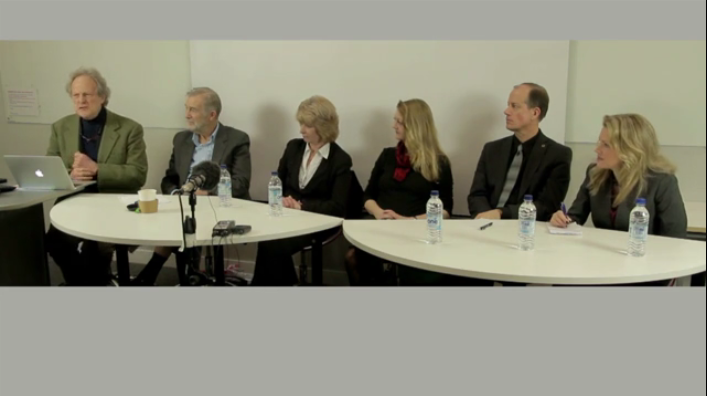
The Whistler, the new whistleblower support network in the UK, recently held an international pre-launch in London.
The Whistler has been set up by Gavin MacFadyen, Director of the Centre for Investigative Journalism and Eileen Chubb of Compassion in Care.
Both, through their work, realise the heavy price that all whistleblowers from every sector have to pay, not just professionally, but also socially, psychologically and also potentially legally. And they want to help.
The organisation took the opportunity to host an event with a number of US intelligence whistleblowers from the Sam Adams Associates for Integrity in Intelligence who were in the country to present (sadly and inevitably in absentia) the 2014 Sam Adams Award to Chelsea Manning at a ceremony at the Oxford Union Society last week.
Here is the full video of The Whistler event:
The Whistler Launch from Annie Machon on Vimeo.
First published on RT Op-Edge.
In the UK last week there was a series of events to celebrate the wonderful work of whistleblowers.
In previous decades these brave and rare individuals have often been all too easily dismissed with the usual, carefully orchestrated media slanders of “disgruntled”, “too junior”, “sacked”, whatever ad nauseam. But no longer.
Now, in this era where we have been lied into illegal wars, where the banks privatise their profits yet make their risks public and get repeatedly bailed out, and when people are needlessly dying in our hospitals, more and more people realise the value that whistleblowers can bring to the public debate.
Indeed, the system is now so broken that the whistleblower is often the regulator of last resort.
Plus, of course, this is the era of Wikileaks, Chelsea Manning and Edward Snowden. The concept of whistleblowing has gone global in response to the scale of the threats we are all now facing from the military-security complex world-wide.
So last week was rather invigorating and involved a number of events that gave due credit to the bravery and sacrifice of whistleblowers.
First up we had the international launch of the UK whistleblower support group, The Whistler. This is a British organisation designed to provide a legal, psychological and social support network to those in the UK brave enough to come out and blow the whistle on incompetence and crime from any sector, public or private, and many hundreds have over the last few years, particularly from the financial and health sectors.
Sadly all experience the same treatment; vilification, suppression, and even the loss of their careers for daring to expose the incompetence and even crime of others. Sadly, while there is a law in place that is supposed to provide some protection, all to often this has failed over the last 16 years. The Whistler provides a much needed service.
A number of international whistleblowers were in the UK for the week for other events, and The Whistler was able to host them and hear their stories. Gavin MacFadyen of the Centre for Investigative Journalism, and the indefatigable campaigner Eileen Chubb hosted the event, and former CIA analyst Ray McGovern, NSA whistleblower Tom Drake, Jesselyn Radack of the Government Accountability project (The Whistler’s US counterpart), and myself spoke. The Whistler will officially be launched in the UK on 20th March, so watch this space.
The next night we found ourselves at the prestigious Oxford Union Society, which was kind enough to host the award ceremony for the Sam Adams Associates for Integrity in Intelligence for the second year running. You may remember that last year the award went to Dr Tom Fingar, whose US National Intelligence Estimate of 2007 single-handedly halted to rush to war against Iran.
The Sam Adams Associates is a group of intelligence, government and military whistleblowers and campaigners. Each year we vote to confer an award on a member of the intelligence community or related professions who exemplifies CIA analyst, Sam Adams’ courage, persistence and telling truth to power, no matter what the consequences.
Since its inception in 2002, the award has been given to truth tellers Coleen Rowley of the FBI, Katherine Gun of GCHQ, Sibel Edmonds of the FBI, Craig Murray former UK ambassador to Uzbekistan, Sam Provance former US army Sgt, Major Frank Grevil of Danish intelligence, Larry Wilkerson former US army Colonel, Julian Assange of Wikileaks, Thomas Drake of NSA and Jesselyn Radack of the Department of Justice, Dr Thomas Fingar former Deputy Director of National Intelligence, and Edward Snowden former NSA contractor.
This year the award went, unanimously and inevitably, to Chelsea Manning, and many Sam Adams associates travelled to the UK to attend and to honour her achievements and 2013 SAA laureate Edward Snowden sent through a congratulatory message. Sadly and for obvious reasons Chelsea could not receive the award in person, but her old school friend, Aaron Kirkhouse read out a powerful and moving statement written by her for the occasion.
The following night the Union hosted a debate on “This house would call Edward Snowden a hero”. I had the pleasure of arguing for the proposition, along with US journalist Chris Hedges, NSA whistleblower Bill Binney, and former UK government minister Chris Huhne, and we won — 212 to 171 was the final tally, I believe.
I very much enjoyed the events, so a massive thanks to Polina Ivanova, the current Union president, and her team who organised the events.
The best part of the week though, apart from the set events, was having the time to be with other intelligence whistleblowers and fellow campaigners. While in London we also all had the opportunity to do a range of media interviews with programmes such as Brian Rose’s London Real TV and Afshin Rattansi’s “Going Underground” on RT.
Sadly but rather predictably, the old media chose not to take advantage of such a rich source of expertise in town. Despite repeated invitations, the MSM failed to attend any of the events or interview any of the whistleblowers. But perhaps that’s better than the appallingly off-beam coverage the Guardian gave to Dr Fingar’s award ceremony last year.
But the old media are behind the times, which are definitely a’changing. In this post-Wikileaks, post-Manning and post-Snowden world, the tone of the debate has changed for good. Whistleblowers are increasingly valued as brave individuals of conscience and there is much more awareness and interest in the issues of privacy, human rights and the meaning of democracy. Indeed, in the fundamental meaning of freedom.
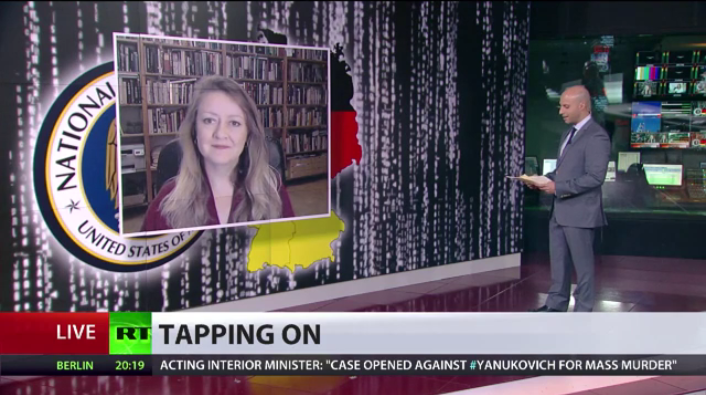
In the wake of what appears to be another NSA leaker, it has been reported that, while Angela Merkel’s phone is apparently off-limits, her close political circle is now being targeted.
Last weekend the Bild am Sonntag newspaper in Germany reported that a senior NSA operative had made these claims. This report has been repeated in media around the world.
While we have yet to see any corroboration, this may indeed indicate that more staff in the global intelligence community are finding the courage to speak out about ethical concerns in the wake of the Snowden disclosures last year.
No guarantee NSA will stop spying on Germany or Merkel from Annie Machon on Vimeo.
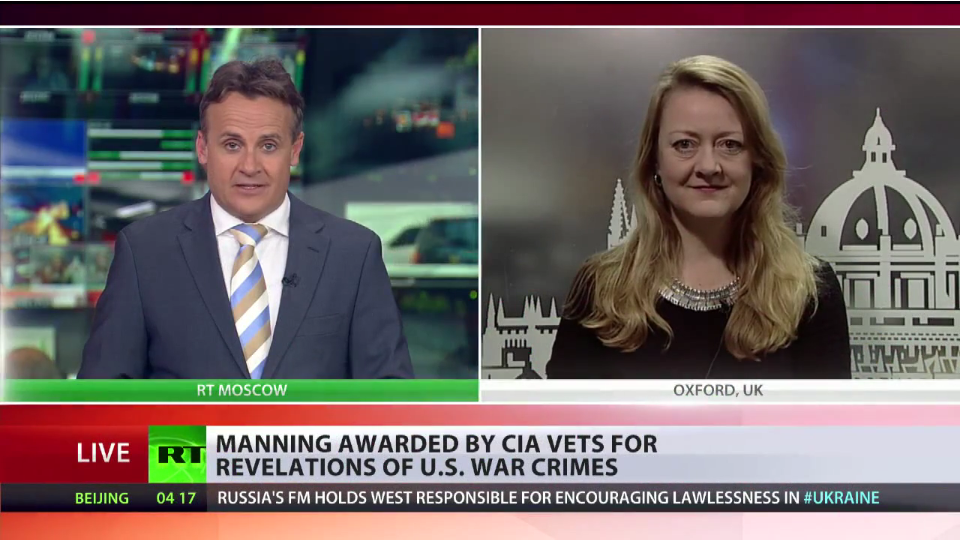
Chelsea Manning was presented with the Sam Adams Award for Integrity in Intelligence at an award ceremony hosted by the Oxford Union Society on 19th April. Many former intelligence personnel from the US and Europe gathered to honour her.
Immediately after the ceremony I was asked on RT for an interview about the ceremony, the achievements of Chelsea Manning and the value of whistleblowers:
In the wake of the recent ARD interview with Edward Snowden, here are my comments on RT yesterday about the NSA’s involvement in industrial espionage:
NSA’s big nose in big business from Annie Machon on Vimeo.
I recommend looking at the Edward Snowden’s support website, and also keep an eye open for a new foundation that will be launched next month: Courage — the fund to protect journalistic sources.
First published at RT Op-Edge.
When asked if Edward Snowden deserves to be the Man of the Year 2013, and I have been many times, my answer has to be a categorical, resounding YES.
Sure, it has been an eventful year and there are a lot of contenders. But Edward Snowden stands out for me for three key reasons: his personal and conscious courage, the sheer scale of his disclosures and the continuing, global impact of what he did. Purely because of his actions we, the world’s citizens, are now able to have a discussion about the nature of our civilisation and potentially call a halt to the frightening slide into a global surveillance dystopia.
For the actions of Snowden have indeed laid bare the fact that we are living global crisis of civilisation . To date it is estimated the we have only seen about 1% of the documents he disclosed — the merest hint of the tip of a monstrous iceberg. What further horrors await us in 2014 and beyond?
The Personal Risk
First of all, there is the personal aspect. Snowden has said that he does not want to be the story, he wants the focus to remain on the information. I respect that, but it is worth reminding ourselves of the scale of sacrifice this young man has made. He had a well-paid job in Hawaii, an apparently happy relationship, and good career prospects. All this he threw away to alert the world to the secret, illegal and dystopian surveillance system that has stealthily been smothering the world.
But Snowden faced far more than merely throwing away a comfortable professional life. Over the last few years the US government, apparently learning well from its former colonial master the UK about the art of crushing of whistleblowers, has been waging a war against what it now deems the “insider threat” — ie persons of conscience who speak out. President Obama has used the Espionage Act (1917) to persecute and prosecute more whistleblowers than all previous presidents in total before him.
This is indeed a “war on whistleblowers”. John Kiriakou, a former CIA officer who refused to participate in the torture programme and then exposed, it is currently languishing in prison; Thomas Drake, an earlier NSA whistleblower, was threatened with 35 years in prison; young Chelsea Manning was maltreated in prison, faced a kangaroo court, and is currently serving a similar sentence for the exposure of hideous war crimes against civilians in the Middle East. And the list goes on.
So not only did Edward Snowden turn his back on his career, he knew exactly the sheer scale of the legal risk he was taking when he went public, displaying bravery very much above and beyond the call of duty.
The intelligence apologists in the media have inevitably shouted “narcissism” about his brave step to out himself, rather than just leak the information anonymously. However, these establishment windbags are the real narcissists. Snowden correctly assessed that, had he not put his name to the disclosures, there would have been a witch-hunt targeting his former colleagues and he wanted to protect them. Plus, as he said in his very first public interview, he wanted to explain why he had done what he had done and what the implications were for the world.
The Disclosures
The sheer scale and nature of the disclosures so far has been breathtaking, and they just keep coming. They show that a vast, subterranean surveillance state that has crept across the whole world, unknown and unchecked by the very politicians who are supposed to hold it to account. Indeed, not only have we learned that we are all under constant electronic surveillance, but these politicians are targeted too. This is a global secret state running amok and we are all now targets.
Only yesterday, Der Spiegel reported more egregious examples of how the spies bug us: hardware hacks, computer viruses and even microwave wavelengths attacking both our computers and us – tin foil hats might not be such a bad idea after all.…
The Implications
Snowden’s disclosures have laid bare the fact that the internet has been thoroughly hacked, subverted and indeed militarised against we the people. The basic freedom of privacy, enshrined in the UN Declaration of Human Rights in the immediate aftermath of the Second World War, has been destroyed.
Without free media, where we can all read, write, listen and discuss ideas freely and in privacy, we are all living in an Orwellian dystopia, and we are all potentially at risk. These media must be based on technologies that empower individual citizens, not corporations or foreign governments, and certainly not a shadowy and unaccountable secret state.
The central societal function of privacy is to create the space for citizens to resist the violation of their rights by governments and corporations. Privacy is the last line of defense historically against the most potentially dangerous organisation that exists: the state.
By risking his life, Edward Snowden has allowed us all to see exactly the scale of the threat now facing us and to allow us the opportunity to resist. We all owe him a debt of gratitude, and it is our duty to ensure that his courage and sacrifice has not been in vain.
Here is my recent talk at the CCC in Hamburg, discussing the war on terror, the war on drugs, the war in the internet and the war on whistleblowers:
30C3 — The Four Wars; Terror, whistleblowers, drugs, internet from Annie Machon on Vimeo.