Off to do a keynote at the Global Investigative Journalism Conference in Kiev. Should be interesting — watch this space.

Off to do a keynote at the Global Investigative Journalism Conference in Kiev. Should be interesting — watch this space.
I have been watching with a certain cynical interest the unfolding of Operation Weeting, one of the plethora of Metropolitan Police investigations into the UK phone hacking scandal, involving many of our favourite players: shady private investigators, predatory journalists, bent coppers, and politicians contorting themselves in an effort to protect both their own reputations and their Friends in High Places. And the ripples are spreading internationally. Nothing like a little bit of globilisation.…
 The Guardian newspaper has made most of the early running in exposing the corrupt practices of the now defunct News of the Screws, highlighting all the dubious tabloid practices of hacking, blagging, pinging, and god knows what else. All this done with the help of bottom-feeding private investigators, but also manifestly with the help of corrupt police officers who were not averse to the idea of taking a bribe to help their friends in Wapping. And how far might this “trickle down corruption” might have gone, um, up?
Despite the self-righteousness of other UK newspapers, it has also now become apparent that these dubious and potentially illegal practices were common throughout Fleet Street, and other national newspapers are also under investigation.
And yet it appears that all this could have been nipped in the bud over a decade ago, when Steven Nott, a concerned British citizen, tried to expose the vulnerability of mobile phones after he stumbled across the practice by accident. He took his findings to a variety of national newspapers, all of whom seem to have initially thought there was a good story, but every time the news was buried. Well, I suppose it would be, wouldn’t it — after all, why would hacks expose a practice that could be so useful?
But back to the dear old OSA and the media.
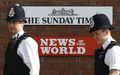 In yesterday’s Observer newspaper, it was reported that the police have threatened the journalists at The Guardian with the Official Secrets Act (1989) to force them to disclose the identity of their source amongst the police officer(s) in Operation Weeting who leaked useful information to the newspaper to help its exposure of illegal practices. And, rightly, the great and the good are up in arms about this draconian use of a particularly invidious law:
“John Cooper, a leading human rights lawyer and visiting professor at Cardiff University, echoed Evans’s concerns. “In my view this is a misuse of the 1989 act,” Cooper said. “Fundamentally the act was designed to prevent espionage. In extreme cases it can be used to prevent police officers tipping off criminals about police investigations or from selling their stories. In this instance none of this is suggested, and many believe what was done was in the public interest.
“Cooper added: “The police action is very likely to conflict with article 10 of the European Convention on Human Rights, which protects freedom of speech.”
But I think he’s missing a bit of recent legal history here. The UK had the 1911 OSA which was supposed to protect the country from espionage and traitors, who faced 14 years in prison upon conviction. Needless to say this provision was rarely used — most of the cold war Soviet moles in the establishment were allowed to slink off to the USSR, or at the very most be stripped of their “K”.
However, as I’ve written before, the revised 1989 OSA was much more useful for the establishment. It was specifically put in place to stop whistleblowing after the embarrassment of the 1980s Clive Ponting/Belgrano case.
 The new act was specifically designed to strip away the “public interest” defence used by Ponting in his trial, and also to penalise journalists who had the temerity to report leaks and whistleblowing from the heart of the establishment. The OSA (1989) has been used extensively since the late 1990s, despite the fact that many senior figures in the former Labour government opposed its provisions when it went through Parliament. Journalists are just as liable as whistleblowers or “leakers” under the provisions of this act (the infamous Section 5).
So, back to The Guardian and its legal champions. I agree with what they are saying: yes, the 1989 OSA has a chilling effect on freedom of speech that unduly victimises both the whistleblower and the journalist; yes, it is a uniquely draconian law for a notional Western democracy to have on its books; yes, there should be a defence of “acting in the public interest”; and yes, the OSA should be deemed to be incompatible with Section 10(2) of the European Convention of Human Rights, guaranteeing free speech, which can only be circumscribed in the interests of “national security”, itself a legally undefined, nebulous, and controversial phrase under British law.
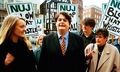 But if all the outraged lawyers read up on their case law, particularly the hearings and legal dogfights in the run up to Regina v Shayler cases, they will see that all these issues have been addressed, apparently to the satisfaction of the honourable m’luds who preside over British courts, and certainly to the establishment figures who like to use the OSA as their “get out of jail free” card.
So I wish The Guardian journalists well in this confrontation. But I have to say, perhaps they would not have found themselves in this situation today vis a vis the OSA if, rather than just a few brave journalists, the media institutions themselves had put up a more robust fight against its provisions during its bastard birth in 1989 and its subsequent abuse.
It has been reported today that the police may have downgraded their investigation to a purely criminal matter, not the OSA. Whatever happens does not obviate the need for the media to launch a concerted campaign to call for reform of the invidious OSA. Just because one of their own is no longer threatened does not mean the chilling threat of this law has gone away. As Martin Luther King said while imprisoned in 1963:
“Injustice anywhere is a threat to justice everywhere.”
I would also suggest the new generation working in the British media urgently read this excellent booklet produced by John Wadham of Liberty and Article 19 way back in 2000 Download Article_19_Liberty_on_OSA_2000, to remind themselves of fundamental arguments against draconian legislation such as the OSA and in favour of the freedom of the press.
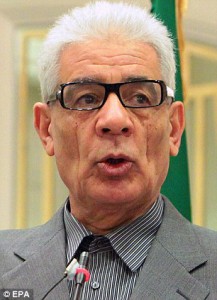 A cache of highly classified intelligence documents was recently discovered in the abandoned offices of former Libyan spy master, Foreign Minister and high-profile defector, Musa Kusa.
These documents have over the last couple of weeks provided a fascinating insight into the growing links in the last decade between the former UK Labour government, particularly Tony Blair, and the Gaddafi régime. They have displayed in oily detail the degree of toadying that the Blair government was prepared to countenance, not only to secure lucrative business contracts but also to gloss over embarrassing episodes such as Lockerbie and the false flag MI6-backed 1996 assassination plot against Gaddafi.
These documents have also apparently revealed direct involvement by MI6 in the “extraordinary rendition” to Tripoli and torture of two Libyans. Ironically it has been reported that they were wanted for being members of the Libyan Islamic Fighting Group, the very organisation that MI6 had backed in its failed 1996 coup.
The secular dictatorship of Col Gaddafi always had much to fear from Islamist extremism, so it is perhaps unsurprising that, after Blair’s notorious “deal in the desert” in 2004, the Gaddafi régime used its connections with MI6 and the CIA to hunt down its enemies. And, as we have all been endlessly told, the rules changed after 9/11…
The torture victims, one of whom is now a military commander of the rebel Libyan forces, are now considering suing the British government. Jack Straw, the Foreign Secretary at the time, has tried to shuffle off any blame, stating that he could not be expected to know everything that MI6 does.
Well, er, no — part of the job description of Foreign Secretary is indeed to oversee the work of MI6 and hold it to democratic accountability, especially about such serious policy issues as “extraordinary rendition” and torture. Such operations would indeed need the ministerial sign-off to be legal under the 1994 Intelligence Services Act.
There has been just so much hot air from the current government about how the Gibson Torture Inquiry will get to the bottom of these cases, but we all know how toothless such inquiries will be, circumscribed as they are by the terms of the Inquiries Act 2005. We also know that Sir Peter Gibson himself has for years been “embedded” within the British intelligence community and is hardly likely to hold the spies meaningfully to account.
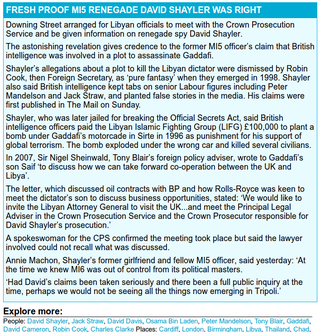 So I was particularly intrigued to hear that the the cache of documents showed the case of David Shayler, the intelligence whistleblower who revealed the 1996 Gaddafi assassination plot and went to prison twice for doing so, first in France in 1998 and then in the UK in 2002, was still a subject of discussion between the Libyan and UK governments in 2007. And, as I have written before, as late as 2009 it was obvious that this case was still used by the Libyans for leverage, certainly when it came to the tit-for-tat negotiations around case of the murder in London outside the Libyan Embassy of WPC Yvonne Fletcher in 1984.
Of course, way back in 1998, the British government was all too ready to crush the whistleblower rather than investigate the disclosures and hold the spies to account for their illegal and reckless acts. I have always felt that this was a failure of democracy, that it seriously undermined the future work and reputation of the spies themselves, and particularly that it was such a shame for the fate of the PBW (poor bloody whistleblower).
But it now appears that the British intelligence community’s sense of omnipotence and of being above the law has come back to bite them. How else explain their slide into a group-think mentality that participates in “extraordinary rendition” and torture?
One has to wonder if wily old Musa Kusa left this cache of documents behind in his abandoned offices as an “insurance policy”, just in case his defection to the UK were not to be as comfortable as he had hoped — and we now know that he soon fled to Qatar after he had been questioned about the Lockerbie case.
But whether an honest mistake or cunning power play, his actions have helped to shine a light into more dark corners of British government lies and double dealing vis a vis Libya.…
Many will be aware of the controversy surrounding the death of Dr David Kelly, the world-renowned weapons inspector who was said to have blown the whistle about the “sexing-up” of the intelligence case that took our countries into the 2003 Iraq War.
 Ignoring all standard British legal requirements, there has never been an inquest into Dr Kelly’s sudden death in 2003. Subsequent government enquiries have tried to assert over the years that he committed suicide. However, a group of senior British doctors has consistently challenged these findings and stated that his death was not proved to be suicide beyond all reasonable doubt.
 The current senior legal advisor to the UK Coalition government, Attorney General Dominic Grieve, promised before last year’s election that he would consider a formal inquest into Dr Kelly’s death. However, since coming to power Grieve has retreated from that. In addition, all the evidence surrounding the death of Dr Kelly will, exceptionally, remain classified for 70 years.
The British doctors, led by Dr David Halpin, have one last chance to get to the truth. This week, they are applying for a Judicial Review of Grieve’s decision.
The legal papers need to be filed by 8th September, and the costs of this case will be at least £50,000, much of which has already been contributed by the doctors and supporters. They are asking for donations to cover the remainder. Please help if you can, spread the word to all your contacts, and ask them to make a financial pledge at this site.
Here’s the film of my talk at the recent summer school at the Centre for Investigative Journalism in London a month ago:
Many thanks to Gavin and the rest of the CIJ team for such a stimulating and thought-provoking weekend!

My next talk in the UK will be a keynote at the renowned CIJ summer school on 16th July. One of the major themes this year is whistleblowing, for obvious Wikileaks-related reasons, and it appears I shall be in good company.
My talk is at 2pm on the Saturday. I understand the keynotes are open to the public, not just summer school attendees, so come along if you can and please spread the word!
My recent talk at the excellent How the Light Gets In philosophy festival at Hay-on-Wye. With credit and thanks to IAI TV and the staff of the Institute of Art and Ideas, the organisers the event.
This article in today’s Guardian about the ongoing repercussions of the Mark Kennedy undercover cop scandal earlier this year piqued my interest.
 It appears that the Crown Prosecution Service (CPS) has suppressed key evidence about the all-too-apparent innocence of environmental protesters in the run-up to their trials. In this case Mark Kennedy aka Stone, the policeman who for years infiltrated protest groups across Europe, had covertly recorded conversations during the planning sessions to break into Ratcliffe-on-Soar power station.
Kennedy offered to give evidence to prove that the unit he worked for at the time, the private and unaccountable ACPO-run National Public Order Investigations Unit (NPOIU), had witheld this key evidence. It now appears that the police are claiming that they passed all the information on to the CPS, which then seems to have neglected to hand it over to the protesters’ defence lawyers.
 Which makes it even more fascinating that in April this year the Director of Public Prosecutions, famous civil liberties QC Keir Starmer no less, took the unprecedented step of encouraging those same protesters to appeal against their convictions because of potential “police” cover-ups.
It’s just amazing, isn’t it, that when vital information can be kept safely under wraps these doughty crime-fighting agencies present a united front to the world? But once someone shines a light into the slithery dark corners, they all scramble to avoid blame and leak against each other?
And yet this case is just the tip of a titanic legal iceberg, where for years the police and the CPS have been in cahoots to cover up many cases of, at best, miscommunication, and at worst outright lies about incompetence and potentially criminal activity.
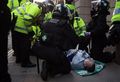 A couple of months ago George Monbiot provided an excellent summary of recent “misstatements” (a wonderfully euphemistic neologism) by the police over the last few years, including such blatant cases as the death of Ian Tomlinson during the London G20 protests two years ago, the ongoing News of the World phone hacking case, and the counter-terrorism style execution, sorry, shooting of the entirely innocent Jean Charles de Menezes, to name but a few.
Monbiot also dwelt at length on the appalling case of Michael Doherty, a concerned father who discovered that his 13 year-old daughter was apparently being groomed by a paedophile over the internet. He took his concerns to the police, who brushed the issue aside. When Doherty tried to push for a more informed and proactive response, he was the one who was snatched from his house in an early morning raid and ended up in court, accused of abusive and angry phone calls to the station in a sworn statement by a member of the relevant police force, sorry, service.
And that would have been that — he would have apparently been bang to rights on the word of a police secretary — apart from the fact he had recorded all his phone calls to the police and kept meticulous notes on the progress of the case. Only this evidence led to his rightful acquittal.
 As Monbiot rightly concludes, “justice is impossible if we cannot trust police forces to tell the truth”.
It appears that the notion of “citizen journalists” is just sooo 2006. Now we all need to be not only journalists but also “citizen lawyers”, just in case we have to defend ourselves against potential police lies. Yet these are the very organisations that are paid from the public purse to protect civil society. Is it any wonder that so many people have a growing distrust of them and concerns about an encroaching, Stasi-like, police state?
This is all part of engrained, top-down British culture of secrecy that allows the amorphous “security services” to think they can get away with anything and everything if they make a forceful enough public statement: black is white, torture is “enhanced interrogation”, and war is peace (or at least a “peacekeeping” mission in Libya.…). Especially if there is no meaningful oversight. We have entered the Orwellian world of NewSpeak.
But plus ca change, plus c’est la meme chose. This all happened in the 1970s and 80s with the Irish community, and also in the 1990s with the terrible miscarriage of justice around the Israeli embassy bombing in 1994. If you have the time, please do read the detailed case here: Download Israeli_Embassy_Case
We need to remember our history.

 Over the last few years there have been a number of egregious cases of police and state cover-ups in the UK around the deaths and wrongful prosecutions of innocent people.
This brings to my mind the appalling miscarriage of justice that occurred in the 1990s when two Palestinian students, a young woman called Samar Alami and a young man called Jawad Botmeh, were both wrongfully convicted of conspiracy to bomb the Israeli embassy in London in July 1994.
In this case a highly sophisticated car bomb as detonated outside the embassy. Thankfully nobody was killed, but a number of people suffered minor injuries. Alami and Botmeh had connections to Palestinian political support groups based in London at the time, many of whom were rounded up during the investigation. Botmeh had naively helped out a shadowy and never-identified figure called Reda Moghrabi, who asked for assistance in buying a second-hand car at auction. This was the car that was used in the explosion.
Why is this case an example of establishment cover-up? Well, this was one of the cases that former MI5 officer David Shayler blew the whistle on during the 1990s. He revealed the existence of two relevant documents that should have been disclosed to the defence but, for some unaccountable reason, were not.
The first, an agent report from a credible and trusted source, pointed to a non-Palestinian group planning the attack before it had even occurred. This report was not acted upon by the MI5 officer responsible, who then tried to cover up her mistake. She was caught out, and there was a much-discussed internal inquiry into the matter within MI5’s G Branch (international terrorism) in late 1994.
But there was another document — one written by G9/1, the senior MI5 officer who oversaw the post-incident investigation. His view was that Mossad, the external Israeli intelligence agency, had carried out a controlled explosion outside its own embassy (the shadowy and unidentified Reda Moghrabi being the potentially crucial missing link) in order to acquire the long-demanded additional security protection around Israeli interests in the UK, and also to shatter the Palestinian support networks in London — a long-term objective of Mossad.
The government at the time tried to dismiss these disclosures. However, the much-missed Private Eye investigative journalist, Paul Foot, and the indefatigable lawyer, Gareth Peirce, followed them up and pursued them tirelessly through the media and the courts.
And guess what? It turns out that these two key documents had indeed not been disclosed to the legal defence team during the trial of Alami and Botmeh — and not just by the hapless spooks. It emerged during the appeal hearing that no fewer than seven people from a variety of police and intelligence organisations had failed to disclose the relevant documentation to the defence. This cannot be explained away as an innocent oversight, a cock-up — it bears all the hallmarks of a deliberate, systemic establishment cover-up.
All this represented, at the very least, a need for a retrial but also a possible gross miscarriage of justice. And yet, while acknowledging that these documents did indeed exist during the appeal hearing and beyond, the presiding m’luds decided to ignore all case law and European law and let those two innocents rot in prison. After all, it would be terribly embarrassing to vindicate the actions of an intelligence whistleblower, wouldn’t it?
As a result, the poor pawns in this sick establishment game, Jawad Botmeh and Samar Alami, ended up serving their full sentences, despite the overwhelming body of evidence proving their innocence, and were finally released in 2008 and 2009 respectively.
For anyone interested in the detailed horror story behind this flagrant miscarriage of justice, here is the relevant chapter from my long-defunct book: Download The_Israeli_Embassy_Case
 Well, this is an interesting case in the US. Thomas Drake, a former senior executive at the American National Security Agency (NSA), the US electronic eavesdropping organisation, is being charged under the 1917 US Espionage Act for allegedly disclosing classified information to a journalist about, gasp, the mismanagement, financial waste and dubious legal practices of the spying organisation. These days it might actually be more newsworthy if the opposite were to be disclosed.…
However, under the terms of the Espionage Act, this designates him an enemy of the American people on a par with bona fide traitors of the past who sold secrets to hostile powers during the Cold War.
It strikes me that someone who reports malpractice, mistakes and under-performance on the part of his (secretive) employers might possibly be someone who still has the motivation to try to make a difference, to do their best to protect people and serve the genuine interests of the whole country. Should such people be prosecuted or should they be protected with a legal channel to disclosure?
Thomas Drake does not sound like a spy who should be prosecuted for espionage under the USA’s antiquated act, he sounds on the available information like a whistleblower, pure and simple. But that won’t necessarily save him legally, and he is apparently facing decades in prison. President Obama, who made such a song and dance about transparency and accountability during his election campaign, has an even more egregious track record than previous presidents for hunting down whistleblowers — the new “insider threat”.
This, of course, chimes with the British experience. So-called left-of-centre political candidates get elected on a platform of transparency, freedom of information, and an ethical foreign policy (think Blair as well as Obama), and promptly renege on all their campaign promises once they grab the top job.
In fact, I would suggest that the more professedly “liberal” the government, the more it feels empowered to shred civil liberties. If a right-wing government were to attack basic democratic freedoms in such a way, the official opposition (Democrats/Labour Party/whatever) would be obliged to make a show of opposing the measures to keep their core voters sweet. Once they’re in power, of course, they can do what they want.
One stark example of this occured during the passing of the British Official Secrets Act (1989) which, as I’ve written before, was specifically designed to gag whistleblowers and penalise journalists. The old OSA (1911) was already in place to deal with real traitors.
And who voted against the passing of this act in 1989? Yes, you’ve guessed it, all those who then went on to become Labour government ministers after the 1997 Labour election landslide — Tony Blair, Jack Straw, the late Robin Cook and a scrum of other rather forgettable ministers and Attorney Generals.…. And yet it was this very New Labour government in the UK that most often used the OSA to halt the free-flow of information and the disclosures of informed whistleblowers. Obama has indeed learnt well.
It’s an oldie but still a goodie: as one of my lawyers once wryly told me, it doesn’t matter whom you vote for, the government still gets in.….
 I did two sessions at Hay-on-Wye philosophy and music festival — How the Light gets In in May 2011.
The first was a debate called “An Age of Transparency” with neo-conservative commentator Douglas Murray, and philosopher Nigel Warburton.
The second was my talk about “Spies, Lies, and Life on the Run”.
Here’s a link to a video of my talk.

“This house believes whistleblowers make the world a safer place.”
I was honoured to be asked to say a few words at the recent debate about the value of whistleblowers in London on 9th April 2011.
The Frontline Club and the left-wing New Statesman magazine jointly hosted the event, which starred Julian Assange, editor in chief of Wikileaks. Here is the debate in full:
Needless to say, the opposition had an uphill battle arguing not only against logic, the fair application of law, and the meaning of a vibrant and informed democracy, but also against the new realities in the worlds of journalism and technology.
The first more diplomatically-minded oppositionist adopted a policy of appeasement towards the audience, but the last two had to fall back on the stale and puerile tactics of name-calling and ad hominem attacks. So good to see that expensive educations are never a waste.…
The proposition was supported enthusiatically by the sell-out crowd, a resounding vote of confidence in the democratic notions of accountability and transparency.
Here’s a snippet of my (brief) contribution to a fantastic afternoon:
Our esteemed governments, intelligence agencies and police forces always attack whistleblowers and organisations such as Wikileaks on the grounds that unauthorised disclosure of classified information puts the lives of agents and informants at risk.
 Agent identities, along with ongoing operations (as Former Assistant Commissioner of Special Operations at the Metropolitan Police, Bob Quick, found to his cost two years ago) and sensitive investigatory techniques, are indeed in need of protection. Much else is not — particularly information about lies, cover-ups, incompetence and crime.
Indeed, once you delve behind the screaming headlines that whistleblower disclosures have risked agent lives, you often find that this is absolutely not the case — in fact their motivation is usually to prevent further needless torture, death and war crimes. So the US Defence Secretary, Robert Gates, was forced to admit that Wikileaks had indeed not endangered lives with the publication of the Afghan War Logs last year, and David Shayler’s trial judge, in his formal ruling, stated that “no lives had been put at risk” by his whistleblowing.
Instead, there is a growing body of evidence to suggest that the security forces are the very organisations not taking the protection and aftercare of their agents seriously.
Mark Kennedy, the undercover police officer who spied on UK environmental protest groups, has gone on the record to say that the supervision, care and psychological support provided to him was woefully lacking. Kevin Fulton, a serving soldier who infiltrated the IRA on behalf of the notorious Forces Research Unit, has similarly been hung out to dry and is now attempting to sue the British Government to provide the promised, adequate aftercare.
Martin McGartland, who worked as a source in Northern Ireland at the height of “The Troubles” and is credited with saving 50 lives, has also borne the brunt of this laissez faire attitude since he stopped working for intelligence. He has the scars to prove it too, having survived assassination attempts, and once blindly leaping out of a third floor window in an frantic attempt to escape torture at the hands of the IRA. As he says:
“Who would put their lives on the line nowadays when they can read what happens to those who did?”, McGartland says. “I can’t go home and the IRA are supposed to be a former terrorist group. Nobody is hunting down my attackers and nobody in authority seems to care. That has a direct impact on recruiting agents.…”
 The most egregious case is of Denis Donaldson, Sinn Féin’s Head of Administration at Stormont in Northern Ireland who was outed as a MI5 and police spy by Gerry Adams in 2006. He was brutally murdered a few months later, allegedly by the Real IRA, having received little protection or support from his erstwhile spook handlers.
So who is really more likely expose current agents to the risk of psychological damage, torture and death, or to deter future agents from volunteering to work with the security forces? Principled whistleblowers who expose crime and incompetence with due care for protecting real secrets, or the spooks who take a cavalier approach to the pastoral care of their agents, and then hang them out to dry once their usefulness is at an end?
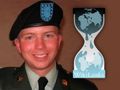 Alleged Wikileaks source US Private Bradley Manning is now charged with “aiding the enemy”, amongst a bewildering array of 22 new charges. This is apparently a capital offence, although the US military has cosily said that they wouldn’t push for this barbaric sentence.
So just life without the hope of parole then.….
Putting aide the minor question of whether the USA should even be entitled to call itself a modern democracy when it still has the death penalty on its books, let’s just remind ourselves of what Manning is alleged to have revealed: the “Collateral Murder” military shoot-up, where innocent children, civilians and journalists were gunned down by US forces in a particularly nasty snuff video game that was then deliberately covered up by the Pentagon for years; many other heinous war crimes and records of daily brutality in Afghanistan and Iraq; and an “embarrass de richesses” of diplomatic cables.
I think “embarrass” is the key word here, on so many levels, and goes a long way to explaining the USA’s desperation to destroy Wikileaks founder, Julian Assange, by any means necessary.
But the phrase from the list of charges against the hapless Manning that leaps out at me is “aiding the enemy”. If — and it’s still a big legal if — Manning was indeed the source of all this crucial information, whom was he actually aiding?
Information that has appeared on Wikileaks over the last few years has been eclectic, international and very much in the public interest. It’s covered such nasties as Trafigura, the BNP, Scientology, Climategate, Guantanamo, the Australian internet blacklist, Sarah Palin, and much more.
It’s certainly not just restricted to the information that hit the headlines last year about the US hegemony. However, there is no doubt that it was the release of the Afghan, Iraq and diplomatic files that stirred up this particularly unpleasant hornets’ nest.
As global citizens I would suggest that we have every right to know what is done in our name. But, having said that, according to these new charges against poor Bradley Manning, the beneficiaries of Wikileaks — ie all of us — have now become the enemy.
When did we, the people, the global citizenry, become the enemy? It seems that our esteemed rulers are at last showing their true colours.…
On that note, do have a look at this video of former MI6 chief, Sir Richard Dearlove, speaking recently at the Cambridge Union Society. An interesting perspective on the British Establishment’s line on Wikileaks and Julian Assange: