My recent interview on “Breaking the Set”, Abby Martin’s show on RT America, discussing all things whistleblowing:
Secret Agent Turns Whistleblower from Annie Machon on Vimeo.
My recent interview on “Breaking the Set”, Abby Martin’s show on RT America, discussing all things whistleblowing:
Secret Agent Turns Whistleblower from Annie Machon on Vimeo.
An abbreviated version of this article was published by RT Op-Edge yesterday.
News of the two bombs in Boston, in which 3 people have so far died and more than 100 have been injured, has ricocheted around the world. Beyond the grim statistics, there is little concrete evidence about the who and the why, and nor will there be possibly for days or even weeks. This confusion is inevitable in the wake of such an attack, as the intelligence agencies and police play frantic catch-up to identify the perpetrators and, we hope, bring them to justice — although of course in post-Patriot Act, post-NDAA America, the perpetrators are more likely to find their names on the CIA’s presidentially-approved kill list.
In the absence of facts, the media fills its airwaves with speculation and repetition, thereby inadvertently whipping up yet more fear and uncertainty. The fall-out from this is an eruption of prejudice in the social media, with desk bound heroes jumping to conclusions and advocating violent reprisals against whole swathes of the Middle East. And this fear and hate plays straight into the hands of the “enemy-industrial complex” so aptly described by Tom Engelhardt recently.
With that in mind, let’s take a moment to pay our respects to those who died in terrorist attacks on Monday. Even a quick surf through the internet produces a grim and no doubt incomplete tally: Iraq (55); Afghanistan (7); Somalia (30); Syria (18); Pakistan (4); USA (3). All these numbers represent someone’s child, mother, friend, brother, loved one, and all will be mourned.
Alas, not all of these victims will receive as much air-time as the unfortunates caught up in the Boston attacks. And this is especially the case where attacks are carried out by the American military against suspected “insurgents” across the Middle East.
Indeed, on the same day The Telegraph reported that the UN special rapporteur on counter-terrorism and human rights, famous British barrister Ben Emmerson (Queen’s Counsel), had stated that drone strikes across the Middle East were illegal under international law. Their continued use only served to legitimise Al Qaeda attacks against the US military and its infrastructure in the region.
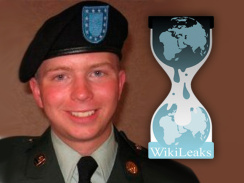 As we saw in 2010 when Wikileaks released the video, “Collateral Murder”, such atrocities are covered up for years, denied by the government, nor will the perpetrators be held to account — they are probably still serving in the military. Instead the whistleblower who exposed this crime, Bradley Manning, languishes in prison facing a court martial, and the publisher of the material, Wikileaks, faces global repression and a secret federal grand jury indictment.
With its endless, speculative scaremongering about the Boston attacks, the US media plays a diabolical role in furthering the work of the attackers — ie terrorising the population, inducing them to live in a state of abject fear. Of course, once suitably terrorised, the US people will be even more willing to give away what remains of their historic freedoms, all in the name of increasing their security. Well, we know the views of one late, great American on this subject, Benjamin Franklin: “those who would give up essential liberty to purchase a little temporary safety deserve neither liberty nor safety”.
Indeed, the abrogation of liberty in the USA has patently not resulted in greater security, as Boston has so brutally demonstrated. No society can protect itself absolutely against terrorism.
In a democracy, just as rights come with responsibilities, so freedoms come with risk. And we need to remember that those freedoms were hard-won by our ancestors and will be equally difficult to win back if we heedlessly throw them away now, while the risks remain statistically negligible.
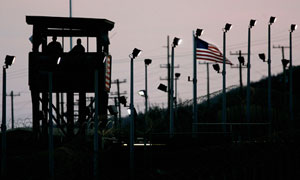 Successive US governments have already decimated the basic rights of the US people in the post‑9/11 security panic. At the sharp end, people, both globally and now also in America, can be extraordinarily rendered (kidnapped) to black prison sites and tortured for years on the word of anonymous intelligence officers, they can be denied due legal process, and they can be killed on presidential decree by drone strikes — a real-world version of the snuff video.
Additionally, the US has descended into a panoptican surveillance state, with endemic data-mining of communications, airborne drone spying, and the categorisation of protesters as “domestic extremists” or even “terrorists” who are then beaten up by militarised police forces. This otiose security theatre constantly reminds US citizens to be afraid, be very afraid, of the enemy within.
Terrorist atrocities are criminal acts, they are not a separate form of “eviltude”, to use George Bush-era terminology. As such, the criminals behind such attacks should be investigated, evidence gathered, and they should be tried in front of a jury of their peers, where justice can be done and be seen to be done. So it is troubling that the Boston FBI bureau chief, Richard DesLauriers, is today quoted in the New York Times as saying he is working on “a criminal investigation that is a potential terrorist investigation”. The precise difference being?
Likewise, terrorist attacks are not an existential threat to the fabric of the nation, even events on the scale of 9/11. However, I would suggest that the response of the security-industrial complex poses a greater existential threat to the future well-being of the USA. The post‑9/11 security crackdown in the USA has eroded core democratic values, while the military response across the Middle East has bankrupted America and created a generation of potential enemies.
But it doesn’t have to be this way. Compare and contrast the response of the Norwegian people in the aftermath of the terrorist attacks and murder of 77 people by Anders Breivik. As a country, there was a need to see justice done, but not to allow such an appalling attack to compromise the values of the society and destroy a cherished way of life for all. And this the Norwegian people achieved.
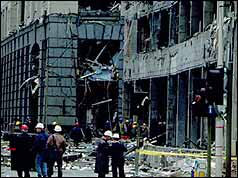 Similarly between the late 1980s and the late 1990s the UK endured Lockerbie, Omagh, Bishopsgate, Canary Wharf, and Manchester, to name but a few major atrocities. A good summary of the terrorist attacks against London alone over the last 150 years can be found here, with the first Tube bombing occurring in 1885. A pilot, Patrick Smith, also recently wrote a great article about aircraft security and the sheer scale of the terrorist threat to the West in the 1980s — and asks a very pertinent question: just how would we collectively react to such a stream of atrocities now?
During the 1990s, at the height of the Provisional IRA’s bombing campaign on mainland Britain, I lived in central London and worked as an intelligence officer for the UK’s domestic Security Service (MI5). Putting aside my professional life, I have personal memories of what it was like to live under the shadow of terrorism. I remember making my way to work in 1991 and commuting through Victoria train station in London 10 minutes before a bomb, planted in a rubbish bin, exploded on the station concourse. One person was killed, and many sustained severe injuries. One person had their foot blown off — the image haunted me for a long time.
I also vividly remember, two years later, sitting at my desk in MI5’s Mayfair office, and hearing a dull thud in the background — this turned out to be a bomb exploding outside Harrods department store in Knightsbridge. And let’s not forget the almost daily disruption to the tube and rail networks during the 1990s because of security alerts. Every Londoner was exhorted to watch out for, and report, any suspicious packages left at stations or on streets.
Londoners grew used to such inconvenience; they grumbled a bit about the disruption and then got on with their lives — echoes of the “keep calm and carry on” mentality that evolved during the Blitz years. In the 1990s the only noticeable change to London’s diurnal rhythm was that there were fewer US tourists clogging up the streets — an early indication of the disproportionate, paranoid US reaction to a perceived terrorist threat.
In contrast to the post‑9/11 years, the UK did not then react by shredding the basic freedoms of its people. There were certainly controversial cases and heated debates about how long you could hold a terrorist suspect without charge, but the way of life continued much as before. Now, twelve years after 9/11 — an attack on a different continent — the UK has all the laws in place to enact a de facto police state within days.
Life and liberty are both precious. It is always tragic when lives are be lost in the name of some twisted or arcane political cause; it is even more tragic when the liberty of all is also lost as a result.
 My heart goes out to those who were injured and to the friends and families who have lost loved ones in the Boston attacks, in the same way it goes out to all those who were killed and maimed across the Middle East yesterday.
However, I do urge caution in the US response; evidence needs to be gathered and justice seen to be done. Another security crackdown on a fearful US population will hurt Americans much more than two bombs in Boston ever could, while yet more remotely-controlled revenge killings across the Middle East will kill, maim and displace many more thousands.
I shall leave you with a quote from another great American, Thomas Jefferson:
“Single acts of tyranny may be ascribed to the accidental opinion of the day; but a series of oppressions, begun at a distinguished period, and pursued unalterably through every change of ministers too plainly proves a deliberate, systematic plan of reducing us to slavery.”
Today’s RT interview about the Bradley Manning hearing:
And here’s the transcript of the full interview I did.
A fun interview with Heimir Már Pétursson on TV2, filmed during my recent tour of Iceland:
Iceland TV 2 from Annie Machon on Vimeo.
My recent interview on Iceland’s premier news discussion show, Silfur Egils, hosted by the excellent Egill Helgason.
The name refers to an old Norse saga about a hero, an earlier Egill, throwing handfuls of silver to the ground so he could make the Viking politicos of the day scrabble around in the dirt trying to pick up the coins.
Plus ça change, plus c’est la même chose.
Wikileaks spokesman, Kristinn Hrafnsson, invited me to speak at the Icelandic Centre for Investigative Journalism while I was in Iceland in February.
While focusing on the intersection and control between intelligence and the media, my talk also explores many of my other current areas of interest.
Iceland Journalists talk 2013 from Annie Machon on Vimeo.
Here’s the link to my interview tonight on UK Anonymous Radio — I had a great time and found it a fun, wide-ranging, and stimulating hour. I hope you do too. So, thank you Anonymous.
And also thank you to Kim Dotcom setting up the new file-sharing site, Mega, which replaces his illegally-taken-down global site, MegaUpload. I have somewhere safe, I think, to store my interviews!
What a shambolic disgrace that MegaUpload raid was, and what a classic example of the global corporatist agenda that I discuss in the interview.
I do love geeks.
Also on the Huffington Post UK, RT, The Real News Network, nsnbc, and Information Clearing House:
Where to start with this tangled skein of media spin, misrepresentation and outright hypocrisy?
Last week the Sam Adams Associates for Integrity in Intelligence presented this year’s award to Dr Tom Fingar at a ceremony jointly hosted by the prestigious Oxford Union Society.
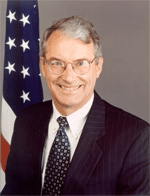 Dr Fingar, currently a visiting lecturer at Oxford, had in 2007 co-ordinated the production of the US National Intelligence Estimate — the combined analysis of all 16 of America’s intelligence agencies — which assessed that the Iranian nuclear weaponisation programme had ceased in 2003. This considered and authoritative Estimate directly thwarted the 2008 US drive towards war against Iran, and has been reaffirmed every year since then.
By the very fact of doing his job of providing dispassionate and objective assessments and resisting any pressure to politicise the intelligence (à la Downing Street Memo), Dr Fingar’s work is outstanding and he is the winner of Sam Adams Award, 2012. This may say something about the parlous state of our intelligence agencies generally, but don’t get me started on that…
Anyway, as I said, the award ceremony was co-hosted by the Oxford Union Society last week, and many Sam Adams Associates attended, often travelling long distances to do so. Former winners were asked to speak at the ceremony, such as FBI Coleen Rowley, GCHQ Katherine Gun, NSA Thomas Drake, and former UK Ambassador Craig Murray. Other associates, including CIA Ray McGovern, diplomats Ann Wright and Brady Kiesling and myself also said a few words. As former insiders and whistleblowers, we recognised the vitally important work that Dr Fingar had done and all spoke about the importance of integrity in intelligence.
One other previous winner of the Sam Adams Award was also invited to speak — Julian Assange of Wikileaks. He spoke eloquently about the need for integrity and was gracious in praising the work of Dr Fingar.
All the national and international media were invited to attend what was an historic gathering of international whislteblowers and cover an award given to someone who, by doing their job with integrity, prevented yet further ruinous war and bloodshed in the Middle East.
Few attended, still fewer reported on the event, and the promised live streaming on Youtube was blocked by shadowy powers at the very last minute — an irony considering the Oxford Union is renowned as a free speech society.
But worse was to come. The next day The Guardian newspaper, which historically fell out with Wikileaks, published a myopic hit-piece about the event. No mention of all the whistleblowers who attended and what they said, no mention of the award to Dr Fingar, no mention of the fact that his work saved the Iranian people from needless war.
Oh no, the entire piece focused on the tawdry allegations emanating from Sweden about Julian Assange’s extradition case. Discounting the 450 students who applauded all the speeches, discounting all the serious points raised by Julian Assange during his presentation, and discounting the speeches of all the other internationally renowned whistleblowers present that evening, The Guardian’s reporter, Amelia Hill, focused on the small demo outside the event and the only three attendees she could apparently find to criticise the fact that a platform, any platform, had been given to Assange from his political asylum at the Ecuadorian Embassy.
 So this is where we arrive at the deep, really deep, hypocrisy of the evening. Amelia Hill is, I’m assuming, the same Guardian journalist who was threatened in 2011 with prosecution under the Official Secrets Act. She had allegedly been receiving leaks from the Metropolitan Police about the on-going investigation into the News of the World phone-hacking scandal.
At the time Fleet Street was up in arms — how dare the police threaten one of their own with prosecution under the OSA for exposing institutional corruption? Shades of the Shayler case were used in her defence. As I wrote at the time, it’s a shame the UK media could not have been more consistently robust in condemning the chilling effects of the OSA on the free-flow of information and protect all the Poor Bloody Whistleblowers, and not just come out fighting when it is one of their own being threatened. Such is the way of the world.…
But really, Ms Hill — if you are indeed the same reporter who was threatened with prosecution in 2011 under the OSA — examine your conscience.
How can you write a hit-piece focusing purely on Assange — a man who has designed a publishing system to protect potential whistleblowers from precisely such draconian secrecy laws as you were hyperbolically threatened with? And how could you, at the same time, airbrush out of history the testimony of so many whistleblowers gathered together, many of whom have indeed been arrested and have faced prosecution under the terms of the OSA or US secrecy legislation?
Have you no shame? You know how frightening it is to be faced with such a prosecution.
Your hypocrisy is breath-taking.
The offence was compounded when the Sam Adams Associates all wrote a letter to The Guardian to set the record straight. The original letter is reproduced below, and this is what was published. Of course, The Guardian has a perfect right under its Terms and Conditions to edit the letter, but I would like everyone to see how this can be used and abused.
And the old media wonders why they are in decline?
Letter to The Guardian, 29 January 2013:
Dear Sir
With regard to the 24 January article in The Guardian entitled “Julian Assange Finds No Allies and Tough Queries in Oxford University Talk,” we question whether the newspaper’s reporter was actually present at the event, since the account contains so many false and misleading statements.
If The Guardian could “find no allies” of Mr. Assange, it did not look very hard! They could be found among the appreciative audience of the packed Oxford Union Debate Hall, and — in case you missed us — in the group seated right at the front of the Hall: the Sam Adams Associates for Integrity in Intelligence.
Many in our group — which, you might be interested to know co-sponsored the event with Oxford Union — had traveled considerable distances at our own expense to confer the 10th annual Sam Adams award to Dr. Thomas Fingar for his work on overseeing the 2007 National Intelligence Estimate that revealed the lack of an Iranian nuclear weaponization program.
Many of us spoke in turn about the need for integrity in intelligence, describing the terrible ethical dilemma that confronts government employees who witness illegal activity including serious threats to public safety and fraud, waste and abuse.
But none of this made it into what was supposed to pass for a news article; neither did any aspect of the acceptance speech delivered by Dr. Fingar. Also, why did The Guardian fail to provide even one salient quote from Mr Assange’s substantial twenty-minute address?
By censoring the contributions of the Sam Adams Associates and the speeches by Dr. Fingar and Mr. Assange, and by focusing exclusively on tawdry and unproven allegations against Mr. Assange, rather than on the importance of exposing war crimes and maintaining integrity in intelligence processes, The Guardian has succeeded in diminishing none but itself.
Sincerely,
The Sam Adams Associates for Integrity in Intelligence:
Ann Wright (retired Army Colonel and Foreign Service Officer of US State Department), Ray McGovern (retired CIA analyst), Elizabeth Murray (retired CIA analyst), Coleen Rowley (retired FBI agent), Annie Machon (former MI5 intelligence officer), Thomas Drake (former NSA official), Craig Murray (former British Ambassador), David MacMichael (retired CIA analyst), Brady Kiesling (former Foreign Service Officer of US State Department), and Todd Pierce (retired U.S. Army Major, Judge Advocate, Guantanamo Defense Counsel).
The Real News Network coverage of the recent Sam Adams Award for Integrity in Intelligence, with contributions from many of the whistleblowers involved:
My recent interview on Max Keiser’s excellent RT show, The Keiser Report, apparently now the most watched English language news commentary show across the world.
We were discussing such happy subjects as the war on terror, the war on drugs, but predominantly the war on the internet:
On 23 January the Oxford Union Society will be hosting the Sam Adams Award for Integrity in Intelligence.
The SAAII is one of the few international recognitions for those within the intelligence community who follow their conscience, often at great professional and personal cost.
This year’s winner is Dr Tom Fingar, who headed up the 2007 US National Intelligence Estimate on Iran. He collated the official assessments of all 16 of America’s intelligence agencies, which unanimously assessed that Iran had ceased trying to build a nuclear weapon in 2003. This evidence-based analysis made it impossible for the Bush administration to push through its plans to launch a war against Iran in 2008. This excellent article by ex-CIA analyst Ray McGovern explains Dr Fingar’s achievements far better than I could.
Former SAAII winners include FBI Coleen Rowley, GCHQ Katherine Gun, NSA Thomas Drake, and Wikileaks supremo Julian Assange.
Over the last few weeks I have had the pleasure of working with the Union officers and fellow SAAIIers, especially renowned peace activists Ray McGovern and Elizabeth Murray (formerly of the US National Intelligence Council), to organise this event. Many of us will be speaking that evening, and Julian Assange will be doing a live video link.
All this in recognition of Dr Fingar’s contribution to professional, ethical intelligence work. Even in this “gloves-off”, post‑9/11 world, it is heartening to hear that is possible.
I hope that many people can support and report on this event.
Here is a link to an in-depth interview I did recently at the Czech national radio station in Prague.
As a Director of Law Enforcement Against Prohibition (LEAP), I was invited to Prague by the progressive Czech National Drug Co-ordinator, Jindrich Voboril, to speak at a drugs conference in the Czech Parliament.
My recent interview for the excellent Oxford University Free Speech Debate project, run by Professor Timothy Garton Ash. I discuss whistleblowing, the Official Secrets Act, Wikileaks and much more:
Part Two of my recent interview on the excellent, independent and fearless Real News Network: