Part One of my recent interview on the excellent, independent and fearless Real News Network:
Category Archives: Whistleblowers
The Assange Witch Hunt
Published in The Huffington Post UK, 17 August 2012
A storm of diplomatic sound and fury has broken over Ecuador’s decision to grant political asylum to Wikileaks founder, Julian Assange. The UK government has threatened to breach all diplomatic protocol and international law and go into the embassy to arrest Assange.
 The UK justifies this by citing the 1987 Diplomatic and Consular Premises Act, a law apparently put in place following the 1984 shooting of WPC Yvonne Fletcher from the Libyan Embassy in London. The murder resulted in an 11-day siege, and the embassy staff eventually being expelled from the country. Nobody has yet been brought to justice for this murder.
It is hard to equate the gravity of the crime that brought about the 1987 legislation — the murder of a policewoman — with Assange’s situation. Despite the screaming headlines, let us not forget that he is merely wanted for questioning in Sweden. Nevertheless, the UK is prepared to overturn all diplomatic protocol and create a dangerous international precedent to “get their man”, despite there being a clear lack of justification under the terms of the ’87 Act.
Many people in the western media remain puzzled about Assange’s fear of being held captive in the Swedish legal system. But can we really trust Swedish justice when it has been flagrantly politicised and manipulated in the Assange case, as has been repeatedly well documented. Indeed, the Swedish justice system has the highest rate per capita of cases taken to the ECtHR for flouting Article 6 — the right to a fair trial.
If Assange were extradited merely for questioning by police — he has yet to be even charged with any crime in Sweden — there is a strong risk that the Swedes will just shove him straight on the next plane to the US under the legal terms of a “temporary surrender”. And in the US, a secret Grand Jury has been convened in Virginia to find a law — any law — with which to prosecute Assange. Hell, if the Yanks can’t find an existing law, they will probably write a new one just for him.
So why all the sound and fury? What is this really all about?
Wikileaks is a ground-breaking new form of high-tech, award-winning journalism that has exposed corrupt practices across the world over the years. And crucially, in this war-torn, weary and financially broken world, it offers a secure conduit to whistleblowers who want to expose institutional crime and corruption for the public good.
Whistleblowers want to get their information out there, they want to make a difference, they want a fair hearing, and they don’t want to pay too high a personal price for doing so. Is that too much to ask?
By going public about serious concerns they have about their workplace, they are jeopardising their whole way of life: not just their professional reputation and career, but all that goes with it, such as the ability to pay the mortgage, their social circle, their family life, their relationship… Plus, the whistleblower can potentially risk prison or worse.
 So, with these risks in mind, they are certainly looking for an avenue to blow the whistle that will offer a degree of protection and allow them to retain a degree of control over their own lives. In the old days, this meant trying to identify an honourable, campaigning journalist and a media organisation that had the clout to protect its source. While not impossible, that could certainly be difficult, and becomes increasingly so in this era of endemic electronic surveillance.
Today the other option is a secure, high-tech publishing conduit such as Wikileaks. This provides anonymity and a certain degree of control to the modern whistleblower, plus it allows their information to reach a wide audience without either being filtered by the media or blocked by government or corporate injunctions.
As someone who has a nodding acquaintance with the repercussions of blowing the whistle on a secret government agency, I have long seen the value of the Wikileaks model — and I also understand quite why governments feel so threatened by it. After all, no government or mega-corporation wants freedom of information and transparency forced upon it, nor an informed citizenry questioning its actions.
Our governments like to spout the phrase “if you have done nothing wrong, you have nothing to hide” as they roll out yet another intrusive surveillance measure.
Wikileaks has turned that right back at them — hence this modern-day witch-hunt.
What whistleblowers want
Whistleblowers want the sun and the moon — or at least they want to get their information out there, they want to make a difference, they want a fair hearing, and they don’t want to pay too high a personal price for doing so.
Is that too much to ask? The decision to expose criminality and bad practice for the public good has serious, life-changing implications.
By going public about serious concerns they have about their workplace, they are jeopardising their whole way of life: not just their professional reputation and career, but all that goes with it, such as the ability to pay the mortgage, their social circle, their family life, their relationship… Plus, the whistleblower can potentially risk prison or worse.
 So, with these risks in mind, they are certainly looking for an avenue to blow the whistle that will offer a degree of protection and allow them to retain a degree of control over their own lives. In the old days, this meant trying to identify an honourable, campaigning journalist and a media organisation that had the clout to protect its source. While not impossible, that could certainly be difficult, and becomes increasingly so in this era of endemic electronic surveillance.
Today the other option is the secure, high-tech publishing conduit, as trail-blazed by Wikileaks. While this does not provide the potential benefits of working with a campaigning journalist, it does provide anonymity and a certain degree of control to the modern whistleblower, plus it allows their information to reach a wide audience without either being filtered by the media or blocked by government or corporate injunctions.
As someone who has a nodding acquaintance with the repercussions of blowing the whistle on a secret government agency, I have liked the Wikileaks model since I first stumbled across it in 2009.
 As with most truly revolutionary ideas, once posited it is blindingly obvious.
Never before has this been technically possible — the idea that a whistleblower’s information could be made freely available to the citizens of the world, in order to inform their democratic choices, with no blockage, not censorship, no filtering or “interpretation” by the corporate media.
This is particularly relevant in an age when the global media has been consolidated in the hands of a few multinationals, and when these multinationals have a certain, shall we say “cosy”, relationship with many of top our politicians and power elites.
The control of the mainstream media by the spooks and governments has been the focus of many of my recent talks. These corrupt inter-relationships have also been recently laid bare with the News International phone-hacking scandals.
The days of garnering news from one favoured paper or TV bulletin are long gone. Few people now trust just one media outlet — they skip across a variety of news sources, trying to evaluate the truth for themselves. But even that can be problematic when something big occurs, such as the “justification” for the invasion of Iraq or Libya, and the current beat of war drums against Iran, when the corporate media mysteriously achieves a consensus.
Hence the democratic disconnect, hence the distrust, and hence (in part) the plummeting profits of the old media.
Wikileaks is based on a simple concept — it allows the people to read the source material for themselves and make up their own minds based on real information. This led to exposure of all kinds of global nasties way before the massive 2010 US data-dump.
Despite this approach, the impact was initially subdued until Wikileaks collaborated with the old media. This, as we all know, did indeed produce the coverage and awareness of those issues deemed important as it was filtered through the MSM. This has also inevitably lead to tensions between the new model hacktivists and the old-school journalists.
 No government, least of all the USA, likes to have demands for justice and transparency forced upon it, and the push back since 2010 has been massive across the world in terms of an apparently illegal financial blockade, opaque legal cases and a media backlash. Certain of Wikileaks’s erstwhile media partners have collaborated in this, turning on one of their richest sources of information in history.
However, Wikileaks is more than a media source. It is a whole new model — a high-tech publisher that offers a safe conduit for whistleblowers to cache and publicise their information without immediately having to overturn (and in some cases risk) their lives.
For this work, Wikileaks has over the years won a number of internationally prestigious journalism awards.
Inevitably, critics in the mainstream media seem to want to have their cake and eat it too: one early partner, the New York Times, has written that it doesn’t recognise Wikileaks as a journalist organisation or a publisher — it is a source, pure and simple.
Either way, by saying this the media are surely shooting themselves in the corporate feet with both barrels. If Wikileaks is indeed “just” a source (the NYT seems to be blithely forgetting that good journalism is entirely dependent on its sources), then the media are breaking their prime directive: protect a source at all costs.
However, if Wikileaks is a journalism or publishing organisation and as such is being targeted by the US government, then all other media are surely equally at risk in the future?
By not standing up for Wikileaks in either capacity, it appears that the old media have a death wish.
Over the years whistleblowers around the world have demonstrated their trust in Wikileaks, as it was set up by someone emerging from the original bona fide hacker community. And rightly so — let’s not forget that no source has been exposed through the failure of the organisation’s technology.
Many media organisations rushed to emulate its success by trying to set up their own “secure” whistleblowing repositories. What the media execs failed to understand was the hacker ethos, the open source mentality: they went to their techie department or commercial IT service providers and said “we want one”, but failed to understand both the ethos and the security concerns around closed, proprietary software systems, often channelled through the post-Patriot Act, post-CISPA USA.
Other, apparently well-meaning organisations, also tried to emulate the Wikileaks model, but most have died a quiet death over the last year. Perhaps, again, for want of real trust in their origin or tech security?
Why on earth would any security-conscious whistleblower, emerging out of a government, military or intelligence organisation, trust such a set-up? If someone comes out of such an environment they will know all-too-well the scale of the push-back, the possible entrapments, and the state-level resources that will be used to track them down. They either need an über-secure whistleblowing platform, or they need journalists and lawyers with fire in their belly to fight the fight, no matter what.
 So now to OpenLeaks — apparently the brainchild of Wikileaks defector Daniel Domsheit-Berg. He and the shadowy “Architect” famously fell out with Julian Assange in late 2010, just when the political heat was ramping up on the organisation. They left, reportedly taking some of the crucial coding and a tranche of files with them, and Domsheit-Berg decided to set up a rival organisation called OpenLeaks. As a result of his actions, Domsheit-Berg was uniquely cast out of the international hacker group, the CCC in Berlin.
He now seems to have been welcomed back into the fold and OpenLeaks appears, finally, to be ready to receive whistleblower information.
However, there is a crucial difference between the two organisations. Where Wikileaks wants to lay the information out there for public evaluation, OpenLeaks will merely act as a repository for certain approved mainstream media organisations to access. We are back to the original blockage of the corporate media deciding what information we, the people, should be allowed to ingest.
I would not wish to comment on Domsheit-Berg’s motivation, but to me this seems to be an even worse option for a whistleblower than directly contacting a campaigning journalist with a proven track record of covering hard-core stories and fighting for the cause.
 With OpenLeaks, the whistleblower loses not only the automatic widespread dissemination of their information, but also any semblance of control over which journalists will be working on their story. Their information will be parked on the website and anyone from pre-selected media organisations will be able to access, use and potentially abuse it.
One could say that OpenLeaks operates as a secure staging platform where a whistleblower can safely store sensitive documents and information.… but the founder allegedly removed and destroyed sensitive files from Wikileaks when he jumped ship in 2010. Could any whistleblower really trust that OpenLeaks would not similarly “disappear” shit-hot information in the future?
Plus, there is the added worry for any rightly-paranoid whistleblower that the founder of OpenLeaks so easily abandoned Wikileaks when under pressure. Who’s to say that this would not happen again, if the full might of the Pentagon were brought to bear on OpenLeaks?
OpenLeaks offers neither the personal support of working with a trusted journalist and a media organisation with the clout to fight back, nor does it provide full disclosure to the wider public to side-step potential media self-censorship and government law suits, as the original Wikileaks model does.
As such OpenLeaks seems, at least to this particular whistleblower, to be an evolutionary blip — a retrograde step — in the quest for justice and accountability.
The Lindmo Show, Norway
Following on from my talk at the Norwegian SKUP investigative journalism conference in March, I was invited onto the Anne Lindmo Show in Norway on 4 May.
Anne is one of the most famous and respected journalists in Norway, and her chat show is extremely popular on prime time NRK TV on Friday nights. We had a lively session discussing the world of spying, what it was like to blow the whistle and go on the run, and the personal price that has to be paid.
Here’s the link to the whole show, and here’s my segment:
Lindmo interview on Norwegian TV from Annie Machon on Vimeo.
La Conférence régionale du journalisme d’enquête, Geneva

 The end of April saw me basking in the hot and sunny weather of Geneva, where I had been invited to give a talk (Download Geneva) at the Swiss Press Club.
We had a lovely time in Geneva, and many thanks to Jean-Philippe Ceppi and the rest of the team for such a warm, interested and interesting welcome.
Whistleblowing and Wikileaks Debate at SKUP, Norway, March 2012
Here is the film of the debate at the SKUP investigative journalism conference in Norway on 25 March 2012:
The Scandinavian Tour 2012
I had an immensely stimulating time during my recent mini-tour of Scandinavian investigative journalism conferences, meeting informed, interesting, and interested people.
The focus of my talks was the nexus between the intelligence world and the media — lessons I had learned, researched and deduced during the whistleblowing years and beyond. I have heard so many hair-raising media stories over the years.…
And, having listened to the experiences of journalists from a wide variety of other countries, it seems I am on the right track.
 First stop was the Grav conference in Sweden, where I gave a talk and had the pleasure of meeting investigative journalists who confirmed what I was saying, even if some of them didn’t think I had quite gone far enough! We also had fun at the “mingel” evening.
Next stop, next day, was the SKUP conference in Norway where I did a talk, and also a debate about the media and whistleblowers. Note to self: never, ever agree to do a morning debate after the legendary SKUP party the night before.
Finally, last weekend, I visited the Tutki 2012 journalism conference in Finland (Download Helsinki_Talk). The response was overwhelmingly positive, and once again I had confirmation of what I was saying from the journalists themselves.
So what can we do about this situation? I shall keep spreading the word, and the journalists themselves just need to keep saying a resounding “no” to the inducements, at least if they want to work on meaningful investigations. And what real journalist doesn’t, au fond?
Next stop Geneva, which is why I’m limbering up with the French.
A blast from the past
How strange to stumble across this article in the Guardian newspaper yesterday, which describes a journalist’s justifiably paranoid experiences interviewing David Shayler and me back in 2000 while writing an article for Esquire magazine.
The author, Dr Eamonn O’Neill, now a lecturer in journalism at Strathclyde University, spent a few days with us in London and Paris way back when.
 The Esquire article highlights the paranoia and surveillance that we had to live with at the time, and the contradictory briefings and slanders that were coming out of the British establishment and the media. O’Neill also intelligently tries to address the motivations of a whistleblower.
When it was published I was mildly uncomfortable about this article — I felt it didn’t do David full justice, nor did it appear to get quite to the heart of the issues he was discussing. I suppose, at the time, I was just too enmeshed in the whole situation.
Now, with hindsight, it is more perspicacious than I had thought. And rather sad.
This article is a timely reminder of how vicious the establishment can be when you cause it embarrassment and pain; the treatment meted out to David Shayler was brutal. And yet nothing has changed to this day, as we can see with the ongoing pursuit and vilification of Wikileaks.
And now to Finland.…
 My grand tour around Scandinavia continues next weekend, when I shall be giving the opening keynote at the Tutki!2012 investigative journalism conference in Helsinki. Looking forward to the conference!
Talks in Sweden and Norway
Off on my travels again at the end of the week, with two keynotes at Scandinavian journalism conferences.
 I shall first be speaking at the Grav conference in Sweden on Friday 23 March.
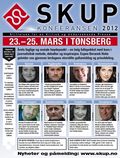 Topics under discussion will include everything from security and intelligence to the war on terror, civil liberties to ethics and media freedoms, government accountability to whistleblowing and Wikileaks.
On Saturday I travel on to Norway to speak at the SKUP conference to give a talk and also on Sunday morning to participate in a panel discussion about all things whistleblowing and Wikileaks. I gather that such discussions can get quite, um, lively.
I’m looking forward to an interesting and stimulating weekend.
The Big Dig Journalism Conference, Copenhagen
I recently did the opening keynote at the Big Dig investigative journalism conference in Copenhagen. Thanks to the organisers for a wonderful weekend!
Mediafabric talk, Prague, October 2011
Last October I had the pleasure of speaking at the excellent Mediafabric conference in Prague. The focus of my talk was the future of intelligence, whistleblowing and journalism.
The event was organised by Sourcefabric, an international organisation that provides open source tools and solutions for journalists, so it was an eclectic and stimulating crowd of journalists, geeks, hacktavists and designers. So well done and thank you to the organisers.
Here’s the video:
Speaking at Mediafabric Conference, Prague, 21 October

Off tomorrow to speak at the Mediafabric conference in Prague.
Should be a good one — all about the media, journalists, technologists, designers, hackers, and all points in between!
The conference has been organised by Sourcefabric, and there will be live streaming here.
Journalists need to wise up to secrecy laws

I had a fantastic time at the Global Investigative Journalism Conference in Kiev last weekend. A huge well done to the organisers for a great four days, and I loved having the chance to meet so many interesting and interested people from across the world!
I was invited to give the opening keynote speech (video to follow), where I discussed some of my experiences from the MI5 whistleblowing years, but then went on to apply the harsh lessons learned to the current situation vis a vis the issue of spy influence on the media today and the thorny issue of whistleblowing and the protection of sources.
Part of my talk focused on the control of the media by the spies in Britain. As I have written before, this is very much a “carrot and stick” scenario: the soft aspect, of course, being cosy chats with selected journalists, well-timed career-enhancing scoops, as well as an increasingly unhealthy journalistic dependence on briefings coming out of the intelligence world and government.
The stick aspect includes the battery of harsh laws that can be called upon to suppress free reporting in the UK, which sometimes leads to self-censorship by the media. These laws include:
- libel laws (Britain is notorious as the libel capital of the world);
- Terrorism Act 2000;
- injunctions;
- super-injunctions;
- Public Interest Immunity certificates (PIIs) or “gagging orders” issued by ministers;
- production orders;
- contempt of court proceedings;
- the media self-censorship of the Defence Press and Broadcasting Advisory Committee (the infamous old “D” Notice system);
- and of course the abusive use of the Official Secrets Act 1989
 How do I know all this? Well, as you can see from many of the links in the above list, I’ve lived through much of this and have followed with great interest similar and related cases over the years. More information about these issues can be found in this excellent report produced by Article 19 and Liberty over a decade ago. The situation has not improved.
While in Kiev I attended an excellent session where two Russian journalists discussed the ramifications of reporting on the modern incarnation of the Russian intelligence agency, the FSB.
I was somewhat startled to hear that even in Russia journalists have more legal protection than those in the UK — ie they face no criminal legal sanction if they report whistleblower material from the Russian spy agencies. In the UK journalists potentially face 2 years in prison for doing so, under the invidious Section 5 of the 1989 OSA.
Way to go, British democracy.