Here is my most recent RT interview, live as Chelsea Manning was sentenced to 35 years in a US prison for blowing the whistle and exposing war crimes:
RT Interview about Manning sentencing from Annie Machon on Vimeo.
Here is my most recent RT interview, live as Chelsea Manning was sentenced to 35 years in a US prison for blowing the whistle and exposing war crimes:
RT Interview about Manning sentencing from Annie Machon on Vimeo.
I was live on RT as the conviction of Bradley Manning was announced:
RT interview as the conviction of Bradley Manning was announced from Annie Machon on Vimeo.
The brutal murder in Woolwich last week of Drummer Lee Rigby rightly caused shock and outrage. Inevitably there has been a media feeding frenzy about “terrorist” attacks and home-grown radicalisation. British Prime Minister, David Cameron, felt it necessary to fly back from a key meeting in France to head up the British security response.
One slightly heartening piece of news to emerge from all the horror is that the PM has stated, at least for now, that there will be no knee-jerk security crack-down in the wake of this killing. Sure, security measures have been ramped up around military bases in the UK, but cynical calls from the securocrats to reanimate a proposed “snoopers’ charter”, aka the draft Communications Data Bill, have for now been discounted. And rightly so — MI5 already has all the necessary powers to monitor suspects.
However, there does still seem to be a politically disingenuous view about the motivation behind this murder. Yet the suspects themselves made no secret of it — indeed they stayed at the scene of the crime for twenty minutes apparently encouraging photos and smart phone recordings in order to get across their message. When the police armed response team finally arrived, the suspects reportedly charged at the police brandishing knives and possibly a gun. They were shot, but not fatally. This may have been attempted “suicide by cop” — delayed until they had said their piece.
This does not strike me as the actions of “crazed killers” as has been reported in the media; rather it reminds me of the cold and calculated actions of Norwegian mass murderer, Anders Breivik. The Woolwich murder was designed to maximize the impact of the message in this social media age.
And the message being? Well, it was indeed captured on smart phone and sent out to the world. The killers clearly stated that this was a political action designed to highlight the gruesome violence daily meted out across North Africa, the Middle East, and Central Asia as a result of the western policy of military interventionism.
This manifests in a variety of ways: violent resistance and insurgency against puppet governments as we see in Iraq; internecine civil war in countries such as post-NATO intervention Libya; covert wars fought by western proxies, as we see in Syria; or overt attacks in Yemen, Somalia, Afghanistan and Pakistan, where US and UK controlled drones target militants named for assassination on presidentially-approved CIA kill lists with the resulting collateral murder of community gatherings, children and wedding parties.
All this does not justify the appalling murder in Woolwich, and the perpetrators must face justice for the crime. However, it does go some way to explaining why such an atrocity occurred, and we as a society need to face up to the facts or this will happen again.
Saying this does not make me an apologist for terrorism, any more than it did journalist Glenn Greenwald — a writer who has had the journalistic attack dogs unleashed on him for similar views. Beyond the group-think denialism within the Washington Beltway and the Westminster Village, the cause and effect are now widely-recognised. Indeed, in her 2010 testimony to the Chilcot Inquiry about the Iraq War, former head of MI5 Eliza Manningham-Buller said precisely the same thing — and I don’t think anyone would dare to label her “an apologist for terrorism”.
The seed of Islamic extremism was planted by western colonialism, propagated by the 1953 CIA and MI6 coup against President Mossadegh of Iran, watered by their support for a fledging Al Qaeda in the 1980s Afghan resistance to the Soviet invasion, and is now flourishing as a means both of violently attempting to eject western occupying forces from Muslim countries and gaining retribution against the West.
We need to face up to this new reality. The brutal murder of this soldier may be a one-off attack, but I doubt it. Indeed, similar attacks against French soldiers in Toulouse occurred last year, and this weekend there has already been what appears to be a copy-cat attack against a soldier in Paris.
In this endemic surveillance society terrorist groups are all too aware of the vulnerabilities inherent in large-scale, co-ordinated attacks, the planning of which can be picked up by sigint or from internet “chatter”. Much simpler to go for the low-tech atrocity and cynically play the all-pervasive social media angle for maximum coverage.
The UK media has reported that the Woolwich suspects have been on the British intelligence radar for the last 8 years, but MI5 failed to take prompt action. The inevitable government enquiry has been promised, but the fall-back defensive position, already being trotted out by former spies and terrorism experts across the media is that the security services are never going to be in a position to accurately predict when every radicalised person might “flip” into violence and that such “lone wolf” attacks are the most difficult to stop.
As more news emerges, this is looking increasingly disingenuous. Reports have emerged that one of the suspects, Michael Adebolajo, was approached to work as an agent for MI5 half a year ago, apparently after he had been arrested and assaulted by police in Kenya. This may be another example of the security services’ failed Prevent initiative that seems to be causing more harm that good within the young British Muslim community.
This story has been compounded by the recent intriguing arrest of one of Adebolajo’s friends, the self-styled Abu Nusaybah, immediately after he had finished recording an interview about this for the BBC’s Newsnight programme. The Metropolitan Police Counter-Terrorism Command swooped at the Beeb and arrested the man on terrorism charges: he has now disappeared into the maw of the legal system.
The only long-term and potentially effective solution is to address the fundamental issues that lead to Islamic violence and terrorism and begin negotiations. The UK, at least, has been through this process before during the 1990s, when it was attempting to resolve the civil war in Northern Ireland. Indeed my former boss, Eliza Manningham-Buller, stated as much during a BBC lecture in 2011, saying that the US and UK governments need to negotiate with Al Qaeda to reach a political settlement.
Over the last 20 years, Al Qaeda has consistently demanded the removal of the western (predominantly US) military presence from the Middle East. Since the 9/11 attacks our political elites and media have equally consistently spun us the line that Al Qaeda carries out attacks because it “hates our way of life, hates our freedoms”.
Unless our governments acknowledge the problems inherent in continued and violent western interventionism, unless they can accept that the war on terror results in radicalisation, “blowback” and yet more innocent deaths, and until they admit that negotiation is the only viable long-term solution, we are all condemned to remain trapped in this ghastly cycle of violence.
Here is my RT interview yesterday about the Woolwich attack. A horrific murder and my thoughts are with the family of the poor victim.
That said, the British and American governments and the NATO countries are disingenuous of they think that their strategy of violent interventionism across North Africa, the Middle East and Central Asia will have no consequences. As a result of our illegal wars, CIA kill lists and drone strikes, countless families are suffering such trauma, violence and loss across the region every day.
RT interview: Lone-wolf attack to become main expression of radicalisation? from Annie Machon on Vimeo.
Here’s the full article about MI6 “ghost money”, now also published at the Huffington Post UK:
Afghan President Hamid Karzai, has recently been criticised for taking “ghost money” from the CIA and MI6. The sums are inevitably unknown, for the usual reasons of “national security”, but are estimated to have been tens of millions of dollars. While this is nowhere near the eyebleeding $12 billion shipped over to Iraq on pallets in the wake of the invasion a decade ago, it is still a significant amount.
And how has this money been spent? Certainly not on social projects or rebuilding initiatives. Rather, the reporting indicates, the money has been funnelled to Karzai’s cronies as bribes in a corrupt attempt to buy influence in the country.
None of this surprises me. MI6 has a long and ignoble history of trying to buy influence in countries of interest. In 1995/96 it funded a “ragtag group of Islamic extremists”, headed up by a Libyan military intelligence officer, in an illegal attempt to try to assassinate Colonel Gaddafi. The attack went wrong and innocent people were killed. When this scandal was exposed, it caused an outcry.
Yet a mere 15 years later, MI6 and the CIA were back in Libya, providing support to the same “rebels”, who this time succeeded in capturing, torturing and killing Gaddafi, while plunging Libya into apparently endless internecine war. This time around there was little international outcry, as the world’s media portrayed this aggressive interference in a sovereign state as “humanitarian relief”.
And we also see the same in Syria now, as the CIA and MI6 are already providing training and communications support to the rebels — many of whom, particularly the Al Nusra faction in control of the oil-rich north-east of Syria are in fact allied with Al Qaeda in Iraq. So in some countries the UK and USA use drones to target and murder “militants” (plus villagers, wedding parties and other assorted innocents), while in others they back ideologically similar groups.
Recently we have also seen the Western media making unverified claims that the Syrian régime is using chemical weapons against its own people, and our politicians leaping on these assertions as justification for openly providing weapons to the insurgents too. Thankfully, other reports are now emerging that indicate it was the rebels themselves who have been using sarin gas against the people. This may halt the rush to arms, but not doubt other support will continue to be offered by the West to these war criminals.
So how is MI6 secretly spending UK taxpayers’ money in Afghanistan? According to western media reporting, it is being used to prop up warlords and corrupt officials. This is deeply unpopular amongst the Afghan people, leading to the danger of increasing support for a resurgent Taliban.
There is also a significant overlap between the corrupt political establishment and the illegal drug trade, up to and including the president’s late brother, Ahmed Wali Karzai. So, another unintentional consequence may be that some of this unaccountable ghost money is propping up the drug trade.
Afghanistan is the world’s leading producer of heroin, and the UN reports that poppy growth has increased dramatically. Indeed, the UN estimates that acreage under poppy growth in Afghanistan has tripled over the last 7 years. The value of the drug trade to the Afghan warlords is now estimated to be in the region of $700 million per year. You can buy a lot of Kalashnikovs with that.
So on the one hand we have our western governments bankrupting themselves to fight the “war on terror”, breaking international laws and murdering millions of innocent people across North Africa, the Middle East, and central Asia while at the same time shredding what remain of our hard-won civil liberties at home.
On the other hand, we apparently have MI6 and the CIA secretly bankrolling the very people in Afghanistan who produce 90% of the world’s heroin. And then, of course, more scarce resources can be spent on fighting the failed “war on drugs” and yet another pretext is used to shred our civil liberties.
This is a lucrative economic model for the burgeoning military-security complex.
However, it is a lose-lose scenario for the rest of us.
Here’s a link to my new article, published exclusively today on RT’s Op-Edge news site.
I discuss the recent news that MI6, in addition to the CIA, has been paying “ghost money” to the political establishment in Afghanistan, other examples of such meddling, and the probable unintended consequences.
I was recently invited to write an article for the Nat West Business Sense online magazine about the potential value and benefits of whistleblowers. Here’s the link, and here’s the article:
The controversial issue of whistleblowing has been firmly thrust into the public consciousness over the last few years with the ongoing saga of Wikileaks.
Often whistleblowers can get a bad rap in the media, deemed to be traitors, grasses or snitches. However, rather than a phenomenon to be feared, if handled correctly whistleblowers can often be beneficial to their organisations. Allow me to explain.
I have a nodding acquaintance with the process. In the 1990s I worked as an intelligence officer for the UK domestic Security Service, generally known as MI5, before resigning to help my former partner and colleague David Shayler blow the whistle on a catalogue of incompetence and crime. As a result we had to go on the run around Europe, lived in hiding and exile in France for 3 years, and saw our friends, family and journalists arrested around us. I was also arrested, although never charged, and David went to prison twice for exposing the crimes of the spies. It was a heavy price to pay.
However, it could all have been so different if the UK government had agreed to take his evidence of spy crimes, undertake to investigate them thoroughly, and apply the necessary reforms. This would have saved us a lot of heartache, and could potentially have improved the work of the spies. But the government’s instinctive response is always to protect the spies and prosecute the whistleblower, while the mistakes and crimes go uninvestigated and unresolved. Or even, it often appears, to reward the malefactors with promotions and gongs.
The draconian Official Secrets Act (1989) imposes a blanket ban on any disclosure whatsoever. As a result, we the citizens have to take it on trust that our spies work with integrity. There is no meaningful oversight and no accountability.
Many good people do indeed sign up to MI5, MI6 and GCHQ, as they want a job that can make a difference and potentially save lives. However, once on the inside they are told to keep quiet about any ethical concerns: “don’t rock the boat, and just follow orders”.
In such an environment there is no ventilation, no accountability and no staff federation, and this inevitably leads to a general consensus – a bullying “group think” mentality. This in turn can lead to mistakes being covered up rather than lessons learned, and then potentially down a dangerous moral slide.
As a result, over the last decade we have seen scandal heaped upon intelligence scandal, as the spies allowed their fake and politicised information to be used make a false case for an illegal war in Iraq; we have seen them descend into a spiral of extraordinary rendition (ie kidnapping) and torture, for which they are now being sued if not prosecuted; and we have seen that they facilitate dodgy deals in the desert with dictators.
But it is not all bleak. Recently, Dr Tom Fingar received The Sam Adams Award for Integrity in Intelligence in Oxford for his work on compiling the US National Intelligence Estimate of 2007. In this he summarised the conclusions of all 16 US intelligence agencies by saying that Iran had ceased trying to develop a nuclear weapons capability in 2003.
There was immense political pressure on him to suppress this evidence, but he went ahead with the report and thereby single-handedly halted the US government’s rush to war with Iran. By having the courage to do his job with integrity, Dr Fingar is responsible for saving countless lives across Iran.
In the world of intelligence, where secrecy is paramount, where crimes can hushed up, and where there is no avenue for voicing concern and dissent, it is perhaps inevitable that whistleblowers will continue to emerge.
But in other sectors of work mistakes can be just as life threatening and the need for exposure just as great. In the UK over the last few years many senior medical whistleblowers have emerged from the NHS, detailing mistakes and incompetence that have put the public at risk. Alas, rather than learn from mistakes made, all too often NHS bosses have either victimised the whistleblowers by suspending them or ruining their reputation, or they have insisted that they sign gagging orders and then covered up the mistakes. Neither option is a good outcome either for staff morale or for patient safety.
While the culture of cover-up exists, so too will whistleblowers. How could this be resolved, and what would be the potential benefits?
If employers institute a culture of trust and accountability, where employees with concerns can be fairly heard, the appropriate action taken, and justice done, the needs and imperatives behind whistleblowing would disappear. Potential problems could be nipped in the bud, improving public trust and confidence in the probity of the organisation and avoiding all the bad publicity following a whistleblowing case.
Plus, of course, the potential whistleblowers would have a legitimate avenue to go down, rather than having to turn their lives inside out – they would no longer need to jeopardise their professional reputation and all that goes with it such as career, income, social standing and even, potentially their freedom.
Having a sound procedure in place to address staff concerns strikes me as a win-win scenario – for staff efficiency and morale, the organisation’s operational capability and reputation, and potentially the wider public, too.
A recent Make Wars History event in the UK Parliament, hosted by John McDonnell MP, with Chris Coverdale and myself speaking. Some practical steps we can all take to make wars history:
Make Wars History talk in Parliament, April 2013 from Annie Machon on Vimeo.
My recent interview on “Breaking the Set”, Abby Martin’s show on RT America, discussing all things whistleblowing:
Secret Agent Turns Whistleblower from Annie Machon on Vimeo.
An abbreviated version of this article was published by RT Op-Edge yesterday.
News of the two bombs in Boston, in which 3 people have so far died and more than 100 have been injured, has ricocheted around the world. Beyond the grim statistics, there is little concrete evidence about the who and the why, and nor will there be possibly for days or even weeks. This confusion is inevitable in the wake of such an attack, as the intelligence agencies and police play frantic catch-up to identify the perpetrators and, we hope, bring them to justice — although of course in post-Patriot Act, post-NDAA America, the perpetrators are more likely to find their names on the CIA’s presidentially-approved kill list.
In the absence of facts, the media fills its airwaves with speculation and repetition, thereby inadvertently whipping up yet more fear and uncertainty. The fall-out from this is an eruption of prejudice in the social media, with desk bound heroes jumping to conclusions and advocating violent reprisals against whole swathes of the Middle East. And this fear and hate plays straight into the hands of the “enemy-industrial complex” so aptly described by Tom Engelhardt recently.
With that in mind, let’s take a moment to pay our respects to those who died in terrorist attacks on Monday. Even a quick surf through the internet produces a grim and no doubt incomplete tally: Iraq (55); Afghanistan (7); Somalia (30); Syria (18); Pakistan (4); USA (3). All these numbers represent someone’s child, mother, friend, brother, loved one, and all will be mourned.
Alas, not all of these victims will receive as much air-time as the unfortunates caught up in the Boston attacks. And this is especially the case where attacks are carried out by the American military against suspected “insurgents” across the Middle East.
Indeed, on the same day The Telegraph reported that the UN special rapporteur on counter-terrorism and human rights, famous British barrister Ben Emmerson (Queen’s Counsel), had stated that drone strikes across the Middle East were illegal under international law. Their continued use only served to legitimise Al Qaeda attacks against the US military and its infrastructure in the region.
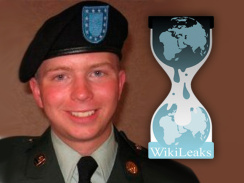 As we saw in 2010 when Wikileaks released the video, “Collateral Murder”, such atrocities are covered up for years, denied by the government, nor will the perpetrators be held to account — they are probably still serving in the military. Instead the whistleblower who exposed this crime, Bradley Manning, languishes in prison facing a court martial, and the publisher of the material, Wikileaks, faces global repression and a secret federal grand jury indictment.
With its endless, speculative scaremongering about the Boston attacks, the US media plays a diabolical role in furthering the work of the attackers — ie terrorising the population, inducing them to live in a state of abject fear. Of course, once suitably terrorised, the US people will be even more willing to give away what remains of their historic freedoms, all in the name of increasing their security. Well, we know the views of one late, great American on this subject, Benjamin Franklin: “those who would give up essential liberty to purchase a little temporary safety deserve neither liberty nor safety”.
Indeed, the abrogation of liberty in the USA has patently not resulted in greater security, as Boston has so brutally demonstrated. No society can protect itself absolutely against terrorism.
In a democracy, just as rights come with responsibilities, so freedoms come with risk. And we need to remember that those freedoms were hard-won by our ancestors and will be equally difficult to win back if we heedlessly throw them away now, while the risks remain statistically negligible.
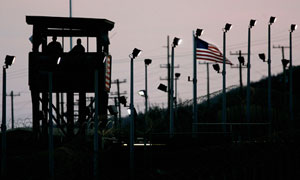 Successive US governments have already decimated the basic rights of the US people in the post‑9/11 security panic. At the sharp end, people, both globally and now also in America, can be extraordinarily rendered (kidnapped) to black prison sites and tortured for years on the word of anonymous intelligence officers, they can be denied due legal process, and they can be killed on presidential decree by drone strikes — a real-world version of the snuff video.
Additionally, the US has descended into a panoptican surveillance state, with endemic data-mining of communications, airborne drone spying, and the categorisation of protesters as “domestic extremists” or even “terrorists” who are then beaten up by militarised police forces. This otiose security theatre constantly reminds US citizens to be afraid, be very afraid, of the enemy within.
Terrorist atrocities are criminal acts, they are not a separate form of “eviltude”, to use George Bush-era terminology. As such, the criminals behind such attacks should be investigated, evidence gathered, and they should be tried in front of a jury of their peers, where justice can be done and be seen to be done. So it is troubling that the Boston FBI bureau chief, Richard DesLauriers, is today quoted in the New York Times as saying he is working on “a criminal investigation that is a potential terrorist investigation”. The precise difference being?
Likewise, terrorist attacks are not an existential threat to the fabric of the nation, even events on the scale of 9/11. However, I would suggest that the response of the security-industrial complex poses a greater existential threat to the future well-being of the USA. The post‑9/11 security crackdown in the USA has eroded core democratic values, while the military response across the Middle East has bankrupted America and created a generation of potential enemies.
But it doesn’t have to be this way. Compare and contrast the response of the Norwegian people in the aftermath of the terrorist attacks and murder of 77 people by Anders Breivik. As a country, there was a need to see justice done, but not to allow such an appalling attack to compromise the values of the society and destroy a cherished way of life for all. And this the Norwegian people achieved.
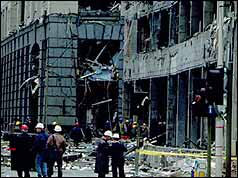 Similarly between the late 1980s and the late 1990s the UK endured Lockerbie, Omagh, Bishopsgate, Canary Wharf, and Manchester, to name but a few major atrocities. A good summary of the terrorist attacks against London alone over the last 150 years can be found here, with the first Tube bombing occurring in 1885. A pilot, Patrick Smith, also recently wrote a great article about aircraft security and the sheer scale of the terrorist threat to the West in the 1980s — and asks a very pertinent question: just how would we collectively react to such a stream of atrocities now?
During the 1990s, at the height of the Provisional IRA’s bombing campaign on mainland Britain, I lived in central London and worked as an intelligence officer for the UK’s domestic Security Service (MI5). Putting aside my professional life, I have personal memories of what it was like to live under the shadow of terrorism. I remember making my way to work in 1991 and commuting through Victoria train station in London 10 minutes before a bomb, planted in a rubbish bin, exploded on the station concourse. One person was killed, and many sustained severe injuries. One person had their foot blown off — the image haunted me for a long time.
I also vividly remember, two years later, sitting at my desk in MI5’s Mayfair office, and hearing a dull thud in the background — this turned out to be a bomb exploding outside Harrods department store in Knightsbridge. And let’s not forget the almost daily disruption to the tube and rail networks during the 1990s because of security alerts. Every Londoner was exhorted to watch out for, and report, any suspicious packages left at stations or on streets.
Londoners grew used to such inconvenience; they grumbled a bit about the disruption and then got on with their lives — echoes of the “keep calm and carry on” mentality that evolved during the Blitz years. In the 1990s the only noticeable change to London’s diurnal rhythm was that there were fewer US tourists clogging up the streets — an early indication of the disproportionate, paranoid US reaction to a perceived terrorist threat.
In contrast to the post‑9/11 years, the UK did not then react by shredding the basic freedoms of its people. There were certainly controversial cases and heated debates about how long you could hold a terrorist suspect without charge, but the way of life continued much as before. Now, twelve years after 9/11 — an attack on a different continent — the UK has all the laws in place to enact a de facto police state within days.
Life and liberty are both precious. It is always tragic when lives are be lost in the name of some twisted or arcane political cause; it is even more tragic when the liberty of all is also lost as a result.
 My heart goes out to those who were injured and to the friends and families who have lost loved ones in the Boston attacks, in the same way it goes out to all those who were killed and maimed across the Middle East yesterday.
However, I do urge caution in the US response; evidence needs to be gathered and justice seen to be done. Another security crackdown on a fearful US population will hurt Americans much more than two bombs in Boston ever could, while yet more remotely-controlled revenge killings across the Middle East will kill, maim and displace many more thousands.
I shall leave you with a quote from another great American, Thomas Jefferson:
“Single acts of tyranny may be ascribed to the accidental opinion of the day; but a series of oppressions, begun at a distinguished period, and pursued unalterably through every change of ministers too plainly proves a deliberate, systematic plan of reducing us to slavery.”
Also published on the Huffington Post UK.
A couple of days ago I was invited onto RT Arabic TV to do an interview about the ongoing clusterfuck that is Syria, with a particular focus on the issue of Western jihadis allegedly flooding into the country.
The premise, pushed across much of the Western media, is that these newly trained jihadis will then return home chock-full of insurgency know-how, ready to unleash terror on their unwitting host countries.
And, yes, there is an element of truth in this: the lessons of the US-backed mujahideen in 1980s Afghanistan and onwards across the Middle East since then is testament to that. Not that this lesson seems to have been absorbed by Western governments, who continue recklessly to back “rebel” forces across North Africa and the Middle East.
Or has it, at least on a certain level? If you do a little digging into where these stories are emanating from, another picture emerges.
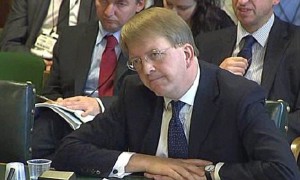 The basis for these scare stories is a heavily-spun recent report, produced by the Office for Security and Counter-Terrorism (OSCT). What is this, you might ask? Well, it appears to be a sinecure within the UK’s Home Office. The head of the organisation is a hawkish securocrat called Charles Farr, a former senior MI6 officer from the cold war era.
In 2007 Mr Farr (OBE) moved to his new home at the Home Office, where he is conveniently in a relationship with Fiona Cunningham, special advisor to his new boss the Home Secretary Theresa May. Oh, and then he applied to be the civil servant in charge of the Home Office, but was recently turned down for that job a couple of months ago.
So how is Farr now spending his time? Well, he has just released a report, and it appears that he is behind some of the most egregious recent assaults on basic British freedoms.
Where to begin? His department was behind the Prevent campaign — supposedly a social initiative to reach out to disaffected youth in Britain and help “prevent” their radicalisation. Unfortunately, Prevent has been publicly lambasted for intimidating young Muslim men and trying to browbeat them into reporting on their communities.
On top of that, Charles Farr has, it has been reported, been one of the key lobbyists pushing for the totalitarian “Snoopers’ Charter” — a proposed law that would allow the intelligence and law enforcement agencies to hoover up all our data communications.
And finally, Mr Farr is one of the key supporters of the utterly undemocratic new Justice and Security Bill that enshrines the concept of “secret courts”, all done in the name of protecting “national security”, natch. Or in other words, covering up the embarrassment of the intelligence agencies when they are caught red-handed in illegal activities such as kidnapping and torture.
So, is it purely coincidental that this is the same upstanding British public servant reporting that Syria will be a new breeding-ground for radicalised Muslim youth attacking the UK? Or might there be a sneaking suspicion that the threat could be yet another excuse to be used to ramp up the case for all these undemocratic and deeply unpopular new laws?
Let’s not to forget that the UK has a history of backing such insurgency groups when it suits them, and then turning on them for political expediency — shades of Abdel Hakim Belhaj in Libya, anyone? It strikes me that the situation in Syria is evolving along similar lines.
So let’s retain a healthy scepticism about the wheels and cogs of vested interests and media manipulation whirring behind securocrats such as Charles Farr. The predictions of his Office for Security and Counter-Terrorism could have damaging consequences for our liberties in the UK; they could also have potentially fatal consequences for many thousands of people in Syria and the wider Middle East.
RT TV interview earlier this afternoon on US deployment of Anti-Ballistic Missile Defence systems in Alaska.
Today’s RT interview about the Bradley Manning hearing:
And here’s the transcript of the full interview I did.
A fun interview with Heimir Már Pétursson on TV2, filmed during my recent tour of Iceland:
Iceland TV 2 from Annie Machon on Vimeo.
