Here’s my recent interview on RT’s excellent and incisive new UK politics programme, “Going Underground”. In it I discuss rendition, torture, spy oversight and much more:
Going Underground Ep 22 1 from Annie Machon on Vimeo.
Here’s my recent interview on RT’s excellent and incisive new UK politics programme, “Going Underground”. In it I discuss rendition, torture, spy oversight and much more:
Going Underground Ep 22 1 from Annie Machon on Vimeo.
First published by RT Op-Edge.
We, the citizens of the world, already owe NSA whistleblower Edward Snowden a huge debt of gratitude. Even the limited publication of a few of the documents he disclosed to journalists has to date provoked a political and public debate in countries across the planet — and who knows what other nasties lurk in the cache of documents, yet to be exposed?
Thanks to Snowden, millions of people as well as many governments have woken up to the fact that privacy is the vital component of free societies. Without that basic right we are unable to freely read, write, speak, plan and associate without fear of being watched, our every thought and utterance stored up to be potentially used against us at some nebulous future date. Such panoptic global surveillance leads inevitably to self-censorship and is corrosive to our basic freedoms, and individual citizens as well as countries are exploring ways to protect themselves and their privacy.
As I and others more eminent have said before, we need free media to have a free society.
But even if we can defend these free channels of communication, what if the very information we wish to ingest and communicate is no longer deemed to be free? What if we become criminalised purely for sharing such un-free information?
The global military security complex may be brutal, but it is not stupid. These corporatist elites, as I prefer to think of them, have seen the new medium of the internet as a threat to their profits and power since its inception. Which is why they have been fighting a desperate rearguard action to apply US patent and copyright laws globally.
 They began by going after music sharing sites such as Napster and imposing grotesque legal penalties on those trying to download a few songs they liked for free, then trying to build national firewalls to deny whole countries access to file sharing sites such as The Pirate Bay and persecuting its co-founder Anakata, mercifully failing to extradite Richard O’Dwyer from the UK to the US on trumped up charges for his signposting site to free media, and culminating in the take down of Megaupload and the illegal FBI attack against Kim Dotcom’s home in New Zealand last year.
But for all these high-profile cases of attempted deterrence, more and more people are sharing information, culture, and research for free on the internet. Using peer to peer technologies like Bittorrent and anonymising tools like Tor they are hard to detect, which is why the corporatist lobbyists demand the surveillance state develop ever more intrusive ways of detecting them, including the possibility of deep packet inspection. And of course once such invasive technologies are available, we all know that they will not only be used to stop “piracy” but will also be used against the people of the world by the military surveillance complex too.
But that is still not enough for the corporatists. Largely US-based, they are now trying to flex their political muscle globally. First the US claims that any site ending with a tier one US domain name (.com, .org, .net and .info) comes under US law — anywhere in the world — and can be taken down without warning or redress by a diktat from the US government.
More egregiously still, the US corporatists have been trying to impose their legal dominion globally via a series of secret regional trade agreements: ACTA, TTIP/TAFTA, SOPA, and now in the recently Wikileaked details of the Trans-Pacific Partnership (TPP) targeting the countries around the Pacific rim.
These agreements, written by corporate lobbyists, are so secret that the democratic representatives of sovereign countries are not even allowed to read the contents or debate the terms — they are just told to sign on the dotted line, effectively rubber-stamping legislation that is antithetical to the vast majority their citizens’ interests, which gives greater sovereign powers to the interests of the corporations than it does to nation states, and which will criminalise and directly harm the people of the world in the interests of the few.
One of the proposals is that multinational corporations can sue national governments for future lost profits based on patents not granted or environmental restrictions. This is nothing short of full-on corporatism where international law and global treaties serve a handful of large corporations to the detriment of national sovereignty, environmental health and even human life.
For by protecting “intellectual property” (IP), we are not just talking about the creative endeavours of artists. One does not need to be a lawyer to see the fundamental problematic assumptions in the goals as defined in the leaked document:
Enhance the role of intellectual property in promoting economic and social development, particularly in relation to the new digital economy, technological innovation, the transfer and dissemination of technology and trade;
This statement assumes that IP, a made-up term that confuses three very different areas of law, is by definition beneficial to society as a whole. No evidence for these claimed benefits is provided anywhere. As with “what-is-good-for-General-Motors-is-good-for-America” and the theory of ”trickle down” economics, the benefits are simply assumed and alternative models actively and wilfully ignored. The idea that most societies on the planet might vastly benefit from a relaxation of patent laws or the length of copyright is not even up for debate. This despite the fact that there is plenty of research pointing in that direction.
These secret proposed treaties will enforce patents that put the cost of basic pharmaceuticals beyond the reach of billions; that privatise and patent basic plants and food; and that prevent the sharing of cutting edge academic research, despite the fact that this is usually produced by publicly funded academics at our publicly funded universities.
The price, even today, of trying to liberate research for the public good can be high, as Aaron Swartz found out earlier this year. After trying to share research information from MIT, he faced a witch hunt and decades in prison. Instead he chose to take his own life at the age of 26. How much worse will it be if TPP et al are ratified?
It is thanks to the high-tech publisher, Wikileaks, that we know the sheer scale of the recent TPP débacle. It is also heartening to see so many Pacific rim countries opposing the overweening demands of the USA. Australia alone seems supportive — but then regionally it benefits most from its membership of the “Five Eyes” spy programme with America.
The intellectual property wars are the flip side of the global surveillance network that Snowden disclosed — it is a classic pincer movement.
 As well as watching everything we communicate, the corporatists are also trying to control exactly what information we are legally able to communicate, and using this control as justification for yet more intrusive spying. It’s the perfect self-perpetuating cycle.
By curtailing the powers of the spy agencies, we could restore the internet to its original functionality and openness while maintaining the right to privacy and free speech — but maintaining a 20th century copyright/IP model at the same time is impossible. Or we could give up our privacy and other civil rights to allow specific protected industries to carry on coining it in. A last option would be to switch off the internet. But that is not realistic: modern countries could not survive a day without the internet, any more than they could function without electricity.
As a society we’re going through the painful realisation that we can only have two out of the three options. Different corporatist interest groups would no doubt make different choices but, along with the vast majority of the people, I opt for the internet and privacy as both a free channel for communication and the free transfer of useful information.
Like any social change (the abolition of slavery, universal suffrage), this is also accompanied by heated arguments, legal threats and repression, and lobbyist propaganda. But historically all this sound and fury will signify.… precisely nothing. Surely at some point basic civil rights will make a comeback, upheld by the legislature and protected by law enforcement.
The choice is simple: internet, privacy, copyright. We can only choose two, and I know which I choose.
Here is an interview I did for Voice of Russia radio in London last week about spies and their relationship with our democratic processes, oversight, Edward Snowden and much more:
Voice of Russia radio interview from Annie Machon on Vimeo.
Here’s a recent interview I did for BBC World about the three top British spies deigning, for the first time ever, to be publicly questioned by the Intelligence and Security Committee in parliament, which has a notional oversight role:
BBC World interview on UK Parlaimentary hearings on NSA/Snowden affair from Annie Machon on Vimeo.
It subsequently emerged that they only agreed to appear if they were told the questions in advance. So much for this already incredibly limited oversight capability in a notional Western democracy.….
Here’s a recent interview I did about the recent Iran nuclear deal, adding some context and history and trying to cut through some of today’s media myths:
Russia Today interview in Iran nuclear deal from Annie Machon on Vimeo.
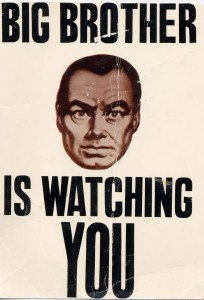 Here’s one for the diary, if you’re in the UK and value your basic, enshrined right to privacy (UDHR Article 12) in this NSA/GCHQ etc dystopic, panoptican world.
Come along to the Cryptofestival at Goldsmiths, London on 30th November, where concerned hacktivists can help concerned citizens learn how to protect their online privacy.
And if you believe the “done nothing wrong, nothing to hide” garbage, have a look at this.
Cryptoparties, where geeks offer their help for free to their communities, were started by privacy advocate Asher Wolf in Australia just over a year ago. The phenomenon has swept across the world since then, helped along by the disclosures of the heroic Edward Snowden.
I hope to see you there. You have to fight for your right (crypto)party — and for your right to privacy! Use it or lose it — and bring your laptop.
An interview on the German mainstream TV channel ARD. The programme is called FAKT Magazin:
BND will bei Spionage mitmischen from Annie Machon on Vimeo.
On the day the UK spy chiefs were called to account for the first time by the Intelligence and Security Committee in the British parliament:
Spy accountability and the ISC — Channel 4 News from Annie Machon on Vimeo.
First published on RT Op-Edge.
As the Snowden-related disclosures continue to flow, each new one refuting the last dissembling statements of the desperate spies, diplomats around the world must be cursing the overweening ambitions of the NSA and it vassals.
American ambassadors are being summoned from their fortified embassies to account for US malfeasance in country after country: Brazil, Spain, France and, of course, Germany.
In this last country there has been scandal after scandal: first the hoovering up of billions of private communications; the revelation that the German intelligence agency, the BND, had been an enthusiastic partner of the NSA in developing the XKeyScore programme and more; then, despite this, humiliatingly to learn that Germany is only considered a 3rd Party intelligence partner by the Yanks — putting them on a par with countries like Iran, China and Russia.
The pièces de résistance, however, are the two most recent disclosures: that Angela Merkal’s private phone had been targeted, and that there was a NSA spy base embedded in the US embassy in Berlin. This, reportedly, has now ceased operations as the US government tries to appease an incandescent Angela.
Now it is the turn of the Brits, whose ambassador, Simon McDonald, was also this week given a carpeting by the German Foreign Minister — for doing precisely what the Americans did and hiding a GCHQ spy outpost at the British embassy in Berlin, flouting all kinds of treaties and diplomatic protocols in the process. As the embassy was only built in the early 1990s after German reunification, they cannot even claim that this is merely a hangover from the bad old days of the Cold War.
Of course, the Germans are particularly sensitive to encroaching surveillance states, after experiencing the horrors of the Gestapo and the Stasi. How much more concerned need they be, when faced with the sheer scale of the modern technological capability?
Even before the Snowden story broke, German courts were upholding the constitution in the face of government moves to expand the intelligence capability to fight the “war on terror”. Indeed, even some mega-corporations took a stand. In 2009, on the anniversary of the fall of the Berlin Wall, the head of T Mobile in German refused to store the communications data of ordinary Germans, on the off-chance that one or two of them might subsequently turn terrorist — the good of the many outweighted the threat from a few.
So the Brits are somewhat out of favour with the rest of Europe, and especially Germany. It was clear, with the revelations about GCHQ’s Tempora programme and the huge funding acquired from the NSA, that GCHQ was no longer primarily concerned with protecting British national security, but had become the European offshoot of the NSA. Indeed, internal documents have shown a management obsession with pleasing their American paymasters.
This is the very heart of the so-called special relationship — the combined capabilities of the NSA and GCHQ. Even as the old British Empire crumbled in the mid-20th century, the spooks could still build outposts for eavesdropping in hotspots around the world: Cyprus, the Middle East, Hong Kong and, er, Berlin. They were happy to offer up the product to their new American overlords, as this gave them a continuing place at the international top table.
This the British would find very difficult to relinquish. And this is why, in stark contrast to all other European countries, the politicians have moved to defend the spies, why the monochrome phrase “we never discuss intelligence matters” is now wearily rolled out on a daily basis, and why intelligence lackeys across the national media have defended the status quo and respect the voluntary DA Notice gagging order. This is also why the Guardian’s hard drives had to be symbolically smashed up and why there have been calls to prosecute the newspaper under the draconian Official Secrets Act.
It is not the Guardian that has damaged British national security (a legally nebulous concept) by printing the truth about our spy agencies working for the NSA and trampling over our basic rights and freedoms. It is the spies themselves that have caused the harm, by running amok with legally dubious surveillance schemes, kidnapping suspects around the world, and getting involved in torture.
So tomorrow is potentially an historic date in the annals of British intelligence. For the very first time in their 100 year history, the heads of MI5, MI6, and GCHQ will be called to account by the Intelligence and Security Committee in parliament. Not only that, the event will be live streamed so we plebs can hear what is being done secretly in our names.
Well, almost live streamed — apparently there will be a few seconds delay, in order to ensure no “damage to national security” occurs. My mind is boggling somewhat at the possibility that three spooks who have made it to the top of their respective organisations would be so inept as to blurt out state secrets on live TV, but you never know…
So, can we hope for a full and frank discussion around the Snowden disclosures? Well, probably not. I have written at length before about the cosy establishment ineptitude of the Prime Minister’s hand-picked stooges who populate the ISC. Plus the chairman, Sir Malcolm Rifkind (himself a former Foreign Secretary notionally in charge of MI6 and GHHQ), has not only publicly supported the work of GCHQ, post-Snowden, but has also ruled out any discussion of “technological capabilities” at the hearing.
I hope to be surprised. After all, even the US — the home of the NSA and cause of all this pain — is holding congressional hearings and having national debates. But I fear the good old British establishment will yet again rally around and protect its own.
Whitewash all round!
Here’s an interview I did for BBC World Service radio about the NSA’a global electronic surveillance and spy oversight:
On October 31 st Goldsmith’s University on London organised a super-cryptoparty called the CryptoFestival. I spoke and discussed privacy and the use of technical means with Prof. Ross Anderson, Nick Pickles and Smari Mccarthy. Over 500 people attented the festival to discuss privacy and share knowlegde on technical means to protect it.
Crypto Festival Panel session 2013 Prof. Ross Anderson, Annie Machon, Nick Pickles, Smari Mccarthy from Annie Machon on Vimeo.
A recent interview on BBC World Service radio, on “World Have Your Say”. An interesting debate with some other former intelligence types:
BBC World Service “World Have Your Say” interview from Annie Machon on Vimeo.
Just a short post to announce the new Edward Snowden website. Away from all the spin and media hysteria, here are the basic facts about the information disclosed and the issues at stake.
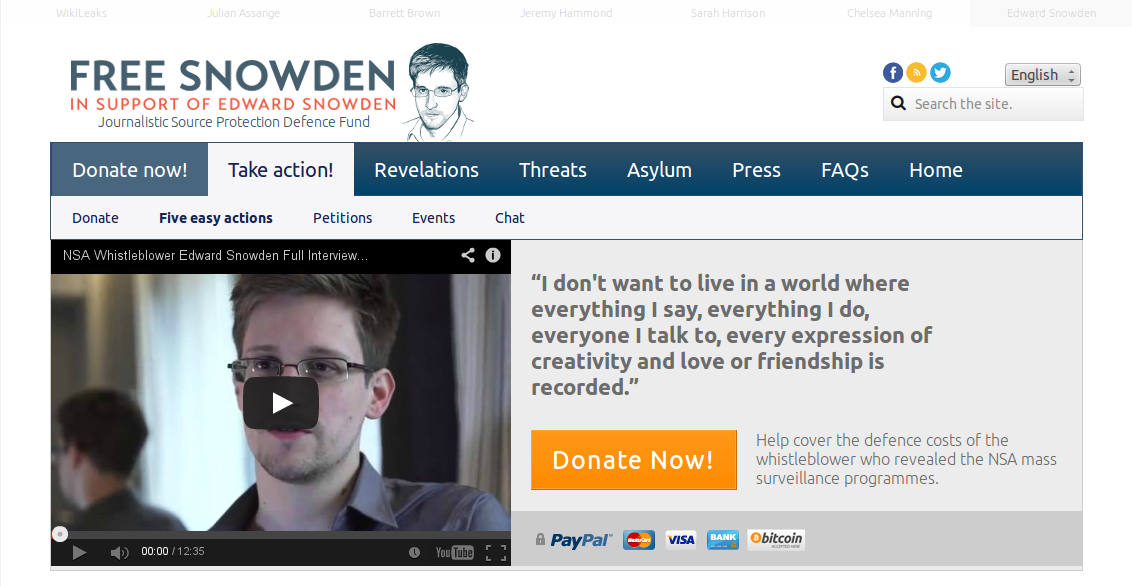
And here’s another aide memoire of the disclosures so far. The impact of these disclosures is global. Edward Snowden is simply the most significant whistleblower in modern history.
Here’s my interview on RT about the failure of political oversight of the spies in the UK and US:
RT: Snowden files reveal spy agency’s efforts to escape legal challenge from Annie Machon on Vimeo.
Also posted on www.maxkeiser.com.