Article on life as a spy in Emirates women magazine

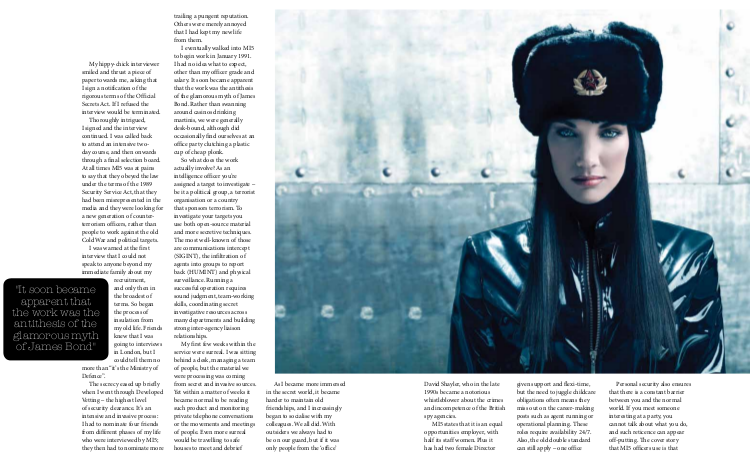 click on the image above or here to download the entire article as a PDF
Article on life as a spy in Emirates women magazine
click on the image above or here to download the entire article as a PDF
A recent interview on RTTV about the ongoing civil war in Libya following the NATO invasion last year:
Part One of my recent interview on the excellent, independent and fearless Real News Network:
Published in The Huffington Post UK, 2 October 2012
Only in the mad world of modern British politics could it be possible to connect MPs, drones and royal breasts. Is this sounding a little too bizarre? Let me explain.…
 Way back in 2008 Conservative MP Damien Green, who was at the time the Shadow Minister for Immigration, was arrested on suspicion of eliciting leaks from a Home Office civil servant that appeared to confirm the then Labour government was covering up UK immigration figures.
When I say arrested, this was not the standard, civilised and pre-arranged appointment at the local nick, which the police traditionally allow their political “masters” or, for that matter, their buddies at News International.
Oh no, this was a full-on, Cold War-style arrest, carried out by the Metropolitan Police Counter-Terrorism command (known in the old days as Special Branch). Intriguingly, civil servants appeared to have misleadingly hyped up the need for a heavy-handed police response by stating that they were “in no doubt that there has been considerable damage to national security already as a result of some of these leaks”.
And indeed, the resulting arrests bore all the hall-marks of a national security case: secret police, dawn raids, and counter-terrorism style searches of the family home, the constituency office, and — shock — an invasion of Green’s office in parliament.
Yet Green was not arrested under the terms of the Official Secrets Act. Instead, both he and his hapless whistleblower, Christopher Galley, were only seized on suspicion of breaching some arcane Victorian law (“aiding and abetting misconduct in public office”). I suppose arresting a sitting MP for a breach of the OSA would have been just too politically tricky.
Leaving aside the understandable upset caused to Green’s wife and children by the raid on their home, plus the fact that the police violated not only their personal effects such as bed sheets and love letters but also confidential legal papers about child abuse cases that Mrs Green was working on, what really caused outrage in the media and political classes was the fact that Plod had dared to invade the hallowed ground of parliament.
 There was an outcry from politicians about the “encroaching police state”. The case was duly dropped, the senior officer, Assistant Commissioner Bob Quick, had to resign (but only after committing yet another political gaffe), and other stories, such as the MP expenses scandal, grabbed the attention of the mainstream media.
Roll on four years, and Damien Green has now ascended to the giddy heights of Home Office Minister of State for Police and Criminal Justice. Well, meeting his new staff must have been an interesting experience for him.
But what is this man now doing in his eminent role, to stop the slide into the encroaching police state that is the UK? Of all people, one would expect him to be sensitive to such issues.
Sadly, he appears to have already gone native on the job. It was reported yesterday that he is proposing the use of police drones to spy on the UK population, but in an “appropriate and proportionate” manner of course.
The concept of small aerial drones being used by UK police has been mooted for a few years now — indeed some police forces and security agencies have already bought them. But whereas the initial, standard justification was that it would help in the “war on terror” (as it has so ably done in the Middle East, where innocent families are routinely slaughtered in the name of assassinating militants), mission-creep has already set in. Damien Green stated at the launch of the new National Police Air Service (NPAS) that drones could be useful monitoring protests and traffic violations. It has even been reported that the Home Office plans to use non-lethal weapons to do so.
Of course there are problems around the use of drones in UK airspace. Our skies are already very crowded and they could present a hazard to aircraft, although the BBC has reported that drones could be airborne in the next few years. This appears to be the only argument holding the use of drones in check — forget about civil liberties and privacy issues.
 This is particularly pertinent as we look at the evolution of drone technology. Currently the UK police are discussing toy-sized drones, but it has already been reported that drones the size of birds or even insects, with autonomous intelligence or swarm capabilities are being developed. And don’t even get me started on the subject of potential militarisation.…
There is a whole debate to be had about what can be viewed and what cannot — where does the public sphere end and the private begin? A couple of years ago I suggested somewhat facetiously that our best hope of defeating the introduction of surveillance drones in the UK might be indignant celebs suing the paparazzi for using the technologies. But perhaps the ante has already been upped in the recent fall-out from the Duchess of Cambridge and her royally papped breasts.
If drone technology becomes widespread, then nobody will have any privacy anywhere. But who knows, before we get to that stage perhaps HM Queen will come out swinging on the side of privacy for her granddaughter-in-law, if not for the rest of her “subjects”. If that were to happen then no doubt Damien Green will abandon his new-found enthusiasm for these airborne surveillance pests; if not to stop the “encroaching police state” of which he must have such colourful recollections, then at least to safeguard any potential knighthood in his rosy ministerial future.
Published in The Huffington Post UK, 30 September 2012
Published in The Real News Network, 30 September 2012
A lot of sound and fury has been expended in the British media over the last few months about the Coalition government’s proposal to enact secret courts via the proposed Justice and Security Bill — purely for terrorist cases, you understand. Which, of course, is OK as we all know terrorists are by definition the Baddies.
Except we need to drill down into the detail of the proposals, have a look at some history, and think through the future implications.
The concept of secret courts emerged from the official UK spook sector — MI5 and MI6 have been lobbying hard for such protection over recent years. Their argument revolves around a number of civil cases, where British victims of extraordinary rendition and subsequent torture have sued the pants off the spies through civil courts and received some recompense for their years of suffering.
 The most notorious case was that of Binyam Mohamed, who was repeatedly tortured in a black prison in Morocco, with British spies allegedly contributing to his questioning. And we’re not talking about a few stress positions, awful as they are. Mohamed was strung up and had his penis repeatedly slashed with a razor.
MI5 and MI6 are aggrieved because they could not defend themselves in the resultant civil actions brought against them, and they (and their former political master Jack Straw) are particularly worried about future cases around the MI6-organised Libyan renditions exposed last year. The spies’ argument is that having to produce evidence in their own defence would damage that ever-flexible but curiously vague concept of “national security”.
Well, they would say that, wouldn’t they?
The spooks have traditionally used the “national security” argument as the ultimate get-out-of-jail-free card. It has never been legally defined, but it is unfailingly effective with judges and politicians.
We saw similar arguments during the post‑9/11 security flap, when many terrorist suspects were scooped up and interned in high security British prisons such as Belmarsh on the say-so of faceless intelligence officers. No evidence needed to be adduced, nor could it be challenged. The subsequent control order system was equally Kafkaesque.
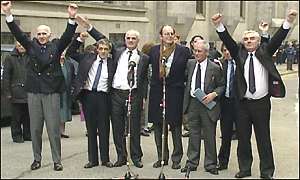 That’s not to say that certain interned individuals might not have been an active threat to the UK. However, in the “good” old days (god, I sound ancient), suspects would have had evidence gathered against them, been tried by a jury, convicted and imprisoned. The system was never perfect and evidence could be egregiously withheld, but at least appeals were possible, most notably in the case of the Birmingham Six.
Since 9/11 even breathing the word “terrorist” has meant that all these historic common law principles seem to have been jettisoned. Even before the proposed enshrinement of “secret courts” in the new Bill, they are already being used in the UK — the Special Immigration Appeal Commission (SIAC) tribunals hear secret evidence and the defendant’s chosen lawyer is not allowed to attend. Instead a special, government-approved advocate is appointed to “represent the interests” of the defendant who is not allowed to know what his accusers have to say. And there was no appeal.
But all this is so unnecessary. The powers are already in place to be used (and abused) to shroud our notionally open court process in secrecy. Judges can exclude the press and the public from court rooms by declaring the session in camera for all or part of the proceedings. Plus, in national security cases, government ministers can also issue Public Interest Immunity Certificates (PIIs) that not only bar the press from reporting the proceedings, but can also ban them from reporting they are gagged — the governmental super-injunction.
So the powers already exist to protect “national security”. No, the real point of the new secret courts is to ensure that the defendant and, particularly in my view, their chosen lawyers cannot hear the allegations if based on intelligence of any kind. Yet even the spies themselves agree that the only type of intelligence that really needs to be kept secret involves ongoing operations, agent names, and sensitive operational techniques.
 And as for the right to be tried by a jury of your peers — forget it. Of course juries will have no place in such secret courts. The only time we have seen such draconian judicial measures in the UK outside a time of official war was during the Troubles in Northern Ireland — the infamous Diplock Courts — beginning in the 1970s and which incredibly were still in use this year.
I am not an apologist of terrorism although I can understand the social injustice that can lead to it. However, I’m also very aware that the threat can be artificially ramped up and manipulated to achieve preconceived political goals.
I would suggest that the concept of secret courts will prove fatally dangerous to our democracy. It may start with the concept of getting the Big Bad Terrorist, but in more politically unstable or stringent economic times this concept is wide open to mission creep.
We are already seeing a slide towards expanding the definition of “terrorist” to include “domestic extremists”, activists, single issue campaigners et al, as I have written before. And just recently information was leaked about a new public-private EU initiative, Clean IT, that proposes ever more invasive and draconian policing powers to hunt down “terrorists” on the internet. This proposal fails to define terrorism, but does provide for endemic electronic surveillance of the EU. Pure corporatism.
Allowing secret courts to try people on the say-so of a shadowy, unaccountable and burgeoning spy community lands us straight back in the pages of history: La Terreur of revolutionary France, the creepy surveillance of the Stasi, or the disappearances and torture of the Gestapo.
Have we learned nothing?
 An interview I did on behalf of LEAP this week for the newsletter of the UK campaign, Release.
Release, run by the indefatigable Niamh Eastwood, does excellent work providing legal advice about drug issues, and campaigning for fairer and more compassionate drug laws.
The interview appeared in the campaign’s newsletter, “TalkingDrugs”.
Here’s the link, and here’s the text:
Q1 What led you into thinking that current drug policies on illicit drugs were failing?
My journey began when I was working as an intelligence officer for MI5 in the 1990s. One of my roles was investigating terrorist logistics and working closely with UK Customs. I learned then that trying to stop the flow of illicit material into the UK (whether drugs, weapons, or people) is like looking for a needle in the proverbial haystack. Plus there is a huge overlap between the funding of organised crime and terrorist groups.
Over the last decade I have become a writer, commentator and public speaker on a variety of inter-connected issues around intelligence, the war on terror, whistleblowers, policing, and civil liberties. To me, the war on drugs meshes very closely with all these topics. Three years ago I was approached by LEAP to become a speaker, and then in March this year I became a member of the international board and also the Director of LEAP Europe in order to consolidate the organisation’s work here.
Q2 Do you think that there are barriers to police officers being honest about the effectiveness of their actions to combat the trade in illicit drugs and is the greater disquiet amongst those involved in law enforcement about current policies than is popularly perceived ?
Yes, absolutely, and it’s not just amongst the police but also the wider law enforcement community.
LEAP supporters, approaching 100,000 in over 90 countries around the world, include judges, lawyers, prison governors, customs and intelligence officers, and former drug czars. Within all these professions there is a tacit understanding that you toe the conventional line. In my experience, most people go into this type of work hoping not only to have an interesting job, but also to do some good and make a difference. Many then see the social fall-out, or that friends, family or community are affected by the drug wars, and many serving officials do question what it is all about and what it is really achieving.
However, they are there to do a job, which is upholding and applying the law. The cultural pressure within such groups can make it extremely difficult on many levels for them to speak out.
Any change to the international and national drug laws will have to come from the politicians within the UN and nationally. LEAP increasingly contributes to the political debate and is building a groundswell of support internationally. Most people today will know someone who has at least tried a currently illegal drug. They also instinctively know this is mere social experimentation, relaxation or, at worst, a health problem. And penalisation, imprisonment and a criminal record exacerbates rather than helps the situation.
Q3 Does the policing of drug possession impact the effectiveness of policing generally and what benefits do you think could stem from ceasing to use law enforcement to attempt to discourage drug use?
There are multiple strands to this issue: the diversion of police resources, the additional crime caused by prohibition that is not dealt with successfully, the diversion of resources from harm reduction programmes, the criminalisation of what are essentially health issues, and the disrepute that results for law enforcement.
The policing of drug possession takes away vast resources from investigating other crimes such as burglary, rape and murder. Yet it is largely pointless – those with a drug dependency need health interventions, and there will always be replacements for any low-level dealers who are arrested and imprisoned. If you arrest and convict a rapist, he will not be on the streets committing more rapes; but if you catch a drug dealer, you just create a job vacancy for which many will compete in ever more violent ways for a slice of an incredibly lucrative market.
The UK anti-prohibition advocacy group, Transform, estimates that even if just cannabis were legalised in the UK, an additional $1.6 billion would flow into the British economy every year. While tax raised on a controlled and regulated cannabis trade is predicted to provide the bulk of this ($1.2 billion), $170 million would be saved from law enforcement, $155 million from the justice system, and $135 million from the prison system.
In the current economic situation, can the UK afford not to consider alternatives to the current drug war?
Also, as we have seen since the decriminalistion laws in Portugal since 2001 and Switzerland since 1994, the “peace dividend” by ending the war on drugs would not only see a drop in property crimes (about 50% of which are committed to fund drug dependencies), it could also be used to finance and extend harm reduction programmes. As we have seen in the case of tobacco across the West, we do not need to ban a substance to reduce its use; education and treatment are far more effective.
Finally, illegal drugs are available to anyone who wants to buy them on the streets of the UK. The increasing militarisation of the police to fight the war on drugs, the breakdown of civil liberties for the same reason (mirroring the war on terror), and the widespread flagrant flouting of the drug laws by large numbers of the population, thereby “making an ass of the law”, has led to a breakdown of trust and respect between the police and the policed. One of LEAP’s aims is to rebuild this trust, this social contract.
Q4 The impact on the safety of law enforcement personnel of the ‘war on drugs’ should be an issue for other membership organisations representing the sector, will you be reaching out to them to encourage campaigning on the issue?
Safety is certainly an issue, although we have been more fortunate in Europe than our colleagues in the USA, where the more prevalent gun culture leads to many more law enforcement deaths. That said, gang violence is on the rise across Europe where organised crime gangs fight increasingly violent turf battles.
Mexico has been one of the worst hit countries in the world. Since the ramping up of the war on drugs almost six years ago, over 62,000 men women and children have been tortured and murdered in that country, and many of them had no involvement whatsoever in the drugs trade. In fact, LEAP USA has just successfully participated in the Mexican Caravan for Peace, a group of activists and families highlighting the tragedy, that toured across the USA for a month to raise awareness and finished with a rally in Washington last week.
The increasing violence of the drugs trade and the militarisation of the response should be of concern to all law enforcers, membership organisations and allied groups working in the drugs sector. We need to think urgently about how to avoid a similar spiral of violence in Europe. LEAP is happy to reach out to such organisations to develop a more humane solution.
Q5 How would you like to see LEAP in Europe develop and will you be looking to lobby European policy makers in Brussels?
There are already LEAP speakers across most European countries. We in LEAP see the organisation’s primary goal as educational. We shall be working to build up speaking engagements for a wide variety of groups and audiences, including the political sector, as well as strengthening our media exposure. We recognise the valuable work Release and other NGOs and advocacy groups are already doing across Europe, and hope that you will see that we offer a unique voice and pool of expertise that can be used to strengthen your work.
It is wonderful that so many organisations and indeed governments around the world (particularly in Europe and Latin America) are now focusing on exploring alternatives such as decriminalistion and harm reduction programmes. Based on our professional experience, LEAP argues that we need, at very least, to consider the next logical step in the chain: controlled regulation of the drug market as we currently do with alcohol and tobacco.
Decriminalisation may help to reduce the harm for the drug users, but leaves the drug trade in the hands of increasingly violent global organised crime networks. Only by removing the profit motive from this illicit trade can we end the involvement of the criminal element and all the attendant violence, and work to make the world safer for all.

 I have written over the years about the encroaching surveillance state, the spread of CCTV and the increasing use of drones in our skies. When the North East of England introduced talking CCTV cameras that could bark orders at passing pedestrians in 2008, I thought that we were fast approaching the reductio ad absurdum point — and indeed this subject has raised a wry laugh from audiences around the world ever since.
Recently I have been reading with dismay a slew of articles about the increasing corporatisation of the surveillance state. First I stumbled across a piece describing Facebook’s latest innovation, Facedeal: cameras planted in shops and bars that will use the facial recognition and tagging abilities of FB to recognise you as a valued customer and offer you a discount, simply because you have signed up to this Big Brother app on Facebook.
Add this to the fact that Facebook is probably, well, an open book for to the entire US security apparatus, and you can see the potential abuse of this system. We shall effectively be bribed to allow ourselves to be spied on.
 Facedeal is being trialed in the US. Some European countries, most notably Germany, have already stated that data recognition technology used even just for photo “tagging” is or could be deemed illegal. Germany specifically has regulations that allow Internet users control over their data. They are not going to like Facedeal.
Secondly, it was reported today that Google had patented intelligent image recognition technology. Combine this capability with Googles Earth and Street, and we are potentially looking at a truly panopticon society. The Germans are really not going to like that. (Nor indeed will certain of the French, including the man who earlier this year tried to sue Google after being photographed having a pee in his own front garden).
Thirdly, Boeing has triumphantly launched the concept of the drone swarm, operating with a hive mentality and upping the capabilities of military surveillance exponentially, while taking much of the risk out of any operation.
 And finally, the Wikileaks story about TrapWire. This first emerged as yet another bonkers American scheme, where the footage from CCTV street cameras was being mainlined into the security apparatus. Subsequently, it has emerged via Wikileaks that Trapwire is also being used in other western countries, including the UK.
Not only can the securocrats watch you, they too are installing face recognition software that can identify you. While this may not yet be as accurate as the spies might wish, TrapWire has also installed predictive software that apparently can assess whether you are acting, loitering or walking in a suspicious manner. So you could pre-emptively be assessed to be about to commit a crime or an act of terrorism and, no doubt, appropriately and pre-emptively “dealt with”.
All of which must be so reassuring to protest groups such as Occupy, which have been subject to massive CCTV surveillance in NYC and which have been labelled a “terrorist/extremist threat” in the City of London.
At the risk of sounding alarmist, we now all know what “being dealt with” in this era of anti-activist SWAT teams, drone strikes and kill lists can potentially entail.
So where does this leave us as concerned citizens? It strikes me that we are being catapulted into some sci-fi dystopia beyond even Orwell’s wildest imaginings. Any fan of modern thrillers and sci-fi will be familiar with the concept of integrated super-computers that can watch our every move via CCTV.
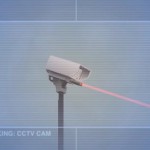 The latter is what TrapWire et al are working towards. These new technologies remind me of a story line from a wonderful series of books called the The Laundry Files by Charles Stross. These novels are a perfect of merging of Len Deighton’s laconic spy fiction, à la Harry Palmer, with the geek universe and beyond. And, at the risk of a spoiler, one of the story lines envisages a centralised and weaponised CCTV system, mainlining into the secret services, that can be turned on UK citizens if the balloon goes up. This system is codenamed the “Scorpion Stare”.
Sounds far-fetched? Well The Laundry Files are a rollicking good read, but do bear in mind not only that our CCTV systems may be centralised courtesy of TrapWire, but also that various law enforcement agencies in the UK are using micro-drones to spy on protesters, and that they have reportedly enquired if these drones could be weaponised.….
So it all depends on how you define the balloon, I suppose.
Published in The Huffington Post UK, 3 September 2012
Following on from the article former CIA analyst, Ray McGovern, and I co-authored last month about the possible “fixing” of intelligence around Iran, here is a subsequent interview we did for The Real News Network:
Published in The Huffington Post UK, 17 August 2012
A storm of diplomatic sound and fury has broken over Ecuador’s decision to grant political asylum to Wikileaks founder, Julian Assange. The UK government has threatened to breach all diplomatic protocol and international law and go into the embassy to arrest Assange.
 The UK justifies this by citing the 1987 Diplomatic and Consular Premises Act, a law apparently put in place following the 1984 shooting of WPC Yvonne Fletcher from the Libyan Embassy in London. The murder resulted in an 11-day siege, and the embassy staff eventually being expelled from the country. Nobody has yet been brought to justice for this murder.
It is hard to equate the gravity of the crime that brought about the 1987 legislation — the murder of a policewoman — with Assange’s situation. Despite the screaming headlines, let us not forget that he is merely wanted for questioning in Sweden. Nevertheless, the UK is prepared to overturn all diplomatic protocol and create a dangerous international precedent to “get their man”, despite there being a clear lack of justification under the terms of the ’87 Act.
Many people in the western media remain puzzled about Assange’s fear of being held captive in the Swedish legal system. But can we really trust Swedish justice when it has been flagrantly politicised and manipulated in the Assange case, as has been repeatedly well documented. Indeed, the Swedish justice system has the highest rate per capita of cases taken to the ECtHR for flouting Article 6 — the right to a fair trial.
If Assange were extradited merely for questioning by police — he has yet to be even charged with any crime in Sweden — there is a strong risk that the Swedes will just shove him straight on the next plane to the US under the legal terms of a “temporary surrender”. And in the US, a secret Grand Jury has been convened in Virginia to find a law — any law — with which to prosecute Assange. Hell, if the Yanks can’t find an existing law, they will probably write a new one just for him.
So why all the sound and fury? What is this really all about?
Wikileaks is a ground-breaking new form of high-tech, award-winning journalism that has exposed corrupt practices across the world over the years. And crucially, in this war-torn, weary and financially broken world, it offers a secure conduit to whistleblowers who want to expose institutional crime and corruption for the public good.
Whistleblowers want to get their information out there, they want to make a difference, they want a fair hearing, and they don’t want to pay too high a personal price for doing so. Is that too much to ask?
By going public about serious concerns they have about their workplace, they are jeopardising their whole way of life: not just their professional reputation and career, but all that goes with it, such as the ability to pay the mortgage, their social circle, their family life, their relationship… Plus, the whistleblower can potentially risk prison or worse.
 So, with these risks in mind, they are certainly looking for an avenue to blow the whistle that will offer a degree of protection and allow them to retain a degree of control over their own lives. In the old days, this meant trying to identify an honourable, campaigning journalist and a media organisation that had the clout to protect its source. While not impossible, that could certainly be difficult, and becomes increasingly so in this era of endemic electronic surveillance.
Today the other option is a secure, high-tech publishing conduit such as Wikileaks. This provides anonymity and a certain degree of control to the modern whistleblower, plus it allows their information to reach a wide audience without either being filtered by the media or blocked by government or corporate injunctions.
As someone who has a nodding acquaintance with the repercussions of blowing the whistle on a secret government agency, I have long seen the value of the Wikileaks model — and I also understand quite why governments feel so threatened by it. After all, no government or mega-corporation wants freedom of information and transparency forced upon it, nor an informed citizenry questioning its actions.
Our governments like to spout the phrase “if you have done nothing wrong, you have nothing to hide” as they roll out yet another intrusive surveillance measure.
Wikileaks has turned that right back at them — hence this modern-day witch-hunt.
Published in The Huffington Post UK, 27 July 2012
OK, I was really so not planning on ever writing anything, whatsoever, at any point while I continue to breathe, about the London Olympics. First of all I have absolutely zero interest in the circus that is modern competitive sport (panem et circenses), and secondly what more could I possibly add to the scandals around the security? All the information is out there if people choose to join the dots.
But synchronicity plays its part. Firstly, this morning I read this excellent article by former UK ambassador-turned-whistleblower, Craig Murray, about how the UK is now under martial law in the run-up to the Olympics. Shortly afterwards I did an interview with the women’s glossy magazine, Grazia, about the security set-up around the games. I know, I know, sometimes the heavens align in a once-in-a-century configuration.…..
So on the back of this fortuitous alignment and while my angry-o-meter is still spiked at the “dangerous” level, I wanted to set some thoughts down.
 Craig is correct — because of the Olympic Games, London has gone into full martial law lock-down. Never before in peace-time has the capital city of the formerly Great Britain seen such a military “defensive” presence: missile launchers on local tower blocks primed to blow straying commercial airliners out of the skies over London, regardless of “collateral damage”; anti-aircraft bunkers dug in on Greenwich common; and naval destroyers moored on the Thames.
Plus, absent the promised G4S publicly-funded work-experience slaves — sorry, security staff — the military has been drafted in. Soldiers just home from patrolling the streets in Afghanistan in daily fear of their lives have had all leave cancelled. Instead of the much-needed R & R, they shall be patrolling the Olympic crowds. Does anyone else see a potential problem here?
And all this follows a decade of erosion of basic freedoms and civil liberties — all stripped away in the name of protecting the UK from the ever-growing but nebulous terrorist threat.
But I would take it a step further than Craig Murray — this is not just martial law, this is fascist martial law.
(And being conscious of any potential copyright thought-crimes, I hereby give all due credit to a very famous UK TV advert campaign which appears to use the same cadence.)
Why do I say this is one step beyond?
The Italian World War II dictator, Benito Mussolini, is famously credited with defining fascism thus: “the merger of the corporate and the state”.
And this is precisely what we are seeing on the streets of London. Not only are Londoners subjected to an overwhelming military and police presence, the corporate commissars are also stalking the streets.
 When Seb Coe and Tony Blair triumphantly announced that London had won the Olympics on 6th July 2005, one of their mantras was how London and the UK would benefit from the presence of the games. They painted a rosy picture of local businesses booming on the back of the influx of tourists.
But the cold reality of today’s Olympics is greyer. Commuters are being advised to work from home rather than use the overloaded transport networks; the civil service is effectively shutting down; and Zil lanes for the “great and the good” of the Olympics universe are choking already congested London streets.
Even worse, businesses across the UK, but particularly the local ones in the economically deprived environs of the Olympic Park in East London, are categorically NOT allowed to benefit from the games. Under the terms of the contracts drawn up by the corporate mega-sponsors, London small businesses are not allowed to capitalize in any conceivable, possible, miniscule way on the presence of the games in their own city.
And these terms and conditions are enshrined in the Olympics Act 2006; any infraction of the rules carries a criminal penalty. For more than a week, corporate police enforcers have been patrolling London looking for infractions of the Olympic trademark. And this goes way beyond “Olympics R US” or some such. As Nick Cohen wrote in an excellent recent article in The Spectator magazine:
“In the London Olympic Games and Paralympic Games Act of 2006, the government granted the organisers remarkable concessions. Most glaringly, its Act is bespoke legislation that breaks the principle of equality before the law. Britain has not offered all businesses and organisations more powers to punish rivals who seek to trade on their reputation. It has given privileges to the Olympics alone. The government has told the courts they may wish to take particular account of anyone using two or more words from what it calls ‘List A’ — ‘Games’; ‘Two Thousand and Twelve’; ‘2012’; ‘twenty twelve’. The judges must also come down hard on a business or charity that takes a word from List A and conjoins it with one or more words from ‘List B’ — ‘Gold’; ‘Silver’; ‘Bronze’; ‘London’; ‘medals’; ‘sponsors’; ‘summer’. Common nouns are now private property.”
I heard recently that a well-established local café in Stratford, East London, that has for years been known as the Olympic Café, has been ordered to paint over its sign for the duration of the games. If I owned the café, I would be tempted to sue the Olympic Committee for breach of trademark.
 It seems to me that this real-world trademark protectionism is an extension of the ongoing copyright wars in cyberspace — a blatant attempt to use state level power and legislation to protect the interests of the wealthy international mega-corps few. We saw early attempts at this during the South African Football World Cup in 2010, and the Vancouver Winter Olympics the same year.
But the London Olympics take it to the next level: there is a long list of what you are not allowed to take into the stadia. Spectators will be subjected to airport-style security theatre. This will ensure that no liquids of more than 100ml can be carried, although empty bottles will be allowed if people want to fill them up with tap water on site. This, of course, means that more spectators will be buying their sponsor-approved liquids in situ and at no-doubt over-inflated prices, to the benefit of one of the key Olympic sponsors.
The London games seem to be the first time that the global corporate community is demonstrating its full spectrum dominance — where the legal, police, and military resources of the state are put at the disposal of the giant, bloated, money-sucking leech that is the International Olympic Committee.
 Every city that has hosted the Olympics over the last four decades has been financially bled white; many are still paying back the initial investment in the infrastructure, even if it is now decaying and useless. Greece, anybody?
But do the IOC or its regional pimps care? Hell, no. Like all good parasites, once the original host has been drained dry, the Games move on to a new food source every four years.
What really, deeply puzzles me is why the hell are the people of London not out there protesting against this corporatist putsch? Perhaps they fear being shot?
How can it be a crime to take a full bottle of water into a stadium when you want to watch a sport? How can it be a crime to tweet a picture? How can it be criminal to celebrate the occasion in your local pub with Olympic flags draped around your bar, drinking a beer and eating a burger marketed cheesily as “fit for champions” or some such?
The original ideals behind the reconstitution of the modern Olympics in 1896 were a highly romanticised and distorted vision of the values of the ancient games. But even that naïve ideal has been lost in the crapulous corporatism that is the modern event.
We have even gone way beyond the Roman view of bread and circuses placating the masses. Now we are into the hardcore realpolitik of international corporations and national governments using the games as a perfect pretext to tighten the “security” screws even more.
And so the UK is proud to present full-blown Corporate Fascism Version 2.0.
Vae victis.
By: Ray McGovern, former CIA analyst and Annie Machon, former MI5 intelligence officer
Recent remarks by the head of MI6, Sir John Sawers, leave us wondering if the Secret Intelligence Service is preparing to “fix” intelligence on Iran, as his immediate predecessor, Sir John Scarlett, did on Iraq.
 Scarlett’s pre-Iraq war role in creating “dodgy dossiers” hyping the threat of non-existent “weapons of mass destruction” is well known. As for Sawers, the red warning light for politicization blinked brightly on July 4, as he told British senior civil servants that Iran is “two years away” from becoming a “nuclear weapons state.” How did Sawers come up with “two years?”
Since late 2007, the benchmark for weighing Iran’s nuclear program has been the unanimous assessment by all 16 U.S. intelligence agencies that Iran halted its nuclear weapons program in late 2003 and that, as of mid-2007, had not restarted it. Those judgments have been revalidated every year since — despite strong pressure to bow to more ominous — but evidence-light — assessments by Israel and its neo-conservative supporters.
Intelligence Can Make a Difference
The 2007 the US National Intelligence Estimate helped to thwart plans to attack Iran in 2008, the last year of the Bush/Cheney administration. This shines through in George Bush’s own memoir, Decision Points, in which he rues the NIE’s “eye-popping declaration: ‘We judge with high confidence that in fall 2003, Tehran halted its nuclear weapons program.’”
 Bush continues, “But after the NIE, how could I possibly explain using the military to destroy the nuclear facilities of a country the intelligence community said had no active nuclear weapons program?” (Decision Points, p. 419)
Hands tied on the military side, US covert operations flowered, with $400 million appropriated at that same time for a major escalation of the dark-side struggle against Iran, according to military, intelligence, and congressional sources cited by Seymour Hersh in 2008. This clandestine but all-too-real war on Iran has included attacks with computer viruses, the murders of Iranian scientists, and what the Israelis call the “unnatural” demise of senior officials like Revolutionary Guards Major General Hassan Moghaddam father of Iran’s missile program.
Moghaddam was killed in a large explosion last November, with Time magazine citing a “western intelligence source” as saying the Israel’s Mossad was behind the blast. More threatening still to Iran are the severe economic sanctions, which are tantamount to an act of war.
Israeli Prime Minister Benjamin Netanyahu and pro-Israel neo-conservatives in the U.S. and elsewhere have been pushing hard for an attack on Iran, seizing every pretext they can find. Netanyahu was suspiciously fast off the blocks, for example, in claiming that Iran was behind the tragic terrorist bombing of Israeli tourists in Bulgaria on July 18, despite Bulgarian authorities and even the White House warning that it is too early to attribute responsibility.
 Netanyahu’s instant indictment of Iran strongly suggests he is looking for excuses to up the ante. With the Persian Gulf looking like an accident waiting to happen, stocked as it is with warships from the U.S., the U.K. and elsewhere — and with no fail-safe way of communicating with Iranian naval commanders — an escalation-generating accident or provocation is now more likely than ever.
July 23: Marking a Day of Infamy
Oddly, Sawers’s speech of July 4 came just as an important date approached — the tenth anniversary of a sad day for British intelligence on Iraq. On July 23, 2002 at a meeting at 10 Downing Street, then-MI6 head, John Dearlove, briefed Tony Blair and other senior officials on his talks with his American counterpart, CIA Director George Tenet, in Washington three days before.
In the official minutes of that briefing (now known as the Downing Street Memo), which were leaked to the London Times and published on May 1, 2005, Dearlove explains that George Bush has decided to attack Iraq and the war was to be “justified by the conjunction of terrorism and weapons of mass destruction.” While then-Foreign Secretary Jack Straw points out that the case was “thin,” Dearlove explains matter-of-factly, “The intelligence and facts are being fixed around the policy.”
 There is no sign in the minutes that anyone hiccupped — much less demurred — at making a case for war and furthering Blair’s determination to join Bush in launching the kind of “war of aggression” outlawed by the post-world war Nuremberg Tribunal and the UN treaty.
Helped by the acquiescence of their chief spies, the Blair government mainlined into the body politic un-assessed, raw intelligence and forged documents, with disastrous consequences for the world.
UK citizens were spoon-fed fake intelligence in the September Dossier (2002) and then, just six weeks before the attack on Iraq, the “Dodgy Dossier”, based largely on a 12-year old PhD thesis culled from the Internet — all presented by spy and politician alike as ominous premonitory intelligence.
So was made the case for war. All lies, resulting in hundreds of thousands dead and maimed and millions of Iraqis displaced — yet no one held to account.
Sir Richard Dearlove, who might have prevented this had he had the integrity to speak out, was allowed to retire with full honours and became the Master of a Cambridge college. John Scarlett, who as chair of the Joint Intelligence Committee signed off the fraudulent dossiers, was rewarded with the top spy job at MI6 and a knighthood. George W. Bush gave George Tenet the Presidential Medal of Freedom — the highest civilian award.
What need have we for further proof? “So are they all, all honourable men” — reminiscent of those standing with Brutus in Shakespeare’s play, but with no Mark Anthony to expose them and stir the appropriate popular reaction.
Therein lies the problem: instead of being held accountable, these “honourable men” were, well, honoured. Their soft landings offer a noxious object lesson for ambitious bureaucrats who are ready to play fast and loose with the truth and trim their sails to the prevailing winds.
Ill-got honours offer neither deterrent nor disincentive to current and future intelligence chiefs tempted to follow suit and corrupt intelligence rather than challenge their political leaders with hard, un-“fixed” facts. Integrity? In this milieu integrity brings knowing smirks rather than honours. And it can get you kicked out of the club.
Fixing Intelligence on Iran
Are we in for another round of “fixing” — this time on Iran? We may know soon. Israeli Prime Minister Netanyahu, citing the terrorist attack in Bulgaria, has already provided what amounts to a variation on Dearlove’s ten-year old theme regarding how war can be “justified by the conjunction of terrorism and weapons of mass destruction.”
According to the Jerusalem Post on July 17, Netanyahu said that all countries that understand that Iran is an exporter of world terror must join Israel in “stating that fact clearly,” in order to emphasize the importance of preventing Iran from obtaining a nuclear weapon.
Appearing yesterday on Fox News Sunday and CBS’s Face the Nation, Netanyahu returned to that theme. Putting the blame for the terrorist attack in Bulgaria squarely on Iran (and Hezbollah), Netanyahu warned of the increased dangers that would accrue if Iran acquired nuclear weapons. “What would be the consequences if the most dangerous régime in the world got the world’s most dangerous weapons?”.
Will MI6 chief Sawers model his conduct on that of his predecessors who “justified” war on Iraq? Will he “fix” intelligence around U.K./U.S./Israeli policy on Iran? Parliamentary overseers should demand a briefing from Sawers forthwith, before erstwhile bulldog Britain is again dragged like a poodle into another unnecessary war.
Annie Machon is a former intelligence officer in the UK’s MI5 Security Service and Ray McGovern is a fomer U.S Army Intelligence Officer and CIA analyst.
Whistleblowers want the sun and the moon — or at least they want to get their information out there, they want to make a difference, they want a fair hearing, and they don’t want to pay too high a personal price for doing so.
Is that too much to ask? The decision to expose criminality and bad practice for the public good has serious, life-changing implications.
By going public about serious concerns they have about their workplace, they are jeopardising their whole way of life: not just their professional reputation and career, but all that goes with it, such as the ability to pay the mortgage, their social circle, their family life, their relationship… Plus, the whistleblower can potentially risk prison or worse.
 So, with these risks in mind, they are certainly looking for an avenue to blow the whistle that will offer a degree of protection and allow them to retain a degree of control over their own lives. In the old days, this meant trying to identify an honourable, campaigning journalist and a media organisation that had the clout to protect its source. While not impossible, that could certainly be difficult, and becomes increasingly so in this era of endemic electronic surveillance.
Today the other option is the secure, high-tech publishing conduit, as trail-blazed by Wikileaks. While this does not provide the potential benefits of working with a campaigning journalist, it does provide anonymity and a certain degree of control to the modern whistleblower, plus it allows their information to reach a wide audience without either being filtered by the media or blocked by government or corporate injunctions.
As someone who has a nodding acquaintance with the repercussions of blowing the whistle on a secret government agency, I have liked the Wikileaks model since I first stumbled across it in 2009.
 As with most truly revolutionary ideas, once posited it is blindingly obvious.
Never before has this been technically possible — the idea that a whistleblower’s information could be made freely available to the citizens of the world, in order to inform their democratic choices, with no blockage, not censorship, no filtering or “interpretation” by the corporate media.
This is particularly relevant in an age when the global media has been consolidated in the hands of a few multinationals, and when these multinationals have a certain, shall we say “cosy”, relationship with many of top our politicians and power elites.
The control of the mainstream media by the spooks and governments has been the focus of many of my recent talks. These corrupt inter-relationships have also been recently laid bare with the News International phone-hacking scandals.
The days of garnering news from one favoured paper or TV bulletin are long gone. Few people now trust just one media outlet — they skip across a variety of news sources, trying to evaluate the truth for themselves. But even that can be problematic when something big occurs, such as the “justification” for the invasion of Iraq or Libya, and the current beat of war drums against Iran, when the corporate media mysteriously achieves a consensus.
Hence the democratic disconnect, hence the distrust, and hence (in part) the plummeting profits of the old media.
Wikileaks is based on a simple concept — it allows the people to read the source material for themselves and make up their own minds based on real information. This led to exposure of all kinds of global nasties way before the massive 2010 US data-dump.
Despite this approach, the impact was initially subdued until Wikileaks collaborated with the old media. This, as we all know, did indeed produce the coverage and awareness of those issues deemed important as it was filtered through the MSM. This has also inevitably lead to tensions between the new model hacktivists and the old-school journalists.
 No government, least of all the USA, likes to have demands for justice and transparency forced upon it, and the push back since 2010 has been massive across the world in terms of an apparently illegal financial blockade, opaque legal cases and a media backlash. Certain of Wikileaks’s erstwhile media partners have collaborated in this, turning on one of their richest sources of information in history.
However, Wikileaks is more than a media source. It is a whole new model — a high-tech publisher that offers a safe conduit for whistleblowers to cache and publicise their information without immediately having to overturn (and in some cases risk) their lives.
For this work, Wikileaks has over the years won a number of internationally prestigious journalism awards.
Inevitably, critics in the mainstream media seem to want to have their cake and eat it too: one early partner, the New York Times, has written that it doesn’t recognise Wikileaks as a journalist organisation or a publisher — it is a source, pure and simple.
Either way, by saying this the media are surely shooting themselves in the corporate feet with both barrels. If Wikileaks is indeed “just” a source (the NYT seems to be blithely forgetting that good journalism is entirely dependent on its sources), then the media are breaking their prime directive: protect a source at all costs.
However, if Wikileaks is a journalism or publishing organisation and as such is being targeted by the US government, then all other media are surely equally at risk in the future?
By not standing up for Wikileaks in either capacity, it appears that the old media have a death wish.
Over the years whistleblowers around the world have demonstrated their trust in Wikileaks, as it was set up by someone emerging from the original bona fide hacker community. And rightly so — let’s not forget that no source has been exposed through the failure of the organisation’s technology.
Many media organisations rushed to emulate its success by trying to set up their own “secure” whistleblowing repositories. What the media execs failed to understand was the hacker ethos, the open source mentality: they went to their techie department or commercial IT service providers and said “we want one”, but failed to understand both the ethos and the security concerns around closed, proprietary software systems, often channelled through the post-Patriot Act, post-CISPA USA.
Other, apparently well-meaning organisations, also tried to emulate the Wikileaks model, but most have died a quiet death over the last year. Perhaps, again, for want of real trust in their origin or tech security?
Why on earth would any security-conscious whistleblower, emerging out of a government, military or intelligence organisation, trust such a set-up? If someone comes out of such an environment they will know all-too-well the scale of the push-back, the possible entrapments, and the state-level resources that will be used to track them down. They either need an über-secure whistleblowing platform, or they need journalists and lawyers with fire in their belly to fight the fight, no matter what.
 So now to OpenLeaks — apparently the brainchild of Wikileaks defector Daniel Domsheit-Berg. He and the shadowy “Architect” famously fell out with Julian Assange in late 2010, just when the political heat was ramping up on the organisation. They left, reportedly taking some of the crucial coding and a tranche of files with them, and Domsheit-Berg decided to set up a rival organisation called OpenLeaks. As a result of his actions, Domsheit-Berg was uniquely cast out of the international hacker group, the CCC in Berlin.
He now seems to have been welcomed back into the fold and OpenLeaks appears, finally, to be ready to receive whistleblower information.
However, there is a crucial difference between the two organisations. Where Wikileaks wants to lay the information out there for public evaluation, OpenLeaks will merely act as a repository for certain approved mainstream media organisations to access. We are back to the original blockage of the corporate media deciding what information we, the people, should be allowed to ingest.
I would not wish to comment on Domsheit-Berg’s motivation, but to me this seems to be an even worse option for a whistleblower than directly contacting a campaigning journalist with a proven track record of covering hard-core stories and fighting for the cause.
 With OpenLeaks, the whistleblower loses not only the automatic widespread dissemination of their information, but also any semblance of control over which journalists will be working on their story. Their information will be parked on the website and anyone from pre-selected media organisations will be able to access, use and potentially abuse it.
One could say that OpenLeaks operates as a secure staging platform where a whistleblower can safely store sensitive documents and information.… but the founder allegedly removed and destroyed sensitive files from Wikileaks when he jumped ship in 2010. Could any whistleblower really trust that OpenLeaks would not similarly “disappear” shit-hot information in the future?
Plus, there is the added worry for any rightly-paranoid whistleblower that the founder of OpenLeaks so easily abandoned Wikileaks when under pressure. Who’s to say that this would not happen again, if the full might of the Pentagon were brought to bear on OpenLeaks?
OpenLeaks offers neither the personal support of working with a trusted journalist and a media organisation with the clout to fight back, nor does it provide full disclosure to the wider public to side-step potential media self-censorship and government law suits, as the original Wikileaks model does.
As such OpenLeaks seems, at least to this particular whistleblower, to be an evolutionary blip — a retrograde step — in the quest for justice and accountability.
Following on from my talk at the Norwegian SKUP investigative journalism conference in March, I was invited onto the Anne Lindmo Show in Norway on 4 May.
Anne is one of the most famous and respected journalists in Norway, and her chat show is extremely popular on prime time NRK TV on Friday nights. We had a lively session discussing the world of spying, what it was like to blow the whistle and go on the run, and the personal price that has to be paid.
Here’s the link to the whole show, and here’s my segment:
Lindmo interview on Norwegian TV from Annie Machon on Vimeo.
A look at the forensic and police failures around the investigation of the still inexplicable death of intelligence officer, Gareth Williams, in London in 2010.
Here’s the link.