Well, it made me laugh:
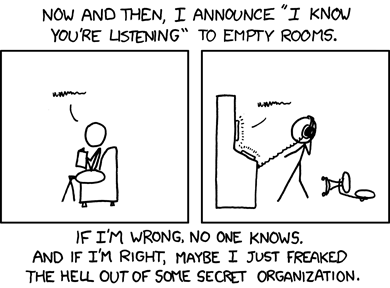
Of course, I’ve never done this myself.….
More of these excellent cartoons can be found at xkcd.org.
Well, it made me laugh:
Of course, I’ve never done this myself.….
More of these excellent cartoons can be found at xkcd.org.
Libya, MI6, torture, and more happy subjects discussed recently on “Africa Today” on Press TV.
The programme was interesting, informed and balanced. Do have a watch:
I have been watching with a certain cynical interest the unfolding of Operation Weeting, one of the plethora of Metropolitan Police investigations into the UK phone hacking scandal, involving many of our favourite players: shady private investigators, predatory journalists, bent coppers, and politicians contorting themselves in an effort to protect both their own reputations and their Friends in High Places. And the ripples are spreading internationally. Nothing like a little bit of globilisation.…
 The Guardian newspaper has made most of the early running in exposing the corrupt practices of the now defunct News of the Screws, highlighting all the dubious tabloid practices of hacking, blagging, pinging, and god knows what else. All this done with the help of bottom-feeding private investigators, but also manifestly with the help of corrupt police officers who were not averse to the idea of taking a bribe to help their friends in Wapping. And how far might this “trickle down corruption” might have gone, um, up?
Despite the self-righteousness of other UK newspapers, it has also now become apparent that these dubious and potentially illegal practices were common throughout Fleet Street, and other national newspapers are also under investigation.
And yet it appears that all this could have been nipped in the bud over a decade ago, when Steven Nott, a concerned British citizen, tried to expose the vulnerability of mobile phones after he stumbled across the practice by accident. He took his findings to a variety of national newspapers, all of whom seem to have initially thought there was a good story, but every time the news was buried. Well, I suppose it would be, wouldn’t it — after all, why would hacks expose a practice that could be so useful?
But back to the dear old OSA and the media.
 In yesterday’s Observer newspaper, it was reported that the police have threatened the journalists at The Guardian with the Official Secrets Act (1989) to force them to disclose the identity of their source amongst the police officer(s) in Operation Weeting who leaked useful information to the newspaper to help its exposure of illegal practices. And, rightly, the great and the good are up in arms about this draconian use of a particularly invidious law:
“John Cooper, a leading human rights lawyer and visiting professor at Cardiff University, echoed Evans’s concerns. “In my view this is a misuse of the 1989 act,” Cooper said. “Fundamentally the act was designed to prevent espionage. In extreme cases it can be used to prevent police officers tipping off criminals about police investigations or from selling their stories. In this instance none of this is suggested, and many believe what was done was in the public interest.
“Cooper added: “The police action is very likely to conflict with article 10 of the European Convention on Human Rights, which protects freedom of speech.”
But I think he’s missing a bit of recent legal history here. The UK had the 1911 OSA which was supposed to protect the country from espionage and traitors, who faced 14 years in prison upon conviction. Needless to say this provision was rarely used — most of the cold war Soviet moles in the establishment were allowed to slink off to the USSR, or at the very most be stripped of their “K”.
However, as I’ve written before, the revised 1989 OSA was much more useful for the establishment. It was specifically put in place to stop whistleblowing after the embarrassment of the 1980s Clive Ponting/Belgrano case.
 The new act was specifically designed to strip away the “public interest” defence used by Ponting in his trial, and also to penalise journalists who had the temerity to report leaks and whistleblowing from the heart of the establishment. The OSA (1989) has been used extensively since the late 1990s, despite the fact that many senior figures in the former Labour government opposed its provisions when it went through Parliament. Journalists are just as liable as whistleblowers or “leakers” under the provisions of this act (the infamous Section 5).
So, back to The Guardian and its legal champions. I agree with what they are saying: yes, the 1989 OSA has a chilling effect on freedom of speech that unduly victimises both the whistleblower and the journalist; yes, it is a uniquely draconian law for a notional Western democracy to have on its books; yes, there should be a defence of “acting in the public interest”; and yes, the OSA should be deemed to be incompatible with Section 10(2) of the European Convention of Human Rights, guaranteeing free speech, which can only be circumscribed in the interests of “national security”, itself a legally undefined, nebulous, and controversial phrase under British law.
 But if all the outraged lawyers read up on their case law, particularly the hearings and legal dogfights in the run up to Regina v Shayler cases, they will see that all these issues have been addressed, apparently to the satisfaction of the honourable m’luds who preside over British courts, and certainly to the establishment figures who like to use the OSA as their “get out of jail free” card.
So I wish The Guardian journalists well in this confrontation. But I have to say, perhaps they would not have found themselves in this situation today vis a vis the OSA if, rather than just a few brave journalists, the media institutions themselves had put up a more robust fight against its provisions during its bastard birth in 1989 and its subsequent abuse.
It has been reported today that the police may have downgraded their investigation to a purely criminal matter, not the OSA. Whatever happens does not obviate the need for the media to launch a concerted campaign to call for reform of the invidious OSA. Just because one of their own is no longer threatened does not mean the chilling threat of this law has gone away. As Martin Luther King said while imprisoned in 1963:
“Injustice anywhere is a threat to justice everywhere.”
I would also suggest the new generation working in the British media urgently read this excellent booklet produced by John Wadham of Liberty and Article 19 way back in 2000 Download Article_19_Liberty_on_OSA_2000, to remind themselves of fundamental arguments against draconian legislation such as the OSA and in favour of the freedom of the press.
This article in today’s New York Times, particularly these following two paragraphs, sent a shiver down my spine for the fate of the Libyan people:
 “The most powerful military leader is now Abdel Hakim Belhaj, the former leader of a hard-line group once believed to be aligned with Al Qaeda.The growing influence of Islamists in Libya raises hard questions about the ultimate character of the government and society that will rise in place of Col. Muammar el-Qaddafi’s autocracy.….
.…Mr. Belhaj has become so much an insider lately that he is seeking to unseat Mahmoud Jibril, the American-trained economist who is the nominal prime minister of the interim government, after Mr. Jibril obliquely criticized the Islamists.”
The Libyans, finally free of Gaddafi’s 42-year dictatorship, now seem faced with a choice between an Islamist faction that has stated publicly that it wants to base the new constitution on Sharia — a statement that must have caused a few ripples amongst Libya’s educated and relatively emancipated women — or a new government headed up by an American-trained economist.
 And we all know what happens to countries when such economists move in: asset stripping, the syphoning off of the national wealth to transnational mega-corps, and a plunge in the people’s living standards. If you think this sounds extreme, then do get your hands on a copy of Naomi Klein’s excellent “Shock Doctrine” — required reading for anyone who wants to truly understand the growing global financial crisis.
Of course, this would be an ideal outcome for the US, UK and other western forces who intervened in Libya.
Mr Belhaj is, of course, another matter. Not only would an Islamist Libya be a potentially dangerous result for the West, but should Belhaj come to power he is likely to be somewhat hostile to US and particularly British interests.
Why? Well, Abdul Hakim Belhaj has form. He was a leading light in the Libyan Islamic Fighting Group, a terrorist organisation which bought into the ideology of “Al Qaeda” and which had made many attempts to depose or assassinate Gaddafi, sometimes with the financial backing of the British spies, most notably in the failed assassination plot of 1996.
Of course, after 9/11 and Gaddafi’s rapprochement with the West, this collaboration was all air-brushed out of history — to such an extent that in 2004 MI6 was instrumental in kidnapping Belhaj, with the say-so of the CIA, and “extraordinarily rendering” him to Tripoli in 2004, where he suffered 6 years’ torture at the hands of Libya’s brutal intelligences services. After this, I doubt if he would be minded to work too closely with UK companies.
So I’m willing to bet that there is more behind-the-scenes meddling from our spooks, to ensure the ascendency of Jibril in the new government. Which will be great for Western business, but not so great for the poor Libyans.….
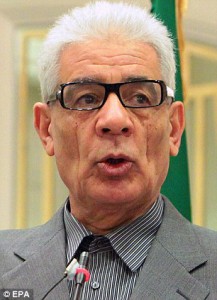 A cache of highly classified intelligence documents was recently discovered in the abandoned offices of former Libyan spy master, Foreign Minister and high-profile defector, Musa Kusa.
These documents have over the last couple of weeks provided a fascinating insight into the growing links in the last decade between the former UK Labour government, particularly Tony Blair, and the Gaddafi régime. They have displayed in oily detail the degree of toadying that the Blair government was prepared to countenance, not only to secure lucrative business contracts but also to gloss over embarrassing episodes such as Lockerbie and the false flag MI6-backed 1996 assassination plot against Gaddafi.
These documents have also apparently revealed direct involvement by MI6 in the “extraordinary rendition” to Tripoli and torture of two Libyans. Ironically it has been reported that they were wanted for being members of the Libyan Islamic Fighting Group, the very organisation that MI6 had backed in its failed 1996 coup.
The secular dictatorship of Col Gaddafi always had much to fear from Islamist extremism, so it is perhaps unsurprising that, after Blair’s notorious “deal in the desert” in 2004, the Gaddafi régime used its connections with MI6 and the CIA to hunt down its enemies. And, as we have all been endlessly told, the rules changed after 9/11…
The torture victims, one of whom is now a military commander of the rebel Libyan forces, are now considering suing the British government. Jack Straw, the Foreign Secretary at the time, has tried to shuffle off any blame, stating that he could not be expected to know everything that MI6 does.
Well, er, no — part of the job description of Foreign Secretary is indeed to oversee the work of MI6 and hold it to democratic accountability, especially about such serious policy issues as “extraordinary rendition” and torture. Such operations would indeed need the ministerial sign-off to be legal under the 1994 Intelligence Services Act.
There has been just so much hot air from the current government about how the Gibson Torture Inquiry will get to the bottom of these cases, but we all know how toothless such inquiries will be, circumscribed as they are by the terms of the Inquiries Act 2005. We also know that Sir Peter Gibson himself has for years been “embedded” within the British intelligence community and is hardly likely to hold the spies meaningfully to account.
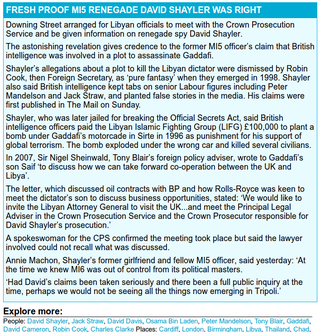 So I was particularly intrigued to hear that the the cache of documents showed the case of David Shayler, the intelligence whistleblower who revealed the 1996 Gaddafi assassination plot and went to prison twice for doing so, first in France in 1998 and then in the UK in 2002, was still a subject of discussion between the Libyan and UK governments in 2007. And, as I have written before, as late as 2009 it was obvious that this case was still used by the Libyans for leverage, certainly when it came to the tit-for-tat negotiations around case of the murder in London outside the Libyan Embassy of WPC Yvonne Fletcher in 1984.
Of course, way back in 1998, the British government was all too ready to crush the whistleblower rather than investigate the disclosures and hold the spies to account for their illegal and reckless acts. I have always felt that this was a failure of democracy, that it seriously undermined the future work and reputation of the spies themselves, and particularly that it was such a shame for the fate of the PBW (poor bloody whistleblower).
But it now appears that the British intelligence community’s sense of omnipotence and of being above the law has come back to bite them. How else explain their slide into a group-think mentality that participates in “extraordinary rendition” and torture?
One has to wonder if wily old Musa Kusa left this cache of documents behind in his abandoned offices as an “insurance policy”, just in case his defection to the UK were not to be as comfortable as he had hoped — and we now know that he soon fled to Qatar after he had been questioned about the Lockerbie case.
But whether an honest mistake or cunning power play, his actions have helped to shine a light into more dark corners of British government lies and double dealing vis a vis Libya.…
Ex-Dr Steven Lomax was last month summarily struck off from the UK register of doctors by the General Medical Council in London.
In this exceptional hearing, the GMC ruled that the former senior psychiatrist, who used to work as the Director of the Castel Hospital in Guernsey:
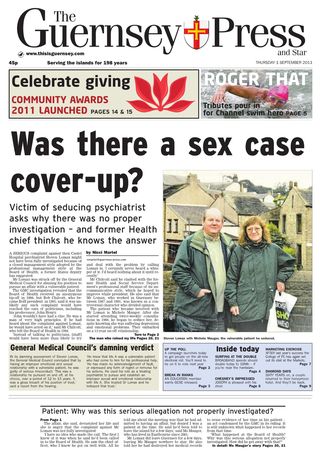
How do I know all this? The victim of this egregious abuse, Michele Mauger, is my mother.
The GMC made an exception to hear this case in the light of the severity of the abuse and the overwhelming prima facie evidence of Lomax’s guilt. Cases older than 5 years are usually not investigated. Michele’s abuse began over 23 years ago.
In a resounding condemnation, the GMC stated that he had “blatantly transgressed” the boundaries governing the doctor/patient relationship and that he had caused “irreparable damage both to the patient and her family”.
There has been some coverage in the media. Perhaps the most accurate reflection of what happened can be found in the Guernsey Press: Download Guernsey_Press_front_page, Download Guernsey_Press_Interview.
The governing body of the Guernsey hospitals, the Board of Health, would also appear to have some serious questions to answer.
Michele recently did an excellent interview on BBC Radio4: Woman’s Hour, that encapsulated the core issues around this type of professional abuse. The interview is at the beginning of the show — listen here.
Many will be aware of the controversy surrounding the death of Dr David Kelly, the world-renowned weapons inspector who was said to have blown the whistle about the “sexing-up” of the intelligence case that took our countries into the 2003 Iraq War.
 Ignoring all standard British legal requirements, there has never been an inquest into Dr Kelly’s sudden death in 2003. Subsequent government enquiries have tried to assert over the years that he committed suicide. However, a group of senior British doctors has consistently challenged these findings and stated that his death was not proved to be suicide beyond all reasonable doubt.
 The current senior legal advisor to the UK Coalition government, Attorney General Dominic Grieve, promised before last year’s election that he would consider a formal inquest into Dr Kelly’s death. However, since coming to power Grieve has retreated from that. In addition, all the evidence surrounding the death of Dr Kelly will, exceptionally, remain classified for 70 years.
The British doctors, led by Dr David Halpin, have one last chance to get to the truth. This week, they are applying for a Judicial Review of Grieve’s decision.
The legal papers need to be filed by 8th September, and the costs of this case will be at least £50,000, much of which has already been contributed by the doctors and supporters. They are asking for donations to cover the remainder. Please help if you can, spread the word to all your contacts, and ask them to make a financial pledge at this site.
My RTTV interview today about Libya, torture, and UK double-dealing:
Nothing like being paid to read a book — a win-win situation for me.
Here’s a link to my review in the Sunday Express newspaper of a new history of MI6, called “The Art of Betrayal” by Gordon Corera, the BBC’s Security Correspondent.
And here’s the article:
REVIEW: THE ART OF BETRAYAL — LIFE AND DEATH IN THE BRITISH SECRET SERVICE
Friday August 19, 2011
By Annie Machon
THE Art of Betrayal: Life and Death in the British Secret Service
Gordon Corera Weidenfeld & Nicholson, £20
THE INTRODUCTION to The Art Of Betrayal, Gordon Corera’s unofficial post-war history of MI6, raises questions about the modern relevance and ethical framework of our spies. It also provides an antidote to recent official books celebrating the centenaries of MI5 and MI6.
Corera, the BBC’s security correspondent, has enjoyed privileged access to key spy players from the past few decades and, writing in an engaging, easy style, he picks up the story of MI6 at the point where the “official” history grinds to a halt after the Second World War.
Spy geeks will enjoy the swashbuckling stories from the Cold War years and he offers an intelligent exploration of the mentality of betrayal between the West and the former Soviet Union, focusing on the notorious Philby, Penkovsky and Gordievsky cases among many others.
For the more cynical reader, this book presents some problems. Where Corera discusses the aimless years of MI6 post-Cold War attempts at reinvention, followed by the muscular, morally ambiguous post‑9/11 world, he references quotes from former top spies and official inquiries only, all of which need to be read with a healthy degree of skepticism. To use a memorable quote from the Sixties Profumo Scandal, also mentioned in the book: “Well, they would say that, wouldn’t they?”
In Corera’s view, there has always been inherent tension in MI6 between the “doers” (who believe that intelligence is there to be acted upon James Bond-style and who want to get their hands dirty with covert operations) and the “thinkers” (those who believe, à la George Smiley, that knowledge is power and should be used behind the scenes to inform official government policy).
He demonstrates that the “doers” have often been in control and the image of MI6 staffed by gung-ho, James Bond wannabes is certainly a stereotype I recognise from my years working as an intelligence officer for the sister spy organisation, MI5.
The problem, as this book reveals, is that when the action men have the cultural ascendancy within MI6 events often go badly wrong through establishment complacency, betrayal or mere enthusiastic amateurism.
That said, the opposing culture of the “thinkers”, or patient intelligence gatherers, led in the Sixties and Seventies to introspection, mole-hunting paranoia and sclerosis.
Worryingly, many former officers down the years are quoted as saying that they hoped there was a “real” spy organisation behind the apparently amateur outfit they had joined, a sentiment shared by most of my intake in the Nineties.
Nor does it appear that lessons were learned from history: the Operation Gladio débâcle in Albania and the toppling of Iran’s first democratically-elected President Mossadeq in the Fifties could have provided valuable lessons for MI6 in its work in Afghanistan, Iraq, and Libya over the past two decades.
Corera is remarkably coy about Libya despite the wealth of now publicly-available information about MI6’s meddling in the Lockerbie case, the illegal assassination plot against Gaddafiin 1996 and the dirty, MI6-brokered oil deals of the past decade.
Corera pulls together his recurring themes in the final chapters, exploring the compromise of intelligence in justifying the Iraq war, describing how the “doers” pumped unverified intelligence from unproven agents directly into the veins of Whitehall and Washington.
Many civil servants and middle-ranking spies questioned and doubted but were told to shut up and follow orders. The results are all-too tragically well known.
Corera does not, however, go far enough.
He appreciates that the global reach of MI6 maintains Britain’s place in an exclusive club of world powers. At what price, though?
Here is the question he should perhaps have asked: in light of all the mistakes, betrayals, liberties compromised, lessons unlearned and deaths, has MI6 outlived its usefulness?
Annie Machon is a former MI5 intelligence officer and author.
Verdict 4/5
Here’s the film of my talk at the recent summer school at the Centre for Investigative Journalism in London a month ago:
Many thanks to Gavin and the rest of the CIJ team for such a stimulating and thought-provoking weekend!
 It was widely reported today that a number of well-respected British lawyers and civil liberties organisations are questioning the integrity of the much-trumpeted inquiry into UK spy complicity in torture.
And about time too. One hopes this is all part of a wider strategy, not merely a defensive reaction to the usual power play on the part of the British establishment. After all, it has been apparent from the start that the whole inquiry would be questionable when it was announced that Sir Peter Gibson would be chairing the inquiry.
Gibson has certain form. He was until recently the Intelligence Services Commissioner — the very person who for the last five years has been invited into MI5, MI6 and GCHQ for cosy annual chats with carefully selected intelligence officers (ie those who won’t rock the boat), to report back to the government that democratic oversight was working wonderfully, and it was all A‑OK in the spy organisations.
After these years of happy fraternising, when his name was put forward to investigate potential criminal complicity in torture on the part of the spies, he did the publicly decent thing and resigned as Commissioner to take up the post of chair of the Torture Inquiry.
Well, we know the establishment always like a safe pair of hands.… and this safety has also been pretty much guaranteed by law for the last six years.
Ever since the Inquiries Act 2005 was pushed through as law, with relatively little press awareness or parliamentary opposition, government departments and intelligence agencies have pretty much been able to call the shots when it comes to the scope of supposedly independent inquiries.
 Interestingly, Tory grandee Sir Malcolm Rifkind, the former Foreign Secretary who now chairs the Intelligence and Security Committee, has also weighed in to the debate. On BBC Radio 4’s Today programme he stated:
“I cannot recollect an inquiry that’s been proposed to be so open as we’re having in this particular case. When was the last time the head of MI5 and the head of MI6 – the prime minister has made quite clear – can be summoned to this inquiry and be required to give evidence?”
This from the senior politician who has always denied that he was officially briefed about the illegal assassination plot against Colonel Gaddafi of Libya in 1996; this from the man who is now calling for the arming of the very same extremists to topple Gaddafi in the ongoing shambles that is the Libyan War; and this from the man who is also loudly calling for an extension of the ISC’s legal powers so that it can demand access to witnesses and documents from the spy organisations.
No doubt my head will stop spinning in a day or two.…
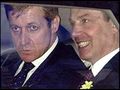 I have long suspected that Alastair Campbell, Labour’s former Director of Communications, may potentially have broken the UK’s Official Secrets Act. Now prima facie evidence is beginning to emerge that he did indeed breach the “clear bright line” against unauthorised disclosure of intelligence.
I know that the Metropolitan Police have their hands full investigating the meltdown that is the News of the World hacking scandal — and also trying to replace all those senior officers who had to resign because of it — but they do have a duty to investigate crime. And not just any old crime, in this case, but one that has potentially threatened the very basis of our national security.
Why do I say this?
 You’ll no doubt have some vague recollection that, in the run-up to the 2003 Iraq War, the British government produced a couple of reports “making a case for war”. The first, the September Dossier (2002), is the one most remembered, as this did indeed sex up the case for war, as well as include fake intelligence about Saddam Hussein trying to acquire uranium from Niger. Most memorably it led to the “Brits 45 minutes from Doom” front-page headline in Rupert Murdoch’s The Sun newspaper, no less, on the eve of the crucial war vote in Parliament.
There was also the notorious leaked Downing Street Memo, where the then-head of MI6, Sir Richard Dearlove ©, was minuted as saying that the intelligence and facts were being fitted around the [predetermined war] policy.
However, for the purposes of a possible Regina v. Campbell day in court, it is the second report that requires our attention.
It was published in February 2003, just before “shock and awe” was launched to liberate the grateful Iraqi people. This report became known as the “Dodgy Dossier”, as it was largely lifted from a 12 year old PhD thesis that the spin doctors had found on the internet. However, it also included nuggets of brand-new and unassessed intelligence from MI6. Indeed, even the toothless Intelligence and Security Committee in Parliament stated in paragraph 82 of its 2002–2003 Annual Report ( Download ISC_2003) that:
“We believe that material produced by the [intelligence] Agencies can be used in publications and attributed appropriately, but it is imperative that the Agencies are consulted before any of their material is published. This process was not followed when a second document was produced in February 2003. Although the document did contain some intelligence-derived material it was not clearly attributed or highlighted amongst the other material, nor was it checked with the Agency providing the intelligence or cleared by the JIC prior to publication. We have been assured that systems have now been put in place to ensure that this cannot happen again, in that the JIC Chairman endorses any material on behalf of the intelligence community prior to publication.”
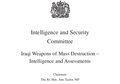 At the time it was reported that Blair and Campbell had spontaneously distributed this report to journalists travelling with them on a tour of the Far East. The ISC confirmed that the intelligence had been passed to journalists without the permission of MI6 in its September 2003 special report — “Iraq Weapons of Mass Destruction: Intelligence and Assessments” (see pars 131 to 134):
“The document was originally given to a number of journalists over the weekend of
1 and 2 February and then placed in the Library of the House on 3 February. The Prime
Minister described the document as follows:
“We issued further intelligence over the weekend about the infrastructure of
concealment. It is obviously difficult when we publish intelligence reports, but I hope
that people have some sense of the integrity of our security services. They are not
publishing this, or giving us this information, and making it up. It is the intelligence
that they are receiving, and we are passing on to people. In the dossier that we
published last year, and again in the material that we put out over the weekend, it is
very clear that a vast amount of concealment and deception is going on.”
“Conclusions:
“The Committee took evidence on this matter from the Chief of the SIS on both
12 February and 17 July and separately from Alastair Campbell on 17 July. Both agreed
that making the document public without consulting the SIS or the JIC Chairman was
a “cock-up”. Alastair Campbell confirmed that, once he became aware that the
provenance of the document was being questioned because of the inclusion of
Dr Al-Marashi’s work without attribution, he telephoned both the Chief of the SIS and
the JIC Chairman to apologise.
“We conclude that the Prime Minister was correct to describe the document as
containing “further intelligence… about the infrastructure of concealment.… It is the
intelligence that they [the Agencies] are receiving, and we are passing on to people.”
“However, as we previously concluded, it was a mistake not to consult the
Agencies before their material was put in the public domain. In evidence to us the
Prime Minister agreed. We have reported the assurance that we have been given
that in future the JIC Chairman will check all intelligence-derived material on
behalf of the intelligence community prior to publication.”
 Crucially, Blair and Campbell had jumped the (old Iraqi super-) gun by issuing this information, but Campbell seems to have got away with it by describing such a breach of the OSA as a “cock-up”. Or perhaps just another precipitous “rush of blood to the head” on his part, as recently described in the long-suppressed testimony of SIS2 revealed around the Chilcot Enquiry and reported in The Guardian:
“Papers released by the Chilcot inquiry into the war show that an MI6 officer, identified only as SIS2, had regular contacts with Campbell: “We found Alastair Campbell, I think, an enthusiastic individual, but also somewhat of an unguided missile.” He added: “We also, I think, suffered from his propensity to have rushes of blood to the head and pass various stories and information to journalists without appropriate prior consultation” (my emphasis).
So why do I suggest that Campbell could be liable for prosecution? It appears that he was a “notified person” for the purposes of Section 1(1) of the OSA. While not employed by the intelligence agencies, notified persons have regular access to intelligence material and are subjected to the highest clearance — developed vetting — in the same way as the full-time spooks. As such, they are also bound by the law against disclosure of such material without the prior written permission of the head of the agency whose intelligence they want to disseminate. There is no room for manœuvre, no damage assessment, and no public interest defence. The law is clear.
And a report in today’s Telegraph about Andy Coulson and the phone-hacking scandal seems to show clearly that Campbell was just such a notified person:
“Unlike Alastair Campbell and other previous holders of the Downing Street communications director role, Mr Coulson was not cleared to see secret intelligence reports and so was spared the most detailed scrutiny of his background and personal life.….
“The only people who will be subject to developed vetting are those who are working in security matters regularly and would need to have that sort of information.
“The only special advisers that would have developed vetting would be in the Foreign Office, Ministry of Defence and maybe the Home Office. Andy Coulson’s role was different to Alastair Campbell’s and Jonathan Powell.
“Alastair Campbell could instruct civil servants. This is why [Coulson] wasn’t necessarily cleared. Given [the nature of] Andy Coulson’s role as more strategic he wouldn’t have necessarily have been subject to developed vetting.”
So it would appear that Alastair Campbell is bang to rights for a breach of the Official Secrets Act under Section 1(1). He released new, unassessed and uncleared MI6 intelligence within the dodgy dossier. This is not just some technical infraction of the law — although even if it were, he would still have a case to answer.
 No, this report led inexorably to our country going to war against Iraq, shoulder to shoulder with the US, and the resulting deaths, maimings, poisonings and displacement of millions of innocent Iraqi people. It has also directly increased the terrorist threat to the UK, as Tony Blair was officially warned pre-Iraq war by the then-head of MI5, Eliza Manningham-Buller. With the dodgy dossier, Campbell has directly harmed countless lives and our national security.
Of course, many of us might fantasise about warmongers getting their just deserts in The Hague. But perhaps the OSA could prove to be Al Campbell’s Al Capone-style tax evasion moment.
Now, what about The Right Honourable Tony Blair?
 The quangocrats charged with overseeing the legality of the work of the UK spies have each produced their undoubtably authoritative reports for 2010.
Sir Paul Kennedy, the commissioner responsible for overseeing the interception of communications, and Sir Peter Gibson, the intelligence services commissioner, both published their reports last week.
Gibson has, of course, honourably now stood down from his 5‑year oversight of MI5, MI6, and GCHQ in order to head up the independent enquiry into spy complicity in torture.
And both the reports say, naturally, that it’s all hunky-dorey. Yes, there were a few mistakes (well, admistrative errors — 1061 over the last year), but the commissioners are confident that these were neither malign in intent nor an indication of institutional failings.
So it appears that the UK spies gained a B+ for their surveillance work last year.
Both commissioners pad out their reports with long-winded descriptions of what precisely their role is, what powers they have, and the full, frank and open access they had to the intelligence officers in the key agencies.
They seem sublimely unaware that when they visit the spy agencies, they are only given access to the staff that the agencies are happy for them to meet — intelligence officers pushed into the room, primped out in their party best and scrubbed behind the ears — to tell them what they want to hear.
Any intelligence officers who might have concerns have, in the past, been rigorously banned from meeting those charged with holding the spies to democratic account.….
.…which is not much different from the oversight model employed when government ministers, the notional political masters of MI6, MI6 and GCHQ, sign off on bugging warrants that allow the aggressive investigation of targets (ie their phones, their homes or cars, or follow them around). Then the ministers are only given a summary of a summary of a summary, an application that has been titrated through many managerial, legal and civil service filters before landing on their desks.
So, how on earth are these ministers able to make a true evaluation of the worth of such an application to bug someone?
They just have to trust what the spies tell them — as do the commissioners.