Canadian Speaking Tour, May 2009
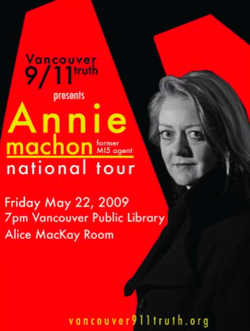 On 22 May I shall be starting my very own national speaking tour in Canada. Following my visit to California last year, the Canadian 9/11 Truth groups have pulled together a 7‑event tour, where I will have the chance to discuss the intelligence world, whistleblowing, going on the run and the issue of 9/11, particularly focusing on its repercussions around the world: the endless “war on terror”, the illegal wars in the Middle East, and the erosion of our democracies in the West.
The Canadian Truth Movement tirelessly campaigns for a new, independent inquiry in the tragic events of 9/11, and has in the past hosted speakers such as Professor David Ray Griffin and architect Richard Gage.
More information about the tour can be obtained from: directors@vancouver911truth.org or elizwood@shaw.ca. See you there!
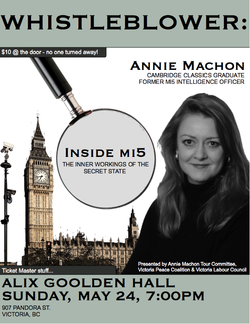
Tour dates:
Friday 22 May — Vancouver
Sunday 24 May — Victoria
Wednesday 27 May — Ottawa
Thursday 28 May —
Montréal
Saturday 30 May — Toronto
Sunday 31 May — Waterloo
Monday 1 June — Hamilton
Agent Names Lost
So the good times keep on rolling for the spook community in the UK. An officer of the Serious Organised Crime Agency (SOCA) apparently lost top secret information such as the names of undercover agents while travelling in Ecuador.
 SOCA is a relatively new agency set up in 2004 to police organised crime, particularly that revolving around the illegal drug trade. The agency has the misfortune to have as Chairman Stephen Lander, erstwhile boss of MI5; a man whose management style was known as “Stalinesque”.
Even before this latest blunder, concerns had been raised by SOCA staff about ineffective and top-heavy management (shades of MI5 in the 1990s)and recent questions have been asked about whether the agency was producing meaningful results, as the price of illicit drugs has plummeted on UK streets, indicating a glut of recent imports.
This latest blunder will hardly have reassured ministers. Reportedly, the hapless SOCA officer lost a USB stick containing the names of undercover agents involved in the drug war in Ecuador, as well as information relating to 5 years’ worth of investigations. The blunder has reportedly jeopardised operations that have cost in the region of £100 million.
Agent identities are, rightly, the most protected of secret information. This is an unforgivable gaff, and yet the officer is apparently only facing “disciplinary charges”.
So, if you are a whistleblower exposing heinous spy crimes, you are put on trial and sent to prison, even if the trial judge acknowledges that no lives were ever put at risk through your disclosures. However, if you carelessly leave top secret agent information lying around in hostile territory, you don’t even get the sack, let alone face prosecution under the Official Secrets Act.
I would suggest that the next intelligence whistleblower to emerge from the shadows should simply claim to have dropped a USB stick outside the offices of a national newspaper. A rap over the knuckles will then be the worst that they face!
Deja Vu
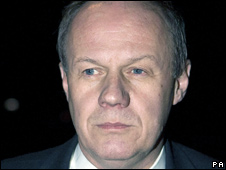 I had a strong sense of déjà vu today, when I read about the woes of Mrs Green, the barrister wife of Tory MP Damien Green who was arrested last November for allegedly encouraging government information leaks.
Mr Green was arrested under an obscure and antique piece of legislation for “conspiring to commit misconduct in a public office and aiding and abetting, counselling or procuring misconduct in a public office”. This, despite the fact that civil service mandarins had persuaded the Metropolitan Police Special Branch (MPSB) to investigate him because he posed a “serious threat to national security”. The case has now been dropped and reports have now shown that these civil servants significantly overstated the case to spur the police into action.
In such a case the obvious step would have been for the Met to have invoked the draconian 1989 Official Secrets Act. Certainly their heavy-handed response seemed to indicate that this was how they were viewing the gravity of the case, even if they were desperately trying to avoid the attendant scandal such a step would have provoked. Special Branch officers in the Counter-Terrorism squad are not normally sent to rip apart people’s houses for minor offences.
Which takes me back to the interview with the outraged Mrs Green. A barrister specialising in highly confidential child abuse cases, she innocently let the secret police enter her home, only to watch in disbelief as they ripped it apart in what sounds to me like a counter-terrorism style search. They, of course, found nothing relevant to their investigation, but scoured the computers, removed the bedsheets, took away love letters between the Greens, and even rifled through the children’s books.
I suppose I was more fortunate than the hapless Mrs Green. When the secret police ripped apart my home in the same way back in 1997, I was in Europe with my ex-partner and colleague, MI5 whistleblower David Shayler. After we had exposed the fact that MI5 was shamelessly breaking the law, the MPSB had obtained a warrant that allowed them to search our home for material relating to our employment in MI5. As I was away, they jackhammered the front door in, and then spent two days ripping through the flat in Pimlico. It had been my home for 4 years.
Naturally, the police found nothing relevant. That did not deter them from searching the place for two days, and taking away bags of possessions, including some of my underwear, the bedsheets, photographs, and our love letters. They also smashed up chairs and lamps, ripped the bath apart, pulled up the carpets, and scattered my remaining underwear across the bedroom floor. It looked like they had been playing with it.
I saw all this when I returned home a month later, and I felt violated. I know this is a common reaction when one’s home is burgled; but in this case my home had been despoiled by the police, not by criminals. No doubt, some would say that we, and the Greens, deserved this treatment. After all, we had the temerity to expose malpractice, lies, and crime within government circles. We, of course, would argue that we had acted for the public good.
Whatever. I still think that a counter-terrorism style search of a whistleblower’s house is over the top and deliberately intimidatory.
The police may have ransacked my home, but I was never charged with any offence. Nor did I ever did get my underwear or love letters back.….
Quick to Miss a Trick
 Former Assistant Commissioner of Special Operations at the Metropolitan Police, Bob Quick, has hit the headlines a couple of times in the last few months — for all the wrong reasons.
Last November he authorised the arrest of Tory MP Damien Green for allegedly encouraging leaks of sensitive government information. This had the knock-on benefit of waking MPs up to the fact that we are now living in a de facto police state. Well, I suppose that must have been a welcome distraction for them. It must be so dull merely to spend your time devising new and ingenious ways of fiddling your parliamentary expenses.
This week, Quick was photographed entering Downing Street with highly classified documents under his arm about a sensitive UK terrorist investigation, which were clearly visible to waiting photographers. The clearly visible “Secret” briefing document detailed an MI5-led operation, codenamed Pathway, and bounced the counter-terrorism agencies into making premature arrests of the suspects, many of them young Pakistanis in the UK on student visas.
Outrage followed this massive security lapse. What on earth was the man doing, openly carrying secret documents? Protective rules dictate that such papers are not allowed outside HQ unless signed out and in a security briefcase. The voluntary press censorship committee, the Defence, Press and Broadcasting Advisory Committee, has slapped a ‘D’ Notice all over the story. Quick has, of course, resigned. Reportedly, he may even (gasp) face disciplinary proceedings within the Met.
Is it just me, or people missing a trick here? This man has disclosed a highly classified intelligence document without permission. In addition, this document contained information about an ongoing operation AND the names of senior intelligence officers — according to MI5 lore two of the most damaging types of information that could possibly be disclosed. So, why is Quick not facing prosecution under the draconian 1989 Official Secrets Act? He clearly falls under Section 1(1) of the Act as a notified person if he is handling Secret documents:
1(1) A person who is or has been—
(a) a member of the security and intelligence services; or
(b) a person notified that he is subject to the provisions of this subsection,
is guilty of an offence if without lawful authority he discloses any information, document or other article relating to security or intelligence which is or has been in his possession by virtue of his position as a member of any of those services or in the course of his work while the notification is or was in force.
Under these provisions, there is no real defence under law. Legal precedent in recent OSA trials has clearly established that the reason for an unauthorised disclosure of secrets is irrelevant. (The theoretical and untested subsequent defence of “necessity” has no bearing on this particular case.) Whether the breach occurs due to principled whistleblowing or a mistake doesn’t matter: the clear bright line against disclosure has been crossed and prosecution inexorably follows.
Except if you have sufficiently seniority, it appears.….
The Real Reason for the Police State?
 I haven’t written here for a while, despite the embarras de richesses that has been presented to us in the news recently: Dame Stella saying that the UK is becoming a police state; drones will patrol the streets of Britain, watching our every move; databases are being built, containing all our electronic communications; ditto all our travel movements. What can a lone blogger usefully add to this? Only so much hot air — the facts speak for themselves.
Plus, I’ve been a bit caught up over the last couple of months with Operation Escape Pod. Not all of us are sitting around waiting for the prison gates to clang shut on the UK. I’m outta here!
But I can’t resist an interesting article in The Spectator magazine this week. And that’s a sentence I never thought I would write in my life.
Tim Shipman, quoting a plethora of anonymous intelligence sources and former spooks, asserts that Britain’s foreign policy is being skewed by the need to placate our intelligence allies, and that the CIA is roaming free in the wilds of Yorkshire.
His sources tell him that the UK is a “swamp” of Islamic extremism, and that the domestic spies are terrified that there will be a new terrorist atrocity, probably against US interests but it could be anywhere, carried out by our very own home-grown terrorists. According to Shipman, this terrible prospect had all the spooks busily downing trebles in the bars around Vauxhall Cross in the wake of the Mumbai bombings.
Apart from the suggestion that the spies’ drinking culture appears to be as robust as ever, I find this interesting because well-sourced spook spin is more likely to appear in the august pages of The Speccie than in, say, Red Pepper. But if this is an accurate reflection of the thinking of our politicians and intelligence community, then this is an extremely worrying development. It goes a long way to explaining why the UK has become the most policed state in the Western world.
Yes, in the 1990s the UK practised a strategy of appeasement towards Islamic extremists. MI5’s view was always that it was better to give radicals a safe haven in the UK, which they would then be loathe to attack directly, and where a close eye could be kept on them.
This, of course, was derailed by Blair’s Messianic mission in the Middle East. By unilaterally supporting Bush’s adventurism in Afghanistan and Iraq, in the teeth of stark warnings about the attendant risks from the head of MI5, Britain has become “the enemy” in the eyes of radical Islam. The gloves are off, and we are all at greater risk because of our former PM’s hubris.
But now we apparently have free-range CIA officers infiltrating the Muslim communities of the UK. No doubt Mossad is also again secretly tolerated, despite the fact that they had been banned for years from operating in the UK because they were too unpredictable (a civil service euphemism for violent).
And I am willing to bet that this international perception that UK spooks will be caught off-guard by an apparently British-originated terrorist attack is the reason for the slew of new totalitarian laws that are making us all suspects. The drones, the datamining and the draconian stop-and-search laws are designed to reassure our invaluable allies in the CIA, Mossad, ISI and the FSB. They will not be put in place to “protect” us.
MPs object to police state
 An interesting political row has erupted this week in the UK about the arrest of the opposition Tory MP, Damien Green, who is also the Shadow Minister for Immigration. He was arrested on Thursday for alleged breaches of an obscure common law “aiding and abetting misconduct in public office”.
Reports indicate that the Metropolitan Police Special Branch, or as the newspapers would have it the “anti-terrorism branch” was called in to investigate leaks from the Home Office about immigration policy, that Green was using these leaks to score points off the government, and the Home Secretary Jacqui Smith in particular.
Naturally, MPs from both sides of the House have been frothing at the mouth: how dare Plod embarrass an MP by arresting him without warning and by conducting co-ordinated searches of his homes and offices in both Kent and London? Newspapers, particularly on the right of the political spectrum, have been full of headlines saying that this is proof that we are living in a police state.
While I have some sympathy for the beleaguered Mr Green, having also been hauled off by the Met Special Branch and quizzed for hours for discussing sensitive information that was very much in the public interest, as well as seeing my home ripped apart in a co-ordinated counter-terrorism style raid and seen friends arrested in co-ordinated dawn raids, I am still aghast at the hypocrisy of both the politicians’ and media’s reaction.
Many of us are already all to painfully aware that we live in a de facto police state. Under the notorious Section 44 of the 2000 Terrorism Act, we can all be stopped and searched for no reason — and can even be arrested purely so that a bobby on the beat can ascertain our identity. Notices to this effect are now helpfully pinned up outside most tube stations in London. Thousands of people are subject to this across the UK every year on the streets of Britain.
But other points rather leap to my attention from the coverage of this case. If MPs don’t like the heavy-handed use and abuse of police powers, why did they pass these laws in the first place? Did they not think through the implications? Or do they think that, as MPs, they are somehow above the laws of this land?
Plus, senior MPs are arguing that the use of leaks from disgruntled civil servants is a time-honoured way for HM Opposition in Parliament to hold the government to account. Well, that might be good for the MPs’ parliamentary careers, but what of the hapless and frequently brave souls within the Civil Service who face 2 years in prison for such leaks if they are convicted of a breach of the 1989 Official Secrets Act? And, of course, there is no legal defense under the OSA of having acted “in the public interest” — the very argument that MPs are using to justify Green’s exposure of Home Office cover-ups and incompetence.
As far as I can see, there have been no comments from either journalists or MPs about the fate of the source. The most I could find was the following in the Daily Telegraph:
“An alleged “whistleblower”, thought to be a male Home Office official was arrested 10 days ago.”
Either that means that journalists and MPs couldn’t give a toss about the fate of this person — after all, an MP’s career is far more important — or that any reporting of the arrest of the whistleblower has been injuncted in the media to the nth degree. This would be even more troubling, as someone can just be “disappeared” into a Kafka-esque legal nightmare.
9/11 Hero in London
 Last week 9/11 hero William Rodriguez was back in London, speaking at the Global Peace and Unity Conference in London’s Docklands. William is invited every year, and addressed an audience of thousands last Sunday.
William was the last survivor to leave the Twin Towers on 9/11. He survived being buried alive by the collapsing North Tower after he ran from the building and dived under a firetruck. After he was pulled from the rubble, miraculously with few injuries, he was immediately interviewed by CNN, before returning to help with the rescue effort. Since then, he has become a spokesperson for the families of the victims and the survivors.
William is recognised in America as a national hero. He had one of the few master keys to the WTC complex, and repeatedly re-entered the North Tower after the attacks to unlock security doors and help the firefighters rescue trapped people. For his bravery he has been recognised at the White House.
He was instrumental in lobbying for the 9/11 Enquiry and, when the commission failed to address a wide range of evidence and questions from the survivors, eyewitnesses and families, he began campaigning for a new, independent enquiry on behalf of these groups.
He now travels the world doing interviews, meeting politicians and heads of state, and recounting his amazing story of survival and hope. He also campaigns against the overt politicisation of the 9/11 tragedy, which has been used and abused by governments to justify the wars in the Middle East, the unending war of terror, and the resulting roll-back of our freedoms and civil liberties. His is an amazing story and acts as an inspiration to many people.
Over the last 2 years I’ve organised three national and international speaking tours for him across the UK and much of Europe — sadly not yet reaching Ireland despite reports to the contrary! — and his experience has touched thousands of people, both at the events themselves and via the extensive media coverage he has received. On this visit to London I arranged interviews for him on Sky News and Press TV.
The Elephant in the Room
 In September an award-winning independent documentary, “The Elephant in the Room” was screened at the Portobello Film Festival in London.
The film, made by British director Dean Puckett, had already won “Best Documentary” at the London Independent Film Festival earlier this year. At Portobello, Dean won the “Best Director” award.
The film documents Dean’s personal journey and response to the tragic events of 9/11. In October 2001 he visited New York with his father, who was running in the marathon. As a budding 19 year old film maker, Dean recorded images of the traumatised city and his personal response to the events, and includes this early footage in the film.
He then goes on to meet activists in the UK and Europe who question the official account, and interview 9/11 hero William Rodriguez and US Presidential candidate Cynthia McKinney, amongst others. He also deals sensitively with the first responders who are ill and dying because the US government lied about the safety of the air in NYC after the attacks. These people are generally ignored and given little help or support.
I helped Dean in some sections of the film, and he accompanied William Rodriguez on the European leg of the speaking tour I organised for him last year — I’m chuffed to have an “Assistant Producer” credit!
The film can be downloaded and watched here.
Talks in California, September 2008
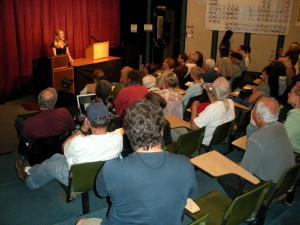 In September I was invited over to California to give two talks about intelligence, whistleblowing, and 9/11 and its impact on the world. I focused on the erosion of our traditional freedoms and basic civil liberties
Two meetings were organised for me in Marin, San Fransisco, and Davis by the Californian 9/11 movement. They were great meetings — packed out — and the response was brilliant. It’s heartening that so many people care about these issues, and the adverse impact the “war on terror” is having, not just on the lives of people in the Middle East wars, but also on our way of life in the West.
Two men in black, apparently carrying handcuffs, turned up at the meeting in Marin, sat at the back and spent much of the time muttering into their mobiles during the talk. At the end, while everyone was clapping, they sat with their arms crossed, glowering at me, and for one mad moment I thought they were going to haul me off for talking in public about dangerous notions such as democracy, civil rights and peace.
Anyway, thank you to all who made this possible, particularly Gabriel, Kevin, and Byron. And thanks also to Ken, Hummux and the team for filming the talk in Marin. DVDs of the talk can be obtained here.
Here’s the talk in Marin:
Echelon and the Special Relationship
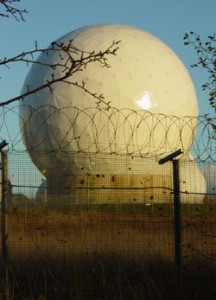 Journalist and writer James Bamford, has a new book, “The Shadow Factory: The Ultra-Secret NSA from 9/11 to the Eavesdropping on America” (Doubleday), which came out this week in the United States.
Bamford is a former producer at ABC News of thirty years’ standing, and his book has caused quite a stir. One of his key gripes is the fact that foreign companies try to acquire work in sensitive US departments. He cites in particular the attempt in 2006 of Israeli data security company, Check Point Software Technologies, to buy an American company with existing contracts at the Defence Department and the NSA. This deal was stopped after the FBI objected.
Foreign software and security companies working within intelligence agencies are indeed a problem for any country. It compromises the very notion of national sovereignty. In the UK, MI5 and many other government departments rely on proprietary software from companies like Microsoft, notorious for their vulnerability to hackers, viruses and back door access. Should our nation’s secrets really be exposed to such easily avoidable vulnerabilities?
Another section of the book to have hit the headlines is Bamford’s claims that bedroom “conversations” of soldiers, journalists and officials in Iraq have been bugged by the National Security Agency (NSA).
Bamford, who is by no means a fan of the NSA in its current rampant form, makes the mistake of thinking that in the innocent days pre‑9/11, the agency respected democratic rights enshrined in the US constitution and never snooped on US citizens in their own country.
While technically this might be true, does nobody remember the ECHELON system?
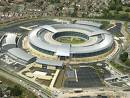 ECHELON was an agreement between the NSA and its British equivalent GCHQ (as well as the agencies of Canada, Australia, and New Zealand) whereby they shared information they gathered on each others’ citizens. GCHQ could legally eavesdrop on people outside the UK without a warrant, so they could target US citizens of interest, then pass the product over to the NSA. The NSA then did the same for GCHQ. Thus both agencies could evade any democratic oversight and accountability, and still get the intelligence they wanted.
Special relationship, anyone?
Ethics Talk at a School
Earlier this month I was invited back to the Bishops Stortford High School to do a talk for its Ethics and Citizenship Course. This is a new, mandatory part of the national curriculum, and a good thing too.
I spoke about the role of a whistleblower in a democratic society, and also about the erosion of our democratic freedoms. About 300 pupils attended, and the response was fantastic, with many interesting and intelligent questions. And so there should be — this is the generation that will have to deal with the mess we are making of our civil liberties in this country.
Singularity Society
And so to my first transhumanist meeting recently. No, this is not some kinky practice imported from Holland. Transhumanism is the study of the impact of developing technologies on the human – the eradication of genetically inherited diseases, increased longevity, augmentation and mental enhancement.
I’ve been introduced to the implications of cutting edge technology over the last year – and it’s been a bit of a culture shock for a classicist. But as technology develops faster and faster, probably leading to a “singularity” where artificial intelligence develops exponentially and humans cannot keep up, we all need to start factoring this in to how we see the world changing in the next 20 – 30 years.
 The vast majority of us think that the current political and economic frameworks will continue in pretty much the same format, with the odd war and recession, in the foreseeable future. Few of us factor in the seismic shift that is looming. We worry about the credit crunch, the price of food and fuel, Big Brother (alas, generally the TV show, not the deteriorating social contract between governments and the governed), and the wars. But what will happen if we wake up one day to find that we as a species are no longer the número uno intelligence on the planet?
This need not be dystopic. We may suddenly find enduring problems for humanity – including the biggies like war, plague and famine — are eradicated. And we could see an advance in biotech that will lead to healthier and longer lives for all of us.
But one stray thought keeps recurring to me: the great MI5 is apparently failing to see the implications. What will happen to their 100-year non-disclosure rule when we all live to be 150? Will we finally get to see our files? My betting is that they will suddenly find urgent national security reasons to extend the secrecy time frame.….
RSC Play about the Shayler Case
 In London in 2001 the Royal Shakespeare Company performed a play called “Epitaph for the Official Secrets Act” by Paul Greengrass (who co-wrote the notorious book “Spycatcher”). The play focused on the political issues around whistleblowing and the Shayler case.
It was an excellent play, with an intelligent analysis of the current mess that is secrecy legislation in the UK, but it was rather strange to see actors using words your own words on stage.
The following report appeared in “The Observer”:
Shayler is a model spy for MI5 play
by Vanessa Thorpe, Arts Correspondent, 2001
Henry V, Macbeth and Hamlet, the great
Shakespearean protagonists who strut before audiences at
Stratford-upon-Avon, are to be joined tomorrow by a new name, the
former MI5 renegade, David Shayler.
A new play by Paul Greengrass, the screenwriter responsible for ITV’s
upcoming film about Bloody Sunday and for the award-winning television
dramatisation of The Murder of Stephen Lawrence , is to be premiered
tomorrow night by the Royal Shakespeare Company.
Epitaph
for the Official Secrets Act will also feature Shayler’s girlfriend,
Annie Machon, and the MI5’s first woman director, Stella Rimington. ‘It
is a play about the year that MI5 first decided to recruit a new sort
of agent,’ explained Simon Reade, the RSC’s dramaturge, referring to
1991, when the secret service briefly turned away from their
established Oxbridge source of graduates and advertised for applicants
from the wider population.
‘The play starts with a
reading of the advertisement that newspapers ran at the time,’ said
Reade, who developed the piece with Greengrass for its six-night run.
‘The ad showed an empty chair under the words “Godot isn’t coming”.’
The play then deals with some of the changes that followed as Rimington
took control of an organisation that was fighting to redefine itself.
Machon and Shayler, both from the graduate intake that was then new, are identified only by their first names.
News of their theatrical debut came as a shock to Shayler and Machon,
who are in London awaiting Shayler’s trial on charges of breaching the
Official Secrets Act. Machon said: ‘It is rather alarming to find that
we are both going to played by actors.’